

2026 Updated Verified AP-212 Downloadable Printable Exam Dumps
The Ultimate Salesforce AP-212 Dumps PDF Review
NEW QUESTION # 33
A Loyalty Management Consultant recently created a new analytics app, but users cannot access the app.
Which two statement correctly describes how to grant proper access on the user details page
- A. Assign user access to the analytics for Loyalty role.
- B. Assign the user the analytics profile for analytics for Loyalty.
- C. Assign user access to permission sets for analytics for Loyalty.
- D. Assign access by checking CRM Analytics plus user
Answer: A,C
Explanation:
To enable users to access a new analytics app, it's crucial to assign them the appropriate roles and permission sets. Assigning user access to the analytics for Loyalty role ensures that users are granted the necessary permissions to view and interact with the Loyalty analytics content. This role is designed to encompass the permissions required for accessing and analyzing Loyalty-specific data.
Additionally, assigning user access to permission sets for analytics for Loyalty is an effective way to provide access. Permission sets offer a flexible and granular approach to managing user permissions, allowing Administrators to specify the exact capabilities each user should have within the analytics app. This method ensures that users have access to the appropriate analytics tools and data relevant to their roles and responsibilities within the Loyalty program.
NEW QUESTION # 34
What is a business use case for integrating Marketing Cloud Personalization with Loyalty Management?
- A. To enable the purchasing of products and take payment.
- B. To create unified profile from multiple source of truth and build a golden record.
- C. To offer promotions in real-time to customers.
- D. To be able to send personalized marketing emails in batches.
Answer: C
Explanation:
Integrating Marketing Cloud Personalization with Loyalty Management serves the crucial business use case of offering real-time promotions to customers. This integration allows for the dynamic presentation of personalized offers and promotions to loyalty members based on their current interactions, preferences, and loyalty status. By leveraging real-time data and personalized content, businesses can enhance customer engagement, encourage repeat purchases, and foster a deeper connection with their brand, ultimately driving loyalty program success and customer satisfaction.
NEW QUESTION # 35
A company has recently rolled out a Loyalty Program with three tiers. The company decided to offer personalized benefits based on customer behavior.
How will the personalized benefits be display for each Loyalty Program member?
- A. On the Transaction Journal Related List, Linked to Loyalty Program Member
- B. On the Voucher Related List, linked to Loyalty Program member
- C. On the Loyalty Member Tier Benefit Related List, linked to Loyalty Program Member
- D. On the Member Benefit Related List, linked to Loyalty Program Member
Answer: D
Explanation:
Personalized benefits for each Loyalty Program member can be displayed On the Member Benefit Related List, linked to Loyalty Program Member (B). This related list can be configured on the Loyalty Program Member page layout to show the specific benefits that a member is entitled to, based on their tier and personalized criteria. This setup allows for a clear and organized display of benefits, making it easy for members and administrators to understand the perks associated with each member's status.
NEW QUESTION # 36
Universal Containers has created a new Loyalty Member Portal for a second Loyalty Program that they have recently launched. A member of the first program has enrolled in the second program and has decided to use the same login for both Loyalty Member Portals. The user cannot access the new Loyalty Member Portal.
How can the Loyalty Administrator verify why the user cannot access the second Loyalty Member Portal?
- A. Create a new user and new profile for the member.
- B. Check if the user has been assigned the Sharing Set for the Second Loyalty Member Portal.
- C. Through Workspaces, check if the user profile has access to the new portal.
Answer: C
Explanation:
When a user cannot access a Loyalty Member Portal, the Loyalty Administrator can verify the issue by checking if the user profile has access to the new portal1. This can be done through Workspaces1. The Salesforce admin enables Loyalty Management in the org and users can create profiles and assign permissions to access the loyalty application as appropriate2. If the user profile does not have the necessary permissions, they will not be able to access the portal12. Therefore, it's important to ensure that the user profile has the correct permissions for the new Loyalty Member Portal12.
NEW QUESTION # 37
The Loyalty Administrator for Northern Trail Outfitters (NTO) defines Basic and Premium as the two Tiers for its Insider program. They want to define a free product sample for all members in Premium Tier.
How does NTO configure tiers within the Loyalty Program to give vouchers for members in the Premium Tier?
- A. Voucher Management and Benefit Action
- B. Voucher Management; Benefits Setup (in Program console); Benefit Action to process benefits
- C. Voucher Management; Benefits Setup (in Program console); Benefit Action to define downstream actions and FLOW - Benefit action for orchestration
- D. Voucher Management and Benefits Setup
Answer: C
Explanation:
To configure tiers within the Loyalty Program at Northern Trail Outfitters (NTO) for giving vouchers to members in the Premium Tier, the configuration involves Voucher Management; Benefits Setup (in Program console); Benefit Action to define downstream actions and FLOW - Benefit action for orchestration (C). This comprehensive approach allows for the creation and management of vouchers as benefits associated with the Premium Tier, the setup of these benefits within the Loyalty Program console to specify the conditions and entitlements, and the use of Salesforce Flow for orchestrating the process of issuing vouchers to qualifying members.
This method ensures that vouchers are systematically managed, associated with the correct tier and member eligibility criteria, and efficiently distributed to members through automated processes, enhancing the value and appeal of the Premium Tier.
Salesforce documentation on Loyalty Management would detail the steps for setting up and managing tier-based benefits, including the use of Voucher Management and Flow for effective benefit administration and member engagement.
NEW QUESTION # 38
In which two scenarios should an Administrator use member engagement attributes?
- A. Member is eligible for 'Bonus days" if the member constantly speeds more than $500 each month for a year.
- B. Member attends three trainings between March 1st and April 30th to get 200 bonus points.
- C. Member buys apparel online and gets 400 bonus points if the member belongs to Gold Tier only.
- D. Member enrolls in "welcome aboard" promotion for free surprise gift every quarter.
Answer: A,B
Explanation:
In Salesforce Loyalty Management, member engagement attributes are used to track and reward customer behaviors that are not directly tied to transactions. In the scenarios provided:
* Member is eligible for 'Bonus days" if the member constantly spends more than $500 each month for a year (A): This scenario is ideal for using member engagement attributes to track consistent high spending over a year. The attributes can be used to monitor monthly spending and, once the criteria are
* met, trigger the bonus days reward.
* Member attends three trainings between March 1st and April 30th to get 200 bonus points (B): This is another perfect use case for member engagement attributes. The attributes can be set to track participation in specific events (like training sessions) and award points when the member meets the attendance requirement.
* Member buys apparel online and gets 400 bonus points if the member belongs to Gold Tier only (C):
This scenario is more about transactional behavior combined with tier status, which might not necessarily require the use of engagement attributes. Instead, this could be managed through regular transactional rules and tier benefits.
* Member enrolls in "welcome aboard" promotion for free surprise gift every quarter (D): While engagement attributes could potentially track enrollment in promotions, this scenario seems more straightforward and could be managed through the promotion and voucher functionalities in Salesforce Loyalty Management without the need for engagement attributes.
Engagement attributes are particularly useful for tracking non-purchase behaviors and engagements, providing a flexible tool to reward members for a wide range of activities, enhancing their loyalty and engagement with the program. The Salesforce Loyalty Management documentation provides extensive guidance on configuring and using member engagement attributes effectively.
NEW QUESTION # 39
A sports clothing and accessories retailer has a strategic partnership with other businesses that provide sports equipment and outdoor sports experiences. This retailer wants its Loyalty program members to be able to redeem their points when shopping with its redemption partners.
When creating a Loyalty Program partner record, how should an Administrator set up the partners in the Loyalty management application?
- A. Set the program partner type to accrual > Activate > Define the redemption cost per unit
- B. Set the program partner type to both > Activate > Define the accrual cost per unit.
- C. Set the program partner type to redemption > Activate > Define the accrual cost per unit.
- D. Set the program partner type to redemption > Activate > Define the redemption cost per unit
Answer: D
Explanation:
For a retailer looking to allow Loyalty program members to redeem points with redemption partners, the correct setup in Salesforce Loyalty Management involves configuring the partner record as a redemption partner. This includes:
* Setting the program partner type to "redemption" to indicate that the partner is involved in the points redemption process.
* Activating the partner record to make it available for transactions within the Loyalty Management application.
* Defining the redemption cost per unit, which specifies how many points are required for members to redeem specific rewards or benefits from the partner.
This setup ensures that Loyalty program members can redeem their points when shopping with strategic partners, aligning with the retailer's goal of enhancing the value and utility of their Loyalty program.
NEW QUESTION # 40
What is the most efficient way to automatically reset qualifying points for high volume Loyalty Programs?
- A. Create Schedule-Triggered Flow that to be executed every night This flow will scan the expired reset Period at the Group Level and rese the points using the out-of-the-box Reset point flow action
- B. Develop an Apex Time Trigger to scan all Member Currencies and reset Qualifying points every time a reset period has expire
- C. Use the out-of-the-box 'Reset Qualifying Points" data processing engine and trigger its execution using, for instance, a Schedule-Triggered Flow.
- D. The reset period is defined at the Tier Group level; Loyalty Management will automatically process it every night to ensure efficient point calculation
Answer: C
Explanation:
The most efficient way to automatically reset qualifying points for high-volume Loyalty Programs is to use the out-of-the-box 'Reset Qualifying Points' data processing engine and trigger its execution using, for instance, a Schedule-Triggered Flow. This method leverages Salesforce's built-in capabilities to manage the reset process without the need for custom code. The data processing engine is designed to handle large volumes of data efficiently, ensuring that the points reset process is completed accurately and timely across all relevant member accounts.
NEW QUESTION # 41
Northern Trail Outfitters an online clothing store has recently enabled the Loyalty Program. Which objects count toward data storage capacity?
- A. Person Account, Orders, Loyalty Program Members, Transaction Journals
- B. Person Account, Loyalty Ledgers, Cases, Loyalty Program Currency
- C. Person Account, Loyalty Member Tier, Orders, Loyalty Program Members
- D. Person Account, Email Messages, Transaction Journals, Loyalty Member Currency
Answer: A
Explanation:
In Salesforce, objects that count toward data storage capacity include Person Account, Orders, Loyalty Program Members, Transaction Journals (A). These objects are essential components of a Loyalty Program and each record created within these objects occupies space in Salesforce's data storage. Person Accounts and Orders are standard Salesforce objects, while Loyalty Program Members and Transaction Journals are custom objects introduced by the Loyalty Management application, all contributing to the overall data storage usage.
NEW QUESTION # 42
Universal Container have a points-based Loyalty Program and a B2C commerce website built with a Commerce built with a Commerce Cloud solution; the clients orders are already synchronized with Loyalty Management. With the every purchase, Loyalty members will earn points. The Directory wants to have traceability of every order transaction on the Loyalty Management app.
What does the Salesforce Administrator have to do?
- A. Use standard Order Lookup on the Loyalty Ledger object
- B. Create a custom Lookup field in Transaction Journal object to save the order purchased by the Loyalty member.
- C. Use the standard Order Lookup of the Transaction Journal Object
- D. Create a custom text field in Transaction Journal object to save the order purchased by the client.
Answer: C
Explanation:
For traceability of every order transaction in the Loyalty Management app, the Salesforce Administrator should utilize the standard Order Lookup field of the Transaction Journal Object. This field is designed to create a direct relationship between a loyalty transaction and the corresponding commerce order, enabling clear visibility and tracking of how each order impacts loyalty points and member accounts. This setup ensures that every purchase made by Loyalty members that earns points is directly linked and traceable in the Loyalty Management application, facilitating easier tracking and management of member transactions.
NEW QUESTION # 43
Universal Containers (UC) has defined a points-based Loyalty Program, and the Loyalty members must receive an email with the point balance every time it is updated.
What should the Salesforce Administrator set up to enable a real-time currency model?
- A. Enable Real-Time Update of Qualifying Points Balance
- B. Enable Real-Time Update of Non-Qualifying Points Balance
- C. Create a Flow to update the Points Balance field
- D. Non-Qualifying Points updates happen in real-time by default
Answer: A
Explanation:
To enable real-time updates of point balances in a points-based Loyalty Program, the Salesforce Administrator should:
* Option B "Enable Real-Time Update of Qualifying Points Balance." This feature ensures that any changes to a member's qualifying points balance are immediately reflected, allowing for real-time communication of point updates.
NEW QUESTION # 44
When setting up a Loyalty Program what is one of the ways a company can measure member engagement with the Loyalty Program?
- A. Analytics Studio
- B. Transaction Journals
- C. Qualifying Currency
- D. Benefits types
Answer: B
Explanation:
One of the ways a company can measure member engagement with the Loyalty Program is through Analytics Studio. Analytics Studio is a powerful tool within Salesforce that allows organizations to create custom dashboards and reports based on their data. By leveraging Analytics Studio, a company can analyze various aspects of the Loyalty Program, such as member activity, redemption rates, point accumulation, and more.
This insight can help identify trends, areas for improvement, and opportunities to enhance member engagement and loyalty.
NEW QUESTION # 45
Due to the point of Sales (POS) system limitations, the client purchases are sent every night to Loyalty Management as transactions.
What are two benefits a program gets by using Batch Management in this context?
- A. Process large volumes of transactions
- B. Load large volumes of external data coming from external systems
- C. Tracks the status and health of batch jobs
- D. Process zip files full of Loyalty Transactions coming from point-of-sales systems
Answer: A,C
Explanation:
The benefits of using Batch Management in Salesforce Loyalty Management, especially in the context of processing nightly batches of transactions from a Point of Sales (POS) system, include:
* Tracks the status and health of batch jobs (A): This allows program administrators to monitor the progress and success of batch processes, ensuring that transactions are being processed efficiently and any issues are quickly identified and addressed.
* Process large volumes of transactions (B): Batch Management is designed to handle high volumes of data, making it well-suited for processing the large number of transactions typically generated by a POS system daily.
Options C and D, while related to the benefits of batch processing, are more specific to the technical aspects of handling external data and file formats, which are not directly mentioned in the question. Batch Management's core benefits in this scenario are its ability to efficiently process and monitor large transaction volumes, ensuring the timely and accurate update of loyalty points and member statuses.
Salesforce documentation on Batch Management within Loyalty Management would offer insights into setting up and optimizing batch jobs for transaction processing, ensuring that loyalty programs can effectively manage member data and transactions even with high volumes and complex processing requirements.
NEW QUESTION # 46
A company's Marketing Team needs to set up a promotion and use Promotion Market Segments where members of a specific age range and with expressed preferences will benefit from this promotion.
What is the recommended solution for the team to set up the Promotion Market Segments?
- A. Salesforce Reports and Dashboards
- B. Custom coded solution
- C. Salesforce Marketing Cloud
- D. Salesforce Customer Data Platform
Answer: D
Explanation:
To set up Promotion Market Segments for members within a specific age range and with certain preferences, the recommended solution is:
* D: Salesforce Customer Data Platform (CDP), which allows for the creation of detailed segments based on a wide range of criteria, including demographic data and expressed preferences.
NEW QUESTION # 47
A Loyalty Manager would like to set up an email-send process in Salesforce Marketing Cloud (SMC) that needs to inform the member via email immediately once a tier change has been applied. The company is using Marketing Cloud Connect.
A solution was proposed to draft a design using a journey process to send the notification email and a new custom object named "Member TierUpdate_ c" that stores the members that are qualified for a tier upgrade.
Which data source options within the journey should a Consultant use to fulfill this design?
- A. "Salesforce Data" as the Entry Source, "Loyalty ProgramMember" object as the datasource
- B. "Salesforce Data" as the Entry Source, "Contact" object as the data-source
- C. "Data-Extension" as the Entry Source, "LoyaltyProgramTier"
- D. "Salesforce Data" as the Entry Source, "LoyaltyMember Tier"
Answer: D
Explanation:
For integrating a custom object "Member TierUpdate_c" with a journey in Salesforce Marketing Cloud for real-time tier change notifications, the correct data source option is:
* Option D "Salesforce Data" as the Entry Source, with the custom object "Member TierUpdate_c" as the data source. This option allows for real-time triggering of journeys in Marketing Cloud based on updates to Salesforce records, in this case, the "Member TierUpdate_c" object which tracks tier upgrades.
* Options A and B do not correctly target the custom object designed to track tier changes.
* Option C, using a "Data-Extension," would not provide the real-time integration needed for immediate email notifications upon tier changes.
NEW QUESTION # 48
A Loyalty Manager wants to send an SMS to a member's mobile device after the member has made a purchase and their non-qualifying points have been increased.
An integrated solution between Salesforce Loyalty Management and Salesforce Marketing Cloud is proposed to meet this business need.
Which two Salesforce solutions are required to meet the business's needs?
- A. Marketing Cloud Personalization
- B. Marketing Cloud Mobile Push
- C. Marketing Cloud MobileConnect
- D. Marketing Cloud Connect
Answer: C,D
Explanation:
To meet the business need of sending an SMS to a member's mobile device after a purchase and an increase in non-qualifying points, the required Salesforce solutions are Marketing Cloud Connect (A) and Marketing Cloud MobileConnect (B). Marketing Cloud Connect facilitates the integration between Salesforce Loyalty Management and Marketing Cloud, while MobileConnect is a specific tool within Marketing Cloud designed for sending SMS messages to mobile devices, allowing for timely and targeted communication with loyalty program members.
NEW QUESTION # 49
An Administrator uses Analytics for Loyalty to develop an InApp-Dashboard showing top and bottom agent performers on the Loyalty call center.
Which dashboard readily available through the Analytics Studio tool can be used to track agents' performance based on the number of members assisted, customer satisfaction scores, and modifications?
- A. Loyalty Member Services Dashboard
- B. Program Manager Home Dashboard
- C. Member Services Manager Home Dashboard
- D. Team Performance Dashboard
Answer: A
Explanation:
To develop an InApp-Dashboard showing top and bottom agent performers in the Loyalty call center, the most suitable dashboard available through the Analytics Studio tool is the:
* Loyalty Member Services Dashboard (D): This dashboard is designed to track the performance of agents interacting with loyalty program members, including metrics like the number of members assisted, customer satisfaction scores, and modifications made by agents. It provides insights into agent
* performance and service quality in the context of loyalty member services.
The Program Manager Home Dashboard (option A), Member Services Manager Home Dashboard (option B), and Team Performance Dashboard (option C) may contain relevant metrics but are not specifically tailored to tracking individual agent performance in the context of loyalty member services.
Salesforce documentation on Analytics for Loyalty would provide information on available dashboards and their intended use cases, including how to customize and leverage them for specific analytical needs, such as tracking call center agent performance.
NEW QUESTION # 50
Cloud Kicks has tasked its Loyalty Manager consultant with setting up its new Loyalty Management program.
The business requirement is to provide its customer base, who are heavy mobile users with access to member program information.
Using existing capabilities available in Loyalty Management, what should the consultant do to fulfill this business requirement?
- A. Create and implement a feature-rich Loyalty Member Mobile App
- B. Install the Salesforce Loyalty Member Mobile App
- C. Configure either Service Cloud or Sales Cloud to establish the customer mobile experience
- D. Enable Experience Cloud and customize the Loyalty Member Portal
Answer: D
Explanation:
To provide Cloud Kicks' customer base, who are heavy mobile users, with access to member program information, the consultant should Enable Experience Cloud and customize the Loyalty Member Portal (A).
Experience Cloud (formerly known as Community Cloud) allows for the creation of branded, mobile-responsive portals that can be customized to meet specific business needs, including providing loyalty program members with access to their program information, account status, rewards, and more. This approach leverages existing Salesforce capabilities and does not require the development of a new mobile app, making it a cost-effective and efficient solution.
NEW QUESTION # 51
The Management team at Cloud Kicks is required to analyze what earning activities are available in the Loyalty Program. What type of user access does the Management Team need to have this information visible in the reports?
- A. Read, Edit access on Journal Type, Loyalty Member Promotions, and Loyalty Member Benefits Objects
- B. Read, View access on Journal Type, Partner Products, and Loyalty Ledgers Objects
- C. Read. Create access on Journal Type, Loyalty Member Currencies, and Partner Products Objects
- D. Read, View All access on Journal Type, Journal Subtype, and Transaction Journal Objects
Answer: D
Explanation:
To analyze earning activities in the Loyalty Program, Cloud Kicks' Management team needs:
* Option D: "Read, View All" access on the "Journal Type," "Journal Subtype," and "Transaction Journal" Objects. This level of access allows the management team to view comprehensive information about all types of transactions and activities within the Loyalty Program, including earning activities, enabling detailed analysis and reporting.
NEW QUESTION # 52
A loyalty Program would like to set up a new process where a push notification or email will be sent to the client immediately after a voucher is added to their member account within Salesforce Marketing Cloud.
The notification message will require the "first name" and the "membership number" to personalize the message and, a custom object named
"voucher issued" with the necessary data attributes.
Which option for the entry event should be selected as the preferred implementation approach that can meet the requirements with the least amount of development effort?
- A.
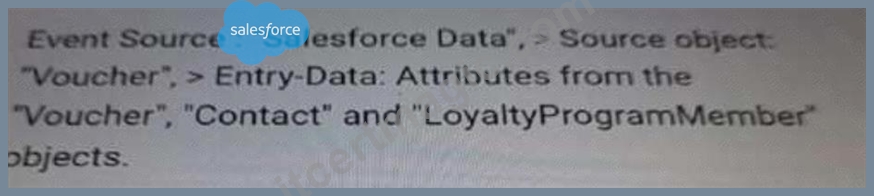
- B.
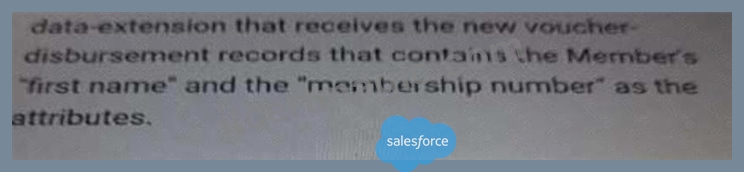
- C.
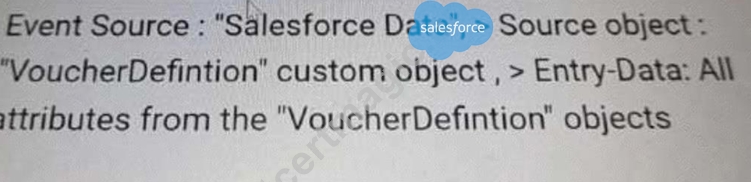
- D.
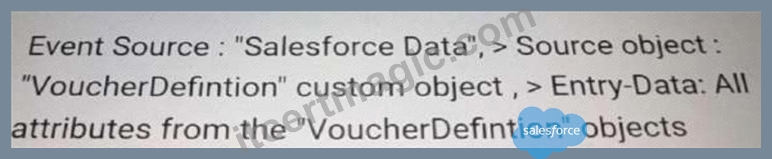
Answer: A
Explanation:
For the scenario described, where a loyalty program wants to send an immediate notification after a voucher is added to a member's account, the entry event in Salesforce Marketing Cloud needs to trigger off of the creation of a record in Salesforce that contains the necessary data attributes for personalization.
Option C is the most suitable choice because it specifies an entry event based on the "Voucher," "Contact," and "LoyaltyProgramMember" objects. This approach aligns with the requirements because it directly utilizes the "first name" from the Contact object and the "membership number" from the LoyaltyProgramMember object, which are necessary for personalizing the notification message.
Moreover, Option C would likely require the least amount of development effort because it leverages existing Salesforce data and related objects without the need for additional configuration or data extensions. In contrast, other options would require the setup of a data extension or custom objects that may not be directly tied to the triggering event, thereby increasing the complexity and development effort.
In Salesforce Marketing Cloud, Journey Builder is the tool that would be used to create this customer journey.
It allows for the configuration of entry events based on data changes in Salesforce, such as the addition of a voucher to a member's account. The real-time nature of this trigger is essential for the immediate notification requirement.
According to Salesforce's official documentation, using Salesforce data as the entry source for a journey allows for real-time messaging based on record creation or updates. This means that as soon as a voucher record is created or updated in Salesforce, the entry event can trigger and begin the journey, which will send the personalized notification to the member.
In practice, setting up this entry event in Journey Builder would involve specifying the criteria for the trigger (in this case, the creation of a voucher) and mapping the necessary data fields for personalization. This is consistent with Salesforce's best practices for creating personalized, real-time customer engagements through Journey Builder.
Salesforce's documentation on Journey Builder and real-time event triggers provides further details on how to configure these types of journeys and can be referred to for step-by-step guidance and the latest feature updates.
NEW QUESTION # 53
What are the three essential steps to establish a Loyalty promotion with Salesforce CDP and Marketing Cloud?
Select three
- A. Transmit Loyalty Promotion Segments to Marketing Cloud
- B. Automatically Generate a New Individual Relationship
- C. Activate and Publish the Segment
- D. Enable Connector Settings on all the Loyalty Objects E. Enable Service Connector for Promotion Escalations.
Answer: A,C,D
Explanation:
To establish a Loyalty promotion with Salesforce CDP (Customer Data Platform) and Marketing Cloud, the three essential steps are:
* Transmit Loyalty Promotion Segments to Marketing Cloud (A): This step involves sharing segmented data from Salesforce CDP to Marketing Cloud, enabling targeted marketing campaigns based on loyalty promotion criteria.
* Activate and Publish the Segment (C): Once the segments are defined and populated with the relevant Loyalty Program Members, the segment needs to be activated and published to be used in campaigns and promotions within Marketing Cloud.
* Enable Connector Settings on all the Loyalty Objects (D): This involves configuring the integration between Salesforce CDP, Loyalty Management, and Marketing Cloud by enabling the necessary connector settings, ensuring seamless data flow and communication between these platforms for the promotion.
Option B (Automatically Generate a New Individual Relationship) and E (Enable Service Connector for Promotion Escalations) are not directly related to the essential steps for establishing a loyalty promotion with Salesforce CDP and Marketing Cloud.
NEW QUESTION # 54
Northern Trail Outfitters, wants to implement its new Loyalty Program. The Chief Marketing Officer wants to offer the following benefits to customers:
* Award points to the customer that can be redeemed for products in the store
* Gamify customers that spend the most to receive exclusive benefits.
What three elements should the Administrator configure?
- A. Set up one qualifying currency and a non-qualifying currency
- B. Set up promotions
- C. Set up one qualifying currency
- D. Set up vouchers for specific products
- E. Set up a tier system based on a cumulative spending value
Answer: B,C,E
Explanation:
For Northern Trail Outfitters' Loyalty Program offering, the Administrator should configure:
* B: One qualifying currency to track points that can be redeemed for products.
* C: A tier system based on cumulative spending to gamify and reward top spenders with exclusive benefits.
* E: Promotions to create special offers or rewards that can enhance the Loyalty Program's appeal and engagement.
NEW QUESTION # 55
While designing an experiential Loyalty Program, what are the two recommended objects to be used as a best practice to track what type of activity the member has with the program?
- A. Loyalty Member Currency & Transaction Journal
- B. Loyalty Ledger & Transaction Journal
- C. Journal Type & Journal Subtype
- D. transaction Journal Type & Transaction Journal Subtype
Answer: C
NEW QUESTION # 56
Universal Containers (UC) has a Loyalty Program with a Loyalty Member Portal implemented using the Loyalty Experience Cloud template. UC is planning to launch a new Loyalty Program and wants to retain the same design and functionalities of the existing Loyalty Member Portal.
Which two steps should UC consider during the implementation of the new Loyalty Program?
- A. Use existing Experience Cloud components to handle the same design and functionalities.
- B. Create a new Loyalty Member Portal and assign it to the new Loyalty Program.
- C. Create new Experience Cloud Components for the new Loyalty Member Portal.
- D. Assign the existing Loyalty Member Portal to the new Loyalty Program too.
Answer: A,B
Explanation:
When implementing a new Loyalty Program while retaining the design and functionalities of an existing Loyalty Member Portal built with the Loyalty Experience Cloud template, Universal Containers should consider:
* Option B: Utilizing existing Experience Cloud components to ensure consistency in design and functionality. This approach leverages the reusable nature of Experience Cloud components, allowing for efficient replication of the portal's look and feel without the need for extensive redevelopment.
* Option D: Creating a new Loyalty Member Portal specifically for the new Loyalty Program. This ensures that the new program has a dedicated portal tailored to its unique requirements while maintaining the desired design and functionalities. This approach allows for customization and scalability, accommodating any program-specific features or requirements.
NEW QUESTION # 57
A Consultant needs to design a new tier-upgrade process for a new Loyalty Program. The custom object to store the qualified members and a batch job is identified for this process.
Which two components should the Consultant select for this process?
- A. A data-processing-engine (DPE) to identify the qualified members
- B. A flow to perform the tier-upgrade rule and another flow to perform the tier-upgrade orchestration process
- C. A flow to perform both tier-upgrade rule and tier-upgrade orchestration process
- D. A flow to schedule and process the custom object's pending records and another flow to perform tier-upgrade orchestration process
Answer: A,B
Explanation:
For designing a new tier-upgrade process in a Loyalty Program, the Consultant should select:
* A flow to perform the tier-upgrade rule and another flow to perform the tier-upgrade orchestration process (C): This approach allows for the separation of concerns, where one flow is responsible for evaluating whether members meet the criteria for a tier upgrade, and another flow is responsible for the actual process of upgrading the member's tier. This modular design improves maintainability and scalability.
* A data-processing-engine (DPE) to identify the qualified members (D): The DPE can efficiently process large sets of member data to identify those who qualify for a tier upgrade based on the program's criteria. This component is crucial for automating the tier-upgrade process at scale, especially in programs with a significant number of members.
Option A combines both processes into a single flow, which could become complex and harder to maintain.
Option B suggests using a single flow for scheduling and processing, which might not offer the required flexibility and efficiency for handling complex tier-upgrade criteria and orchestration.
Salesforce documentation on Loyalty Management provides guidelines on leveraging Flow and DPE for automating and orchestrating various loyalty program processes, including tier upgrades.
NEW QUESTION # 58
......
Achive your Success with Latest AP-212 Exam: https://www.itcertmagic.com/Salesforce/real-AP-212-exam-prep-dumps.html
Achieve The Utmost Performance In AP-212 Exam Pass Guaranteed: https://drive.google.com/open?id=1ea1_knBxLpSo_1SYSd3AYp8n95q-1_wi