

2025 Valid Professional-Cloud-Network-Engineer Exam Updates - 2025 Study Guide
Professional-Cloud-Network-Engineer Certification - The Ultimate Guide [Updated 2025]
Google Professional-Cloud-Network-Engineer (Google Cloud Certified - Professional Cloud Network Engineer) Certification Exam is a highly sought-after certification for professionals in the IT industry. Google Cloud Certified - Professional Cloud Network Engineer certification is designed to validate the skills and knowledge required to design, plan, and implement a secure, reliable, and scalable network infrastructure on the Google Cloud Platform. Google Cloud Certified - Professional Cloud Network Engineer certification demonstrates an individual's ability to design and manage cloud network architectures, monitor network performance, and troubleshoot network connectivity issues.
Google Professional-Cloud-Network-Engineer (Google Cloud Certified - Professional Cloud Network Engineer) Certification Exam is designed for professionals who are interested in validating their skills in designing, implementing, and managing network solutions on the Google Cloud Platform. Google Cloud Certified - Professional Cloud Network Engineer certification exam is intended for applicants with a broad range of skills and expertise in networking technologies, including virtual private clouds, load balancing, and network security.
NEW QUESTION # 27
Your organization is deploying a single project for 3 separate departments. Two of these departments require network connectivity between each other, but the third department should remain in isolation. Your design should create separate network administrative domains between these departments. You want to minimize operational overhead.
How should you design the topology?
- A. Create 3 separate VPCs, and use Cloud VPN to establish connectivity between the two appropriate VPCs.
- B. Create a Shared VPC Host Project and the respective Service Projects for each of the 3 separate departments.
- C. Create a single project, and deploy specific firewall rules. Use network tags to isolate access between the departments.
- D. Create 3 separate VPCs, and use VPC peering to establish connectivity between the two appropriate VPCs.
Answer: D
Explanation:
https://cloud.google.com/vpc/docs/vpc-peering
NEW QUESTION # 28
You are troubleshooting an application in your organization's Google Cloud network that is not functioning as expected. You suspect that packets are getting lost somewhere. The application sends packets intermittently at a low volume from a Compute Engine VM to a destination on your on-premises network through a pair of Cloud Interconnect VLAN attachments. You validated that the Cloud Next Generation Firewall (Cloud NGFW) rules do not have any deny statements blocking egress traffic, and you do not have any explicit allow rules. Following Google-recommended practices, you need to analyze the flow to see if packets are being sent correctly out of the VM to isolate the issue. What should you do?
- A. Enable Firewall Rules Logging on your firewall rules and review the logs.
- B. Verify the network/attachment/egress_dropped_packet.s_count Cloud Interconnect VLAN attachment metric.
- C. Enable VPC Flow Logs on the subnet that the VM is deployed in with sample_rate = 1.0, and run a query in Logs Explorer to analyze the packet flow.
- D. Create a packet mirroring policy that is configured with your VM as the source and destined to a collector. Analyze the packet captures.
Answer: C
Explanation:
Explanation: Enabling VPC Flow Logs with sample_rate = 1.0 on the VM's subnet will give detailed information about network traffic flowing to and from your VM. You can then query this data in Logs Explorer to check whether packets are leaving the VM and reaching the intended destination. This is a recommended practice for troubleshooting such network issues.
NEW QUESTION # 29
Your organization has resources in two different VPCs, each in different Google Cloud projects, and requires connectivity between the resources in the two VPCs. You have already determined that there is no IP address overlap; however, one VPC uses privately used public IP (PUPI) ranges. You would like to enable connectivity between these resources by using a lower cost and higher performance method. What should you do?
- A. Create a VPC Network Peering connection between the two VPCs that allows the export and import of custom routes for public IP addresses. Create the necessary ingress VPC firewall rules that target the specific resources by using service accounts as the source filter.
- B. Create a VPC Network Peering connection between the two VPCs that allows the export and import of subnet routes with public IP addresses. Create the necessary ingress VPC firewall rules that target the specific resources by using IP ranges as the source filter.
- C. Create a VPC Network Peering connection between the two VPCs that allows the export and import of subnet routes with public IP addresses. Create the necessary ingress VPC firewall rules that target the specific resources by using network tags as the source filter.
- D. Create an HA VPN between the two VPCs that includes the PUPI ranges in the custom route advertisements of the Cloud Router. Create the necessary ingress VPC firewall rules that target the specific resources by using IP ranges as the source filter.
Answer: B
Explanation:
VPC Network Peering is the most cost-effective and high-performance method for connecting two VPCs. Since one VPC uses privately used public IP (PUPI) ranges, you need to configure peering to allow the export and import of subnet routes with public IP addresses. Firewall rules can be used to control traffic between the resources.
NEW QUESTION # 30
You are using a 10-Gbps direct peering connection to Google together with the gsutil tool to upload files to Cloud Storage buckets from on-premises servers. The on-premises servers are 100 milliseconds away from the Google peering point. You notice that your uploads are not using the full 10-Gbps bandwidth available to you. You want to optimize the bandwidth utilization of the connection.
What should you do on your on-premises servers?
- A. Compress files using utilities like tar to reduce the size of data being sent.
- B. Use the perfdiag parameter in your gsutil command to enable faster performance: gsutil perfdiag gs://[BUCKET NAME].
- C. Remove the -m flag from the gsutil command to enable single-threaded transfers.
- D. Tune TCP parameters on the on-premises servers.
Answer: B
Explanation:
Explanation/Reference: https://cloud.google.com/solutions/transferring-big-data-sets-to-gcp
NEW QUESTION # 31
You have deployed a proof-of-concept application by manually placing instances in a single Compute Engine zone. You are now moving the application to production, so you need to increase your application availability and ensure it can autoscale.
How should you provision your instances?
- A. Create an unmanaged instance group for each zone, and manually distribute the instances across the desired zones.
- B. Create an unmanaged instance group in a single zone, and then create an HTTP load balancer for the instance group.
- C. Create a single managed instance group, specify the desired region, and select Multiple zones for the location.
- D. Create a managed instance group for each region, select Single zone for the location, and manually distribute instances across the zones in that region.
Answer: C
Explanation:
https://cloud.google.com/compute/docs/instance-groups/creating-groups-of-managed-instances
NEW QUESTION # 32
Question:
Your company's current network architecture has three VPC Service Controls perimeters:
* One perimeter (PERIMETER_PROD) to protect production storage buckets
* One perimeter (PERIMETER_NONPROD) to protect non-production storage buckets
* One perimeter (PERIMETER_VPC) that contains a single VPC (VPC_ONE)
In this single VPC (VPC_ONE), the IP_RANGE_PROD is dedicated to the subnets of the production workloads, and the IP_RANGE_NONPROD is dedicated to subnets of non-production workloads. Workloads cannot be created outside those two ranges. You need to ensure that production workloads can access only production storage buckets and non-production workloads can access only non-production storage buckets with minimal setup effort. What should you do?
- A. Develop a design that removes the PERIMETER_VPC perimeter. Update the PERIMETER_NONPROD perimeter to include the project containing VPC_ONE. Remove the PERIMETER_PROD perimeter.
- B. Develop a design that creates a new VPC (VPC_NONPROD) in the same project as VPC_ONE.
Migrate all the non-production workloads from VPC_ONE to the PERIMETER_NONPROD perimeter.
Remove the PERIMETER_VPC perimeter. Update the PERIMETER_PROD perimeter to include VPC_ONE and the PERIMETER_NONPROD perimeter to include VPC_NONPROD. - C. Develop a design that removes the PERIMETER_VPC perimeter. Update the PERIMETER_PROD perimeter to include the project containing VPC_ONE. Remove the PERIMETER_NONPROD perimeter.
- D. Develop a design that uses the IP_RANGE_PROD and IP_RANGE_NONPROD perimeters to create two access levels, with each access level referencing a single range. Create two ingress access policies with each access policy referencing one of the two access levels. Update the PERIMETER_PROD and PERIMETER_NONPROD perimeters.
Answer: D
Explanation:
Using IP range-based access levels for VPC Service Controls allows segmentation of production and non- production resources within the same VPC. By creating separate access levels and ingress policies for each IP range, you ensure that only production subnets access production buckets and non-production subnets access non-production buckets, providing the required isolation.
NEW QUESTION # 33
Your organization wants to set up hybrid connectivity with VLAN attachments that terminate in a single Cloud Router with 99.9% uptime. You need to create a network design for your on-premises router that meets those requirements and has an active/passive configuration that uses only one VLAN attachment at a time. What should you do?
- A. Create a design that uses the as_path BGP attribute to influence the egress path from Google Cloud to the on-premises environment.
- B. Create a design that uses the local_pref BGP attribute to influence the egress path from Google Cloud to the on-premises environment.
- C. Create a design that uses an equal-cost multipath (ECMP) with flow-based hashing on your on-premises devices.
- D. Create a design that uses a BGP multi-exit discriminator (MED) attribute to influence the egress path from Google Cloud to the on-premises environment.
Answer: D
Explanation:
The BGP multi-exit discriminator (MED) attribute is used in BGP configurations to influence the choice of path in an active/passive setup by prioritizing one path over another for egress traffic. This is ideal for a design that uses only one VLAN attachment at a time.
NEW QUESTION # 34
You are trying to update firewall rules in a shared VPC for which you have been assigned only Network Admin permissions. You cannot modify the firewall rules. Your organization requires using the least privilege necessary.
Which level of permissions should you request?
- A. Service Project Admin privileges from the Shared VPC Admin.
- B. Shared VPC Admin privileges from the Organization Admin.
- C. Organization Admin privileges from the Organization Admin.
- D. Security Admin privileges from the Shared VPC Admin.
Answer: D
Explanation:
https://cloud.google.com/vpc/docs/shared-vpc
NEW QUESTION # 35
You recently deployed Cloud VPN to connect your on-premises data center to Google Cloud. You need to monitor the usage of this VPN and set up alerts in case traffic exceeds the maximum allowed. You need to be able to quickly decide whether to add extra links or move to a Dedicated Interconnect. What should you do?
- A. In the Google Cloud console, use Monitoring Query Language to create a custom alert for bandwidth utilization.
- B. In the VPN section of the Google Cloud console, select the VPN under hybrid connectivity and then select monitoring to display utilization on the dashboard.
- C. In the Monitoring section of the Google Cloud console, use the Dashboard section to select a default dashboard for VPN usage.
- D. In Network Intelligence Center, check for the number of packet drops on the VPN.
Answer: A
Explanation:
Explanation: Using Monitoring Query Language (MQL) to create a custom alert for bandwidth utilization gives you flexibility and precision in setting thresholds. This helps you quickly determine when VPN traffic exceeds the limits, allowing for timely decisions about adding more links or transitioning to a Dedicated Interconnect.
: Google Cloud Monitoring Documentation
NEW QUESTION # 36
You are a admin at XYZ organization. Few of your team members need to use BigQuery Data Transfer Service for Amazon S3 . They want to automatically schedule and manage recurring load jobs from Amazon S3 into BigQuery, they want to run the transfer job every week. They have, Amazon S3 URI for the source data, access key ID , secret access key and Read permission on the data source . What necessary permissions are required for the transfer job creators in BigQuery .
- A. bigquery.jobs.create and bigquery.transfers.get
- B. bigquery.transfers.update and bigquery.transfers.get
- C. bigquery.transfer.get and bigquery.data.sets.update
- D. bigquery.transfers.update and bigquery.datasets.update
Answer: D
Explanation:
Option A is the correct choice because bigquery.transfers.update permissions is needed to create the transfer and bigquery.datasets.update permissions is needed on the target dataset .Also The bigquery.admin predefined Cloud IAM role includes bigquery.transfers.update and bigquery.datasets.update permissions .
Option B is Incorrect because , it is not the required permission for transfer job creators.
Option C and Option D are Incorrect because , they are not the required permission for transfer job creators.
NEW QUESTION # 37
You need to create the network infrastructure to deploy a highly available web application in the us-east1 and us-west1 regions.
The application runs on Compute Engine instances, and it does not require the use of a database. You want to follow Google-recommended practices. What should you do?
- A. Create one VPC in each region, and peer both VPCs.
Create a global load balancer.
Enable Cloud CDN on the load balancer.
Create a CNAME for the load balancer in Cloud DNS. - B. Create one VPC with one subnet in each region.
Create a global load balancer with a static IP address.
Enable Cloud CDN and Google Cloud Armor on the load balancer.
Create an A record using the IP address of the load balancer in Cloud DNS. - C. Create one VPC with one subnet in each region.
Create an HTTP(S) load balancer with a static IP address.
Choose the standard tier for the network.
Enable Cloud CDN on the load balancer.
Create a CNAME record using the load balancer's IP address in Cloud DNS. - D. Create one VPC with one subnet in each region.
Create a regional network load balancer in each region with a static IP address.
Enable Cloud CDN on the load balancers.
Create an A record in Cloud DNS with both IP addresses for the load balancers.
Answer: A
NEW QUESTION # 38
You are designing a shared VPC architecture. Your network and security team has strict controls over which routes are exposed between departments. Your Production and Staging departments can communicate with each other, but only via specific networks. You want to follow Google-recommended practices.
How should you design this topology?
- A. Create 2 shared VPCs within the shared VPC Host Project, and create a Cloud VPN/Cloud Router between them. Use Flexible Route Advertisement (FRA) to filter access between the specific networks.
- B. Create 2 shared VPCs within the shared VPC Host Project, and enable VPC peering between them. Use firewall rules to filter access between the specific networks.
- C. Create 2 shared VPCs within the shared VPC Service Project, and create a Cloud VPN/Cloud Router between them. Use Flexible Route Advertisement (FRA) to filter access between the specific networks.
- D. Create 1 VPC within the shared VPC Host Project, and share individual subnets with the Service Projects to filter access between the specific networks.
Answer: D
Explanation:
Explanation/Reference: https://cloud.google.com/vpc/docs/shared-vpc
NEW QUESTION # 39
You are configuring load balancing for a standard three-tier (web, application, and database) application. You have configured an external HTTP(S) load balancer for the web servers. You need to configure load balancing for the application tier of servers. What should you do?
- A. Configure a URL map on the existing load balancer to route traffic to the application tier.
- B. Configure equal cost multi-path routing on the application servers.
- C. Configure a new internal HTTP(S) load balancer for the application tier.
- D. Configure a forwarding rule on the existing load balancer for the application tier.
Answer: D
NEW QUESTION # 40
You have the following private Google Kubernetes Engine (GKE) cluster deployment: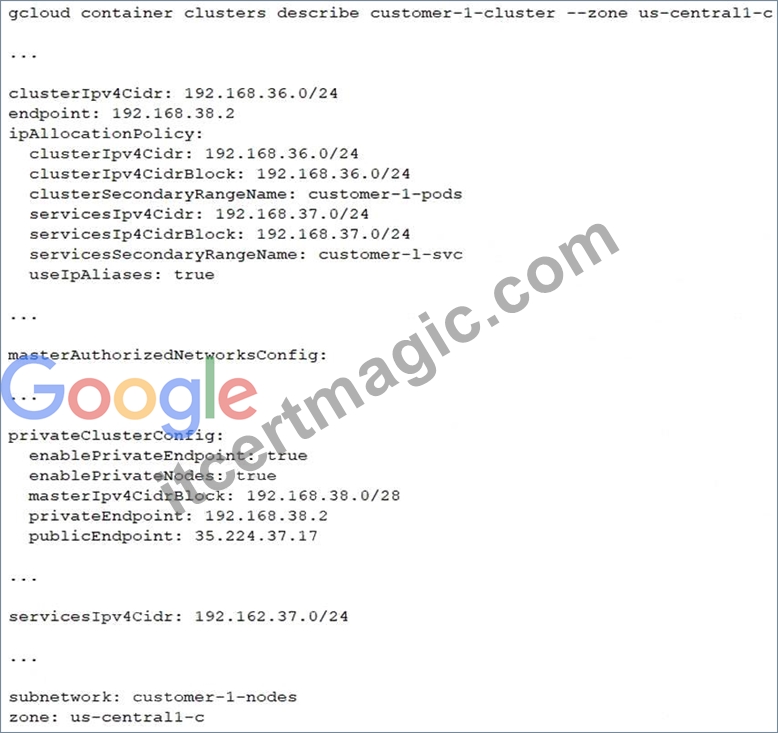
You have a virtual machine (VM) deployed in the same VPC in the subnetwork kubernetes-management with internal IP address 192.168.40 2/24 and no external IP address assigned. You need to communicate with the cluster master using kubectl. What should you do?
- A. Add the network 192.168.36.0/24 to the masterAuthorizedNetworksConfig. Configure kubectl to communicate with the endpoint 192.168.38.2
- B. Add the network 192.168.38.0/28 to the masterAuthorizedNetworksConfig. Configure kubectl to communicate with the endpoint 192.168.38.2
- C. Add an external IP address to the VM, and add this IP address in the masterAuthorizedNetworksConfig.Configure kubectl to communicate with the endpoint 35.224.37.17.
- D. Add the network 192.168.40.0/24 to the masterAuthorizedNetworksConfig. Configure kubectl to communicate with the endpoint 192.168.38.2.
Answer: D
NEW QUESTION # 41
You have the following routing design. You discover that Compute Engine instances in Subnet-2 in the asia-southeast1 region cannot communicate with compute resources on-premises. What should you do?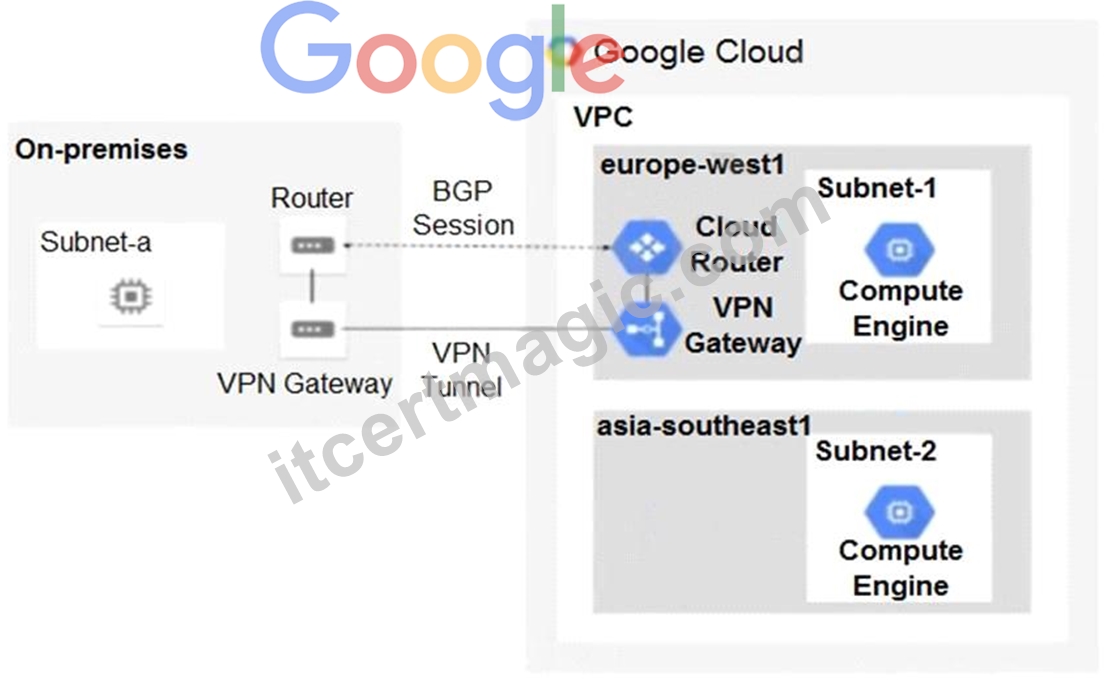
- A. Change the VPC dynamic routing mode to Global.
- B. Enable IP forwarding in the asia-southeast1 region.
- C. Configure a custom route advertisement on the Cloud Router.
- D. Add a second Border Gateway Protocol (BGP) session to the Cloud Router.
Answer: A
NEW QUESTION # 42
You are the Organization Admin for your company. One of your engineers is responsible for setting up multiple host projects across multiple folders and sharing subnets with service projects. You need to enable the engineer's Identity and Access Management (IAM) configuration to complete their task in the fewest number of steps. What should you do?
- A. Set up the engineer with Compute Shared VPC Admin IAM role and Project IAM Admin role at the folder level.
- B. Set up the engineer with Compute Shared VPC Admin IAM role at the folder level.
- C. Set up the engineer with Compute Shared VPC Admin IAM role and Project IAM Admin role at the organization level.
- D. Set up the engineer with Compute Shared VPC Admin IAM role at the organization level.
Answer: D
NEW QUESTION # 43
Your organization is deploying a single project for 3 separate departments. Two of these departments require network connectivity between each other, but the third department should remain in isolation. Your design should create separate network administrative domains between these departments. You want to minimize operational overhead.
How should you design the topology?
- A. Create 3 separate VPCs, and use Cloud VPN to establish connectivity between the two appropriate VPCs.
- B. Create a Shared VPC Host Project and the respective Service Projects for each of the 3 separate departments.
- C. Create a single project, and deploy specific firewall rules. Use network tags to isolate access between the departments.
- D. Create 3 separate VPCs, and use VPC peering to establish connectivity between the two appropriate VPCs.
Answer: B
Explanation:
Use Shared VPC to connect to a common VPC network. Resources in those projects can communicate with each other securely and efficiently across project boundaries using internal IPs. You can manage shared network resources, such as subnets, routes, and firewalls, from a central host project, enabling you to apply and enforce consistent network policies across the projects.
With Shared VPC and IAM controls, you can separate network administration from project administration. This separation helps you implement the principle of least privilege. For example, a centralized network team can administer the network without having any permissions into the participating projects. Similarly, the project admins can manage their project resources without any permissions to manipulate the shared network.
NEW QUESTION # 44
You have ordered Dedicated Interconnect in the GCP Console and need to give the Letter of Authorization/Connecting Facility Assignment (LOA-CFA) to your cross-connect provider to complete the physical connection.
Which two actions can accomplish this? (Choose two.)
- A. Check the email for the account of the NOC contact that you specified during the ordering process.
- B. Run gcloud compute interconnects describe <interconnect>.
- C. Download the LOA-CFA from the Hybrid Connectivity section of the GCP Console.
- D. Open a Cloud Support ticket under the Cloud Interconnect category.
- E. Contact your cross-connect provider and inform them that Google automatically sent the LOA/CFA to them via email, and to complete the connection.
Answer: A,E
Explanation:
https://cloud.google.com/network-connectivity/docs/interconnect/how-to/dedicated/retrieving-loas
NEW QUESTION # 45
......
Professional-Cloud-Network-Engineer Practice Exam and Study Guides - Verified By ITCertMagic: https://www.itcertmagic.com/Google/real-Professional-Cloud-Network-Engineer-exam-prep-dumps.html
2025 Updated Verified Pass Professional-Cloud-Network-Engineer Study Guides & Best Courses: https://drive.google.com/open?id=1d1lDR6FkUjUQDCBuRKJlu2j9avlK1dw-