

View All 1Z0-083 Actual Free Exam Questions Oct 07, 2026 Updated
Pass Authentic Oracle 1Z0-083 with Free Practice Tests and Exam Dumps
How to book the Oracle Database Administration II Exam Number: 1Z0-083
You can schedule the exam anytime at Pearson VUE. You can pay directly from a credit card or redeem a voucher purchased from Oracle.
Oracle 1Z1-083 certification exam is designed for professionals who have already obtained the Oracle Database Administration I certification and wish to further their knowledge and expertise in database administration. 1Z0-083 exam covers advanced concepts and techniques related to database performance tuning, backup and recovery strategies, and high availability solutions. Successfully passing 1Z0-083 exam demonstrates a deep level of understanding of Oracle Database Administration and can help professionals advance their careers in the IT industry.
NEW QUESTION # 79
Examine this configuration:
1. The ORCLdatabase data files are in Automatic Storage Management (Oracle ASM) disk group +DATA.
2. ORCLuses disk group +FRAfor the Fast Recovery Area.
3. LISTENER is the listener for ORCL.
4. The database, listener, ASM instance, and ASM disk groups are managed by Oracle Restart.
5. All components are currently shut down.
You execute this command:
What is the outcome?
- A. Only the ORCLdatabase and the ASM instances are started.
- B. Only the ORCLdatabase instance and the +DATAand +FRAdisk groups are started.
- C. Only the ORCL database instance is started.
- D. The ORCL database, the Oracle ASM instances, the +DATAand +FRAdisk groups, and the LISTENER are started.
- E. Only the ORCLdatabase instance, the Oracle ASM instance, and the +DATAand +FRAdisk groups are started.
Answer: E
NEW QUESTION # 80
Which three are true about Automatic Workload Repository (AWR) and Automatic Database Diagnostic Monitor (ADDM) in an Oracle multitenant environment?
- A. ADDM can run in a nonroot container.
- B. AWR snapshots can be created in CDB$ROOT.
- C. No AWR data is stored in the CDB$ROOT SYSAUX tablespace.
- D. AWR reports can be generated while connected to any container.
- E. All AWR data is stored in the CDB$ROOT SYSAUX tablespace.
- F. AWR snapshots can be created in a PDB.
Answer: B,E,F
NEW QUESTION # 81
Which two are true about a Recovery Manager (RMAN) duplication without a target connection?
- A. RMAN disk-based backups of the database to be duplicated can be used by the auxiliary instance.
- B. The undo tablespace clause is always required when no connection exists to the recovery catalog and the target database is closed.
- C. The undo tablespace clause is always required when no connection exists to the target instance.
- D. RMAN "pushes" the backups of the database to be duplicated over the network to the auxiliary instance.
- E. RMAN SBT-based backups of the database to be duplicated can be used by the auxiliary instance.
Answer: A,B
NEW QUESTION # 82
Which three are true about transporting databases across platforms using Recovery Manager (RMAN) image copies? (Choose three.)
- A. A new DBID is automatically created for the transported database.
- B. Databases can be transported between systems with different endian formats.
- C. By default, the transported database will use Oracle Managed Files (OMF)
- D. The password file is automatically converted by RMAN.
- E. Data files can be converted on the destination system.
- F. Data files can be converted on the source system.
Answer: C,E,F
NEW QUESTION # 83
Which two are true about server-generated alerts?
- A. Stateful alerts must be cleared by a DBA after resolving the problem.
- B. Stateless alerts can be purged manually from the alert history.
- C. Stateless alerts can be cleared manually.
- D. Stateless alerts are automatically cleared.
- E. Stateful alerts are purged automatically from the alert history.
Answer: A,D
NEW QUESTION # 84
You upgraded your database from pre-12c to a multitenant container database (CDB) containing pluggable databases (PDBs). Examine the query and its output:
Which two tasks must you perform to add users with SYSBACKUP, SYSDG, and SYSKM privilege to the password file?
- A. Re-create the password file with SYSBACKUP, SYSDG, and SYSKM privilege and the FORCE argument set to No.
- B. Assign the appropriate operating system groups to SYSBACKUP, SYSDG, SYSKM.
- C. Re-create the password file with SYSBACKUP, SYSDG, and SYSKM privilege, and FORCE arguments set to Yes.
- D. Grant SYSBACKUP, SYSDG, and SYSKM privileges to the intended users.
- E. Re-createthepasswordfileintheOracleDatabase12cformat. Correct
Answer: C,D
NEW QUESTION # 85
Which three are true about Optimizer Statistics Advisor? (Choose three.)
- A. It can be run only manually.
- B. It always analyzes all schemas in the database.
- C. It is part of the DBMS_STATS package.
- D. It is part of the DBMS_ADVISOR package.
- E. It can recommend changes to improve the statistics gathering process.
- F. It runs automatically every night by default.
Answer: C,E,F
Explanation:
Explanation
https://mikedietrichde.com/2017/08/22/oracle-optimizer-statistics-advisor-in-oracle-database-12-2-0-1/
https://www.oracle.com/technetwork/database/bi-datawarehousing/twp-bp-for-stats-gather-19c-5324205.pdf
NEW QUESTION # 86
Which four are true about duplicating a database using Recovery Manager (RMAN)? (Choose four.)
- A. A connection to an auxiliary instance is always required.
- B. Duplication can be done by having the target database instance push copies to the auxiliary database instance.
- C. A connection to the recovery catalog instance is always required.
- D. A subset of the target database can be duplicated.
- E. A backup of the target database is always required.
- F. A connection to the target database instance is always required.
- G. Duplication can be done by having the auxiliary database instance pull backup sets from the target database instance.
- H. A new DBID is always created for the duplicated database.
Answer: A,B,D,G
NEW QUESTION # 87
Choose two. You want to install Oracle Grid Infrastructure for a Standalone Server using Oracle Universal Installer (OUI). There is no existing Oracle installation on the server. Which two are prerequisites?
- A. the Oracle Inventory group oinstall
- B. an operating system user to own this installation
- C. a group called dba
- D. the installation of Oracle ASMLIB
- E. an operating system account called grid
Answer: A,B
NEW QUESTION # 88
Which three are true about Automatic Workload Repository (AWR) and Automatic Database Diagnostic Monitor (ADDM) in an Oracle multitenant environment? (Choose three.)
- A. All AWR data is stored in the CDB$ROOT SYSAUX tablespace.
- B. ADDM can run in a nonroot container.
- C. AWR snapshots can be created in CDB$ROOT.
- D. No AWR data is stored in the CDB$ROOT SYSAUX tablespace.
- E. AWR reports can be generated while connected to any container.
- F. AWR snapshots can be created in a PDB.
Answer: D,E,F
NEW QUESTION # 89
Oracle Data Redaction is active on the SCOTT.EMP table. You queried the table twice. SQL> SELECT ENAME, SAL, COMM, MGR, HIREDATE FROM EMP WHERE DEPTNO=30; SQL> SELECT ENAME, SAL, COMM, MGR, HIREDATE FROM EMP WHERE DEPTNO=30; Which is guaranteed to be true concerning the redaction policy?
- A. RANDOM redaction is active on the MGR column
- B. FULL redaction is active on the SAL column
- C. RANDOM redaction is active on the HIREDATE column
- D. PARTIAL redaction is active on the MGR column.
- E. PARTIAL redaction is active of the HIREDATE column.
Answer: C
NEW QUESTION # 90
Which two are true about server-generated alerts? (Choose two.)
- A. Stateful alerts must be created by a DBA after resolving the problem.
- B. Stateless alerts can be purged manually from the alert history.
- C. Stateless alerts are automatically cleared.
- D. Stateless alerts can be cleared manually.
- E. Stateful alerts are purged automatically from the alert history.
Answer: B,D
Explanation:
Except for the tablespace space usage metric, which is database related, the other metrics are instance related. Threshold alerts are also referred to as stateful alerts which are automatically cleared when an alert condition clears. Stateful alert appears in DBA_OUTSTANDING_ALERTS and when cleared go to DBA_ALERT_HISTORY. Other server-generated alerts correspond to specific database events such as ORA-* errors, "Snapshot too old" errors, Recovery Area Low on Free Space, Resumable Session Suspended. These are non threshold based alerts, also referred to as stateless alerts. Stateless alerts go directly to the History table. +++ Most alerts (such as "Out of Space") are cleared automatically when the cause of the problem disappears. However, other alerts (such as generic alert log errors) are sent to you for notification and must be acknowledged by you. After taking the corrective measures, you acknowledge an alert by clearing or purging it. Clearing an alert sends the alert to the Alert History which is accessible from Monitoring sub menu. Purging an alert removes it from the Alert History.
Reference:
https://jameshuangsj.wordpress.com/2019/12/01/clears-stateless-alerts-in-oem-by-using-emcli/
NEW QUESTION # 91
Which two arc true about Optimizer Statistics ?
- A. They can be gathered by the DBMS_STATE package.
- B. They are gathered by the SQL Tuning Advisor.
- C. By default, they are automatically gathered by a maintenance job.
- D. They provide real-time data about schema objects.
- E. They are ignored by Optimizer if they are state.
Answer: A,C
NEW QUESTION # 92
Which two are true about changing the LOCAL_UNDO_ENABLED property to false in a CDB?
(Choose two.)
- A. After the change, each existing PDB has to be reopened for the new undo mode to take effect.
- B. Undo tablespaces existing in PDBs must be dropped before the change.
- C. After the change, any user with the required privilege can create an undo tablespace in the PDBs.
- D. After the change, only a common user with the required privilege can create an undo tablespace in CDB&ROOT.
- E. After the change, only one undo tablespace can exist in CDB$ROOT.
- F. Any new PDB and existing PDBs are automatically configured to use the default undo tablespace in CDB$ROOT.
Answer: A,D
Explanation:
A is correct, in shared UNDO mode, UNDO can exist in the CDB only.
B is wrong, because PDBs must be reopened to recognize the central UNDO C is wrong, because as the database is RAC and enabled with LOCAL UNDO, you need to assign specific Undo tablespace to each PDB on node-1 & node-2 by executing below commands.
On node-1:
alter system set undo_tablespace=UNDOTBS1 container=current sid='DBCDB1' scope=spfile; >>>> sid=First Instance On Node-2 alter system set undo_tablespace=UNDOTBS2 container=current sid='DBCDB2' scope=spfile; >>>> sid=Second Instance D is wrong, becuase as long as LOCAL UNDO used you cant create UNDO in PDB E is wrong, PDB UNDO tablespaces should be dropped after the change.
F is correct, when you change the undo mode of a CDB, the new undo mode applies to an individual container the first time the container is opened after the change.
NEW QUESTION # 93
The persistent configuration settings for RMAN have default for all parameters. Identify four RMAN commands that produce a multi-section backup.
- A. BACKUP INCREMENTAL LEVEL 0 TABLESPACE SYSAUX SECTION SIZE 100M;
- B. BACKUP AS COPY TABLESPACE SYSTEM SECTION SIZE 100M;
- C. BACKUP TABLESPACE "UNDO" INCLUDE CURRENT CONTROLFILE SECTION SIZE
100M; - D. BACKUP ARCHIVELOG ALL SECTION SIZE 25M;
- E. BACKUP TABLESPACE SYSTEM SECTION SIZE 100M;
- F. BACKUP TABLESPACE "TEMP" SECTION SIZE 10M;
- G. BACKUP SPFILE SECTION SIZE 1M;
Answer: A,B,D,E
NEW QUESTION # 94
Which three are true about requirements for various FLASHBACK operations? (Choose three.)
- A. FLASHBACK transaction query requires undo to retrieve all versions of a row that existed between two points in time.
- B. FLASHBACK drop requires undo to retrieve all versions of a row that existed between two points in time.
- C. FLASHBACK DATA ARCHIVE requires undo to store all versions of all rows of a table being tracked.
- D. FLASHBACK version query requires undo to retrieve all versions of a row that existed between two points in time.
- E. FLASHBACK drop requires that the RECYCLEBIN parameter be set to ON.
- F. FLASHBACK version query requires that the RECYCLEBIN parameter be set to ON.
Answer: A,D,E
Explanation:
Reference:
https://books.google.com.pk/books?id=0iwrL9P25Z0C&pg=PA35&lpg=PA35&dq=FLASHBACK+transaction
+query+requires+undo+to+retrieve+all+versions+of+a+row+that+existed+between+two+points+in
+time&source=bl&ots=MJnYl5CZ1u&sig=ACfU3U0dWP-NPd- U8uu3zbaoi3YZzT0FTQ&hl=en&sa=X&ved=2ahUKEwigi5_Jl9joAhXzUBUIHUh4DksQ6AEwAnoECAsQJg#v= onepage&q=FLASHBACK%20transaction%20query%20requires%20undo%20to%20retrieve%20all% 20versions%20of%20a%20row%20that%20existed%20between%20two%20points%20in%20time&f=false
https://docs.oracle.com/cd/E18283_01/server.112/e17120/tables011.htm
NEW QUESTION # 95
Which two are true about Oracle Grid Infrastructure for a Standalone Server? (Choose two.)
- A. The CSS daemon runs from the Grid Infrastructure home.
- B. It supports volume management, file system, and automatic restart capabilities.
- C. It can manage database resources on the server where it is installed or on a different server.
- D. It requires Oracle Automatic Storage Management (ASM) components to be installed separately.
- E. It must be installed before the Oracle database software is installed.
Answer: A,B
Explanation:
Oracle Grid Infrastructure for a standalone server includes Oracle Restart and Oracle Automatic Storage Management.
If you install Oracle Grid Infrastructure for a standalone server and then create your database, then the database is automatically added to the Oracle Restart configuration. Oracle Restart automatically restarts the database when required.
If you install Oracle Grid Infrastructure for a standalone server on a host computer on which a database already exists, then you must manually add the database, the listener, the Oracle ASM instance, and other components to the Oracle Restart configuration before you are able to configure automatic database restarts.
NEW QUESTION # 96
Which two are true about SQL Performance Analyzer (SPA)? (Choose two.)
- A. It provides before and after execution statistics for each SQL statement in the analysis task
- B. It offers fine-grained analysis of all the SQL statements in the analysis task as a group.
- C. SQL statements that were originally run concurrently are run concurrently by SPA.
- D. It is integrated with the SQL Access Advisor.
- E. It predicts the impact of system changes on SQL workload response time.
Answer: A,E
NEW QUESTION # 97
You plan to install Oracle Grid Infrastructure for a Standalone Server and Oracle Database for the first time on a server.
Examine this command and its outcome:
# id oracle
uid=54321(oracle) gid=54321(oinstall) groups=54321(oinstall) , 54322(dba) Which two are true?
- A. oracle must be the owner of every Oracle Database installation.
- B. The user account, oracle, and group, oinstall, can be used for all Oracle software installations.
- C. oracle will be granted the sysasm privilege when installing the Oracle Database software.
- D. oracle will be an owner of the Oracle Inventory.
- E. oracle can own an Oracle Database installation but not an Oracle Grid Infrastructure installation.
Answer: B
NEW QUESTION # 98
Examine this configuration:
1. CDB1 is an Oracle Database 12c Release 2 container database (CDB).
2. PDB1 and PDB2 are two pluggable databases (PDBs) in CDB1.
After successfully performing all the preupgrade tasks, you execute these commands from the Oracle Database 18c environment:
What is the outcome?
- A. It fails because PDB$SEED is in MIGRATE state.
- B. Only CDB$ROOT, PDB$SEED, and PDB2 are upgraded.
- C. Only CDB$ROOT and PDB$SEED are upgraded.
- D. CDB$ROOT, PDB$SEED, PDB1, and PDB2 are upgraded.
- E. It fails because PDB2 is not in UPGRADE state.
- F. Only CDB$ROOT, PDB$SEED, and PDB1 are upgraded.
Answer: C
NEW QUESTION # 99
Choose two. Which two are true about an RPM-based Oracle Database installation?
- A. It requires an Unbreakable Linux Network (ULN) subscription.
- B. From Oracle Database 18c, a single RPM can be used to install only Oracle Database Server for a single instance.
- C. It performs a software-only Oracle Database installation.
- D. It includes the Oracle Preinstallation RPM.
- E. It uses a service configuration script to create a single-instance database as part of the installation.
Answer: B,C
NEW QUESTION # 100
Which three are located by using environment variables? (Choose three.)
- A. default directories for temporary files used by temporary tablespaces
- B. the list of a disk group names to be mounted by an Oracle Automatic Storage Management (ASM) instance at startup
- C. the maximum number of database files that can be opened by a database instance
- D. the Optimal Flexible Architecture (OFA) compliant path to store Oracle software and configuration files.
- E. the location of Oracle Net Services configuration files
- F. the temporary disk space used by Oracle Installer during installation
Answer: D,E,F
Explanation:
A - ORACLE_BASE, ORACLE_HOME - correct
B - TNS_ADMIN, old TWO_TASK, etc - correct
C - spfile parameter ASM_DISKGROUPS, not env variable
D - [s]pfile parameter DB_CREATE_FILE_DEST, not env variable
E - TMP, TEMP - correct
F - [s]pfile parameter DB_FILES, not env variable
NEW QUESTION # 101
Examine these queries and their output: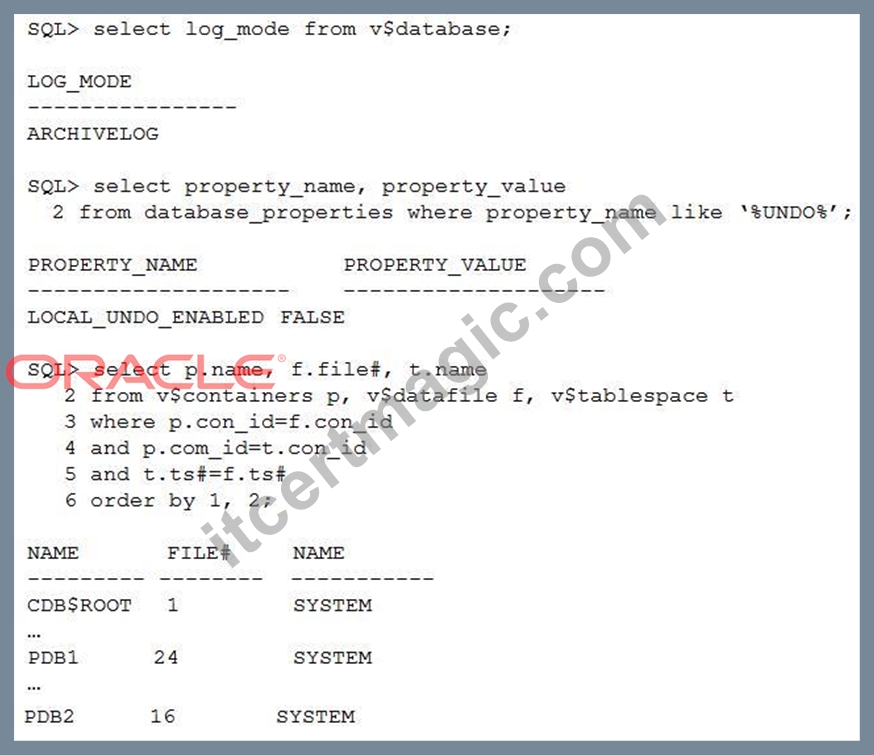
After a system crash, an instance restart and an attempted opening of the PDBs result in: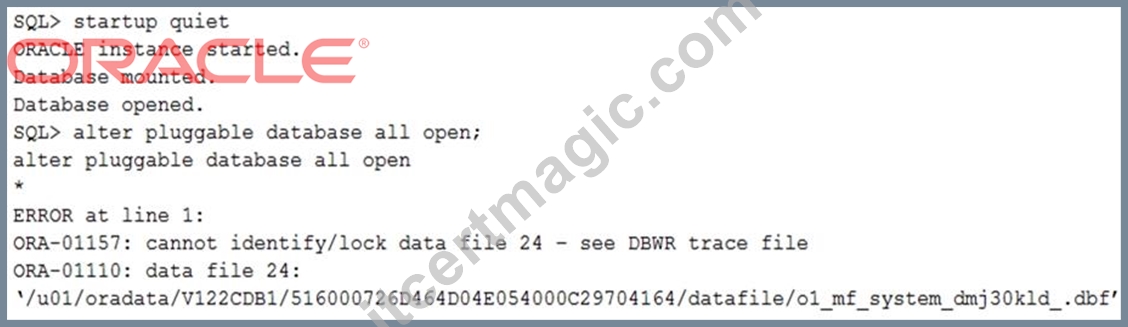
Which two are true? (Choose two.)
- A. Data file 24 cannot be recovered while the CDB is opened.
- B. Data file 24 can be recovered while PDB2 is opened.
- C. Data file 24 can be recovered while CDB$ROOT and PDB$SEED are opened.
- D. Data file 24 must be recovered while PDB2 is closed.
- E. Data file 24 must be recovered while the CDB is opened.
Answer: B,E
Explanation:
Explanation
19c: PDB SYSTEM or UNDO Tablespace Recovery: The CDB and all other PDBs can be left opened. 1.
Connect to PDB 2. Shutdown abort the PDB, if its not automatically done. sqlplus sys@sales_pdb as sysdba sql> SHUTDOWN ABORT; OR ALTER PLUGGABLE DATABASE CLOSE ABORT; rman target sys@slaes_pdb rman> restore database; rman> recover database; rman> alter pluggable database sales_pdb open;
NEW QUESTION # 102
Choose two. Which two are prerequisites for using FLASHBACK TABLE?
- A. A table's indexes must be set to unusable before issuing the flashback.
- B. The FLASHBACK ANY TABLE system privilege or the FLASHBACK object privilege must be granted to the table owner.
- C. A table's constraints must be disabled before issuing the flashback.
- D. Row Movement must be enabled on the table being flashed back.
- E. The FLASHBACK ANY TABLE system privilege or the FLASHBACK object privilege must be granted to the user performing the flashback.
Answer: D,E
NEW QUESTION # 103
......
Oracle 1Z0-083 certification exam is ideal for database administrators, database architects, and IT professionals who work with Oracle databases. It is a challenging exam that requires in-depth knowledge and hands-on experience with databases. Oracle Database Administration II certification not only validates the candidate's skills but also enhances their career prospects by increasing their marketability and earning potential. With the Oracle 1Z0-083 certification, professionals can demonstrate their expertise and commitment to excellence in database administration.
New 1Z0-083 Exam Questions Real Oracle Dumps: https://www.itcertmagic.com/Oracle/real-1Z0-083-exam-prep-dumps.html
Course 2026 1Z0-083 Test Prep Training Practice Exam Download: https://drive.google.com/open?id=1OdW-5kOJb62evrD2MkEUPdQHopE469vL