

Updated Feb-2022 Test Engine to Practice 352-001 Test Questions
352-001 Real Exam Questions Test Engine Dumps Training With 270 Questions
The benefit in Obtaining the 352-001 Exam Certification
- Cisco Certified Network Professional have the knowledge to use the tools to complete the task efficiently and cost effectively than the other non-certified professionals lack in doing so.
- Cisco Certified Network Professional Certification provides practical experience to candidates from all the aspects to be a proficient worker in the organization.
- Cisco Certified Network Professional have more useful and relevant networks that help them in setting career goals for themselves. Cisco Certified Network Professional Certification provide them with the right career direction than non certified usually are unable to get.
- Cisco Certified Network Professional Certifications provide opportunities to get a job easily in which they are interested in instead of wasting years and ending without getting any experience.
- Cisco Certified Network Professional is distinguished among competitors. Cisco Certified Design Expert certification can give them an edge at that time easily when candidates appear for a job interview employers seek to notify something which differentiates the individual to another.
For more info visit:
NEW QUESTION 158
Which design concern should be accounted for in all Layer 3 virtualization technologies?
- A. Layer 3 stability
- B. packet sizing
- C. application usage
- D. Layer 3 redundancy
Answer: B
NEW QUESTION 159
Which option is a critical mechanism to optimize convergence speed when using MPLS FRR?
- A. shared risk link groups
- B. IGP timers
- C. down detection
- D. bandwidth reservation
Answer: C
Explanation:
Section: Layer 2 Control Plane
Explanation/Reference:
NEW QUESTION 160
Refer to the exhibit.
Assume that no multicast optimization is done on LAN switches A and B.
Which feature can be used to optimize multicast traffic forwarding in this situation?
- A. Configure a static MAC entry for the multicast server.
- B. Enable PIM Snooping on both switches.
- C. Disable IGMP snooping on both switches.
- D. Disable the IGMP query election process.
- E. Enable IGMP snooping querier on both switches.
Answer: E
Explanation:
Explanation/Reference:
NEW QUESTION 161
Which design benefit of bridge assurance is true?
- A. It supposes a spanning-tee topology change upon connecting and disconnecting a station on a port
- B. It prevents switch loops caused by unidirectional point-to-point link condition on Rapid PVST + and MST
- C. It prevents switched traffic from traversing suboptimal paths on the network.
- D. It allows small, unmanaged switches to be plugged into ports of access switches without the risk of switch loops.
Answer: B
NEW QUESTION 162
A service provider hires you to design its new managed CE offering to meet these requirements: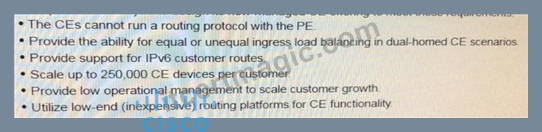
Which tunnelling technology do you recommend?
- A. Point-to-point GRE
- B. FlexVPN
- C. LISP
- D. DMVPN
Answer: C
NEW QUESTION 163
You are the lead network designer for an enterprise company called ABC, and you are leading design discussions regarding IPv6 implementation into their existing network. A question is raised regarding older Layer 2 switches that exist in the network, and if any changes are required to these Layer 2 switches for successful IPv6 implementation. Which two responses should you give? (Choose two.)
- A. If IPv6 multicast deployment is planned, then make sure that Layer 2 switches support MLD snooping at Layer 2 switches.
- B. If IPv6 anycast deployment is planned, then make sure that Layer 2 switches support ND snooping at Layer 2 switches.
- C. IPv6 is transparent on Layer 2 switches, so there is no need to make any changes to the Layer 2 switches.
- D. If IPv6 anycast deployment is planned, then make sure that Layer 2 switches support ICMPv6 snooping at Layer 2 switches.
- E. If IPv6 anycast deployment is planned, then make sure that Layer 2 switches support DHCPv6 snooping at Layer 2 switches.
Answer: A,C
Explanation:
Explanation/Reference:
Explanation:
NEW QUESTION 164
You are designing a wireless LAN with the following components:
High-densityindoor access point deployment
2.4-GHz and 5-GHz radios
802.11a, 802.11g,and 802.11n mode wireless LAN clients
Site survey results show negligible foreign WiFi and non-WiFi interference. What is the best method to decrease duty cycle (radio frequency utilization) and increase overall wireless LAN client performance for this design?
- A. Increase radio transmit power on all access points that report a high duty cycle.
- B. Disable all data rates above 12 Mb/s on all access points.
- C. Disable all data rates below 12 Mb/s on all access points.
- D. Increase radio transmit power on all access points.
- E. Decrease radio transmit power on all access points that report a high duty cycle.
Answer: C
Explanation:
Explanation/Reference:
Explanation:
NEW QUESTION 165
In a network, all routers deploy FIFO queuing. The primary application running on the network is data backup by use of FTP. At certain times, users experience cyclical performance degradation. Which two items can mitigate this problem and help ensure bandwidth is used effectively in the network? (Choose two.)
- A. WRED
- B. traffic policing
- C. CB-WFQ
- D. MDRR
Answer: A,C
Explanation:
Section: (none)
Explanation/Reference:
NEW QUESTION 166
Study the exhibit carefully. Configure P4S-R1, P4S-R2, and P4S-R3 to run EIGRP on all their connected interfaces. P4S-R2 is also configured as an EIGRP stub.
Which EIGRP routes are in the local topology table at P4S-R3?
- A. 172.30.0.0/16
- B. 172.30.2.0/24, 172.30.3.0/31 and 172.30.3.2/31
- C. 172.30.1.0/24, 172.30.2.0/24, 172.30.3.0/31 and 172.30.3.2/31
- D. There's not enough information provided to know what would be in the topology table at P4S-R3.
Answer: B
Explanation:
Section: (none)
Explanation/Reference:
NEW QUESTION 167
What information can you get from TCP flags while assessing an attack?
- A. Source of the attack
- B. Target of the attack
- C. Priority of the attack traffic
- D. Type of attack
Answer: D
NEW QUESTION 168
Select and Place:
Answer:
Explanation:
NEW QUESTION 169
As part of the security protocol for your network design, you have designated that option 82 is enabled for DHCP snooping. When option 82 is enabled, which information will be added to the DHCP request?
- A. switch MAC address and switch IP address
- B. remote ID and circuit ID
- C. switch MAC address and VLAN, module, and port
- D. switch IP address and VLAN, module, and port
Answer: B
Explanation:
Explanation/Reference:
As per http://www.cisco.com/en/US/products/ps6366/
products_configuration_example09186a0080b9c12c.shtml information is remote ID and Circuit ID (origional answer is wrong)
NEW QUESTION 170
What is a design aspect regarding multicast transport for MPLS Layer 3 VPNs using the Rosen Draft implementation?
- A. Multicast traffic is forwarded over GRE tunnels.
- B. Multicast traffic is forwarded over LDP or RSVP signaled LSPs.
- C. LDP is the multicast control plane protocol.
- D. Using the MDT SAFI in BGP ensures that PIM can be disabled in the core.
Answer: A
Explanation:
Explanation/Reference:
Explanation:
NEW QUESTION 171
Which markup language is used to format Ansible's playbook?
- A. XML
- B. NAML
- C. ADML
- D. HTML
- E. YAML
Answer: E
Explanation:
Section: Evolving Technologies
NEW QUESTION 172
In which two ways is IPv4 and IPv6 traffic handled in a network design that uses QoS deployment options? (Choose two.)
- A. IPv6 and IPv4 traffic is treated in the same way by using a single QoS policy that classifies and matches on both protocols.
- B. IPv6 traffic is treated differently than IPv4 by using two different QoS policies.
- C. IPv6 traffic is treated differently than IPv4 because it uses only the DSCP value and not the IP precedence.
- D. IPv6 traffic is treated differently than IPv4 by using the flow-label field, which is built into the IPv6 packet header.
- E. IPv6 traffic does not require QoS because it uses to the flow-label field, which classifies and matches on the IPv6 protocol.
Answer: A,B
NEW QUESTION 173
What are two functions of an NSSA in an OSPF network design? (Choose two.)
- A. An ABR advertises Type 7 LSAs into the area.
- B. An ASBR advertises Type 7 LSAs into the area.
- C. It allows ASBRs to inject external routing information into the area.
- D. It uses opaque LSAs.
- E. It overcomes issues with suboptimal routing when there are multiple exit points from the area.
Answer: B,C
NEW QUESTION 174
Sun Stable is a global insurance company with headquarters located in Houston, Texas. The campus there is made up of a number of office buildings located within the same vicinity. In 2003, a new building, Building 331B was added. The additional building houses approximately 1000 employees. Rather than deploy a private branch exchange (PBX) in the new building, Sun Stable has decided to implement an IP telephony solution. External calls will be carried across a MAN link to another building, where a gateway connects into the worldwide PBX network of Sun Stable. Voice mail and unified messaging components are required and all IP phones and workstations should be on separate VLANs and IP subnets.
Which IP telephony deployment best suits their need?
- A. multisite with distributed call processing
- B. single-site
- C. multisite with centralized call processing
- D. clustering over the WAN
Answer: B
Explanation:
Section: (none)
Explanation/Reference:
NEW QUESTION 175
In Layer 2 access campus design, which mechanism should be enabled on access ports to protect the campus network from undesired access switches and looped ports?
- A. BPDU guard
- B. loop guard
- C. EtherChannel guard
- D. root guard
Answer: A
NEW QUESTION 176
To improve the stability of a global network, you have been tasked with changing the design to include link-state topology summarization. What are two issues that you should address as part of the design? (Choose two.)
- A. suboptimal routing
- B. traffic black-holing
- C. packet reordering
- D. slow convergence
Answer: A,B
NEW QUESTION 177
A Service Provide network designer is considering the use of the G.8032 Ethernet Ring Protection mechanism in order to provide resiliency in the network Which three concepts will be supported with the implement token
G.8032? (Choose three)
- A. Ring Protection Link (RPL)
- B. Ring Automatic Protection Switching (R-APS)
- C. Multi-Router Automatic Protection Switching (MR-APS)
- D. Automatic Protection Switching (APS) Channel
Answer: A,B,D
Explanation:
Explanation
https://www.ieee802.org/1/files/public/docs2008/liaison-itut-g8032-overview-0308.pdf
NEW QUESTION 178
You have been tasked to create a Layer 2 network design that uses vPC to provide resiliency and avoid loops.
vPC removes Layer 2 loops while providing redundancy through which mechanism?
- A. strict forwarding rules
- B. dual-active detection
- C. address synchronization
- D. Bridge Assurance
Answer: A
NEW QUESTION 179
A company is planning to connect its 30 sites with a VPLS WAN backbone. A router at
each site should establish neighborships with all other routers using the OSPF routing protocol. Which three points must be considered regarding DR and BDR when different router platforms are used? (Choose three.)
- A. The role for the DR and BDR will be selected when a new OSPF router comes up.
- B. To force two routers to become a DR and a BDR, the IP OSPF priority can be set to zero at all other OSPF routers.
- C. To select the DR and BDR, the IP OSPF priority must be set to a lower value than the default value at the DR and BDR during the selection process.
- D. If the IP OSPF priority is the same for all routers, the highest loopback IP address and router ID will decide which routers will take the DR and BDR role during the selection process.
- E. It is a best practice that the routers with the most powerful hardware should take the role of the DR and BDR.
- F. To select the DR and BDR, the IP OSPF priority must be set to a higher value than the default value at the DR and BDR during the selection process.
Answer: B,D,E
NEW QUESTION 180
You are evaluating convergence characteristics of various interior gateway protocols for a new network design. Which technology allows link-state routing protocols to calculate paths to destination prefixes that are functionally similar to feasible successors in Enhanced
Interior Gateway Routing Protocol?
- A. partial route calculation
- B. Fast-Flooding
- C. Cisco Multiprotocol Label Switching Traffic Engineering Fast Reroute
- D. Incremental Shortest Path First
- E. Loop-Free Alternate Fast Reroute
Answer: E
NEW QUESTION 181
Your customer wants to migrate their network from IPv4 to IPv6. They currently have Control Plane Policing deployed to protect their network devices from illegitimate ICMP traffic flooding. How do you adjust Control Plane Policing for ICMPv6 traffic, if it should be adjusted at all?
- A. The policy must remain the same for ICMPv4 and ICMPv6
- B. The customer must pay special attention to the ICMPv6 rate limiting policy because it has additional functionality in the LAN
- C. ICMPv6 must be policed to the ICMPv4 lower value because the ICMPv6 packet size is bigger
- D. Unlike ICMPv4, ICMPv6 must never be policed because it has additional functionality in the LAN
Answer: B
Explanation:
Section: Evolving Technologies
NEW QUESTION 182
......
Cisco 352-001 Exam Topics:
| Section | Weight | Objectives |
|---|---|---|
| Evolving Techonologies v1.1 | 10% | 1. Cloud
2. Network programmability (SDN)
3. Internet of things (IoT)
|
| Network Virtualization | 15% | 1. Describe Layer 2 and Layer 3 tunnelling technologies
2. Analyze the implementation of tunnelling
|
| Layer 3 Control Plane | 33% | 1. Describe route aggregation concepts and techniques
2. Describe the theory and application of network topology layering
3. Describe the theory and application of network topology abstraction
4. Describe the effect of fault isolation and resiliency on network design or network reliability
5. Describe metric-based traffic flow and modification
6. Describe fast convergence techniques and mechanisms
7. Describe factors affecting convergence
8. Describe unicast routing protocol operation [OSPF, EIGRP, ISIS, BGP, and RIP] in relation to network design
9. Analyze operational costs and complexity
10. Describe the interaction between routing protocols and topologies 11. Describe generic routing and addressing concepts
12. Describe multicast routing concepts
13. Describe IPv6 concepts and operation
|
352-001 Actual Questions Answers PDF 100% Cover Real Exam Questions: https://www.itcertmagic.com/Cisco/real-352-001-exam-prep-dumps.html