

Unique Top-selling Terraform-Associate-003 Exams - New 2024 HashiCorp Pratice Exam
Terraform Associate Dumps Terraform-Associate-003 Exam for Full Questions - Exam Study Guide
NEW QUESTION # 78
Where can Terraform not load a provider from?
- A. Official HashCrop Distribution on releases.hashcrop.com
- B. Source code
- C. Plugins directory
- D. Provider plugin chance
Answer: B
Explanation:
This is where Terraform cannot load a provider from, as it requires a compiled binary file that implements the provider protocol. You can load a provider from a plugins directory, a provider plugin cache, or the official HashiCorp distribution on releases.hashicorp.com.
NEW QUESTION # 79
What does this code do?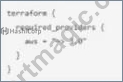
- A. Requires any version of the AWS provider > = 3.0 and <4.0
- B. Requires any version of the AWS provider > 3.0
- C. Requires any version of the AWS provider > = 3.0 major release. like 4.1
- D. Requires any version of the AWS provider >= 3.0
Answer: A
Explanation:
This is what this code does, by using the pessimistic constraint operator (~>), which specifies an acceptable range of versions for a provider or module.
NEW QUESTION # 80
Your DevOps team is currently using the local backend for your Terraform configuration. You would like to move to a remote backend to store the state file in a central location. Which of the following backends would not work?
- A. Terraform Cloud
- B. Artifactory
- C. Amazon S3
- D. Git
Answer: D
Explanation:
Explanation
This is not a valid backend for Terraform, as it does not support locking or versioning of state files4. The other options are valid backends that can store state files in a central location.
NEW QUESTION # 81
Which of these commands makes your code more human readable?
- A. Terraform output
- B. Terraform show
- C. Terraform validate
- D. Terraform fmt
Answer: D
Explanation:
The command that makes your code more human readable is terraform fmt. This command is used to rewrite Terraform configuration files to a canonical format and style, following the Terraform language style conventions and other minor adjustments for readability. The command is optional, opinionated, and has no customization options, but it is recommended to ensure consistency of style across different Terraform codebases. Consistency can help your team understand the code more quickly and easily, making the use of terraform fmt very important. You can run this command on your configuration files before committing them to source control or as part of your CI/CD pipeline. Reference = : Command: fmt : Using Terraform fmt Command to Format Your Terraform Code
NEW QUESTION # 82
How does the Terraform cloud integration differ from other state backends such as S3, Consul,etc?
- A. All of the above
- B. It can execute Terraform runs on dedicated infrastructure in Terraform Cloud
- C. It is only arable lo paying customers
- D. It doesn't show the output of a terraform apply locally
Answer: B
Explanation:
This is how the Terraform Cloud integration differs from other state backends such as S3, Consul, etc., as it allows you to perform remote operations on Terraform Cloud's servers instead of your local machine. The other options are either incorrect or irrelevant.
NEW QUESTION # 83
Running terraform fmt without any flags in a directory with Terraform configuration files check the formatting of those files without changing their contents.
- A. True
- B. False
Answer: B
Explanation:
Running terraform fmt without any flags in a directory with Terraform configuration files will not check the formatting of those files without changing their contents, but will actually rewrite them to a canonical format and style. If you want to check the formatting without making changes, you need to use the -check flag.
NEW QUESTION # 84
Which of the following methods, used to provision resources into a public cloud, demonstrates the concept of infrastructure as code?
- A. curl commands manually run from a terminal
- B. A script that contains a series of public cloud CLI commands
- C. A sequence of REST requests you pass to a public cloud API endpoint Most Voted
- D. A series of commands you enter into a public cloud console
Answer: B
Explanation:
Explanation
The concept of infrastructure as code (IaC) is to define and manage infrastructure using code, rather than manual processes or GUI tools. A script that contains a series of public cloud CLI commands is an example of IaC, because it uses code to provision resources into a public cloud. The other options are not examples of IaC, because they involve manual or interactive actions, such as running curl commands, sending REST requests, or entering commands into a console. References = [Introduction to Infrastructure as Code with Terraform] and [Infrastructure as Code]
NEW QUESTION # 85
Variables declared within a module are accessible outside of the module.
- A. True
- B. False
Answer: B
Explanation:
Explanation
Variables declared within a module are only accessible within that module, unless they are explicitly exposed as output values1.
NEW QUESTION # 86
You should run terraform fnt to rewrite all Terraform configurations within the current working directory to conform to Terraform-style conventions.
- A. False
- B. True
Answer: B
Explanation:
You should run terraform fmt to rewrite all Terraform configurations within the current working directory to conform to Terraform-style conventions. This command applies a subset of the Terraform language style conventions, along with other minor adjustments for readability. It is recommended to use this command to ensure consistency of style across different Terraform codebases. The command is optional, opinionated, and has no customization options, but it can help you and your team understand the code more quickly and easily. Reference = : Command: fmt : Using Terraform fmt Command to Format Your Terraform Code
NEW QUESTION # 87
How do you specify a module's version when publishing it to the public terraform Module Registry?
- A. Mention it on the module's configuration page on the Terraform Module Registry
- B. The Terraform Module Registry does not support versioning modules
- C. Tag a release in the associated repo
- D. Configuration it in the module's Terraform code
Answer: C
Explanation:
Explanation
This is how you specify a module's version when publishing it to the public Terraform Module Registry, as it uses the tags from your version control system (such as GitHub or GitLab) to identify module versions. You need to use semantic versioning for your tags, such as v1.0.0.
NEW QUESTION # 88
When using multiple configuration of the same Terraform provider, what meta-argument must you include in any non-default provider configurations?
- A. Alias
- B. Id
- C. name
- D. Depends_on
Answer: A
Explanation:
This is the meta-argument that you must include in any non-default provider configurations, as it allows you to give a friendly name to the configuration and reference it in other parts of your code. The other options are either invalid or irrelevant for this purpose.
NEW QUESTION # 89
Which of the following is not a valid Terraform collection type?
- A. Tree
- B. List
- C. Map
- D. set
Answer: A
Explanation:
Explanation
This is not a valid Terraform collection type, as Terraform only supports three collection types: list, map, and set. A tree is a data structure that consists of nodes with parent-child relationships, which is not supported by Terraform.
NEW QUESTION # 90
Which task does terraform init not perform?
- A. Validates all required variables are present
- B. Sources any modules and copies the configuration locally
- C. Sources all providers used in the configuration and downloads them
- D. Connects to the backend
Answer: A
Explanation:
The terraform init command is used to initialize a working directory containing Terraform configuration files. This command performs several different initialization steps to prepare the current working directory for use with Terraform, which includes initializing the backend, installing provider plugins, and copying any modules referenced in the configuration. However, it does not validate whether all required variables are present; that is a task performed by terraform plan or terraform apply1.
Reference = This information can be verified from the official Terraform documentation on the terraform init command provided by HashiCorp Developer1.
NEW QUESTION # 91
How would you reference the volume IDs associated with the ebs_block_device blocks in this configuration?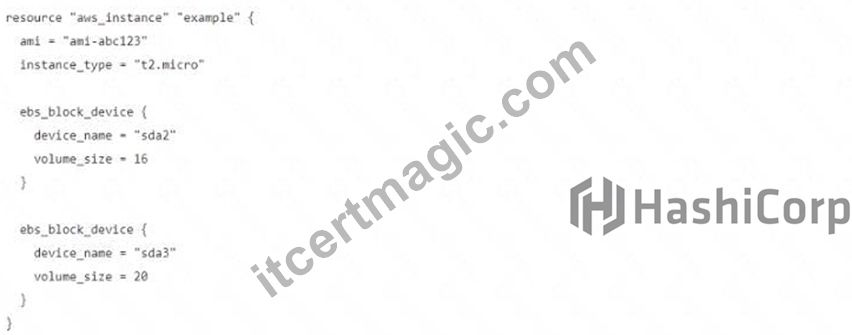
- A. aws_instance.example.ebs_block_device[sda2,sda3).volume_id
- B. aws_lnstance.example.ebs_block_device.[*].volume_id
- C. aws_instance.example-ebs_block_device.*.volume_id
- D. aws_lnstance.example.ebs_block_device.volume_ids
Answer: C
Explanation:
Explanation
This is the correct way to reference the volume IDs associated with the ebs_block_device blocks in this configuration, using the splat expression syntax. The other options are either invalid or incomplete.
NEW QUESTION # 92
What value does the Terraform Cloud private registry provide over the public Terraform Module Registry?
- A. The ability to share modules publicly with any user of Terraform
- B. The ability to tag modules by version or release
- C. The ability to share modules with public Terraform users and members of Terraform Cloud Organizations
- D. The ability to restrict modules to members of Terraform Cloud or Enterprise organizations
Answer: D
Explanation:
The Terraform Cloud private registry provides the ability to restrict modules to members of Terraform Cloud or Enterprise organizations. This allows you to share modules within your organization without exposing them to the public. The private registry also supports importing modules from your private VCS repositories. The public Terraform Module Registry, on the other hand, publishes modules from public Git repositories and makes them available to any user of Terraform. Reference = : Private Registry - Terraform Cloud : Terraform Registry - Provider Documentation
NEW QUESTION # 93
Which of the following ate advantages of using infrastructure as code (laC) instead of provisioning with a graphical user interface (GUI)? Choose two correct answers.
- A. Provisions the same resources at a lower cost
- B. Lets you version, reuse, and share infrastructure configuration
- C. Reduces risk of operator error
- D. Secures your credentials
- E. Prevents manual modifications to your resources
Answer: B,C
Explanation:
It lets you version, reuse, and share infrastructure configuration as code files, which can be stored in a source control system and integrated with your CI/CD pipeline.
It reduces risk of operator error by automating repetitive tasks and ensuring consistency across environments. IaC does not necessarily provision resources at a lower cost, secure your credentials, or prevent manual modifications to your resources - these depend on other factors such as your cloud provider, your security practices, and your access policies.
NEW QUESTION # 94
Which backend does the Terraform CU use by default?
- A. Local
- B. Terraform Cloud
- C. Depends on the cloud provider configured
- D. Remote
- E. HTTP
Answer: A
Explanation:
This is the backend that the Terraform CLI uses by default, unless you specify a different backend in your configuration. The local backend stores the state file in a local file named terraform.tfstate, which can be used to track and manage the state of your infrastructure.
NEW QUESTION # 95
You have to initialize a Terraform backend before it can be configured.
- A. True
- B. False
Answer: B
Explanation:
You can configure a backend in your Terraform code before initializing it. Initializing a backend will store the state file remotely and enable features like locking and workspaces. Reference = [Terraform Backends]
NEW QUESTION # 96
Which command should you run to check if all code in a Terraform configuration that references multiple modules is properly formatted without making changes?
- A. terraform fmt -check -recursive
- B. terraform fmt -list -recursive
- C. terraform fmt -check
- D. terraform fmt -write-false
Answer: A
Explanation:
This command will check if all code in a Terraform configuration that references multiple modules is properly formatted without making changes, and will return a non-zero exit code if any files need formatting. The other commands will either make changes, list the files that need formatting, or not check the modules.
NEW QUESTION # 97
The_________determines how Terraform creates, updates, or delete resources.
- A. Terraform provisioner
- B. Terraform configuration
- C. Terraform provider
- D. Terraform core
Answer: C
Explanation:
Explanation
This is what determines how Terraform creates, updates, or deletes resources, as it is responsible for understanding API interactions with some service and exposing resources and data sources based on that API.
NEW QUESTION # 98
How would you output returned values from a child module in the Terraform CLI output?
- A. Declare the output in both the root and child module
- B. Declare the output in the root configuration
- C. Declare the output in the child module
- D. None of the above
Answer: A
Explanation:
To output returned values from a child module in the Terraform CLI output, you need to declare the output in both the child module and the root module. The child module output will return the value to the root module, and the root module output will display the value in the CLI. Reference = [Terraform Outputs]
NEW QUESTION # 99
......
Best way to practice test for HashiCorp Terraform-Associate-003: https://www.itcertmagic.com/HashiCorp/real-Terraform-Associate-003-exam-prep-dumps.html
Terraform-Associate-003 Dump Ready - Exam Questions and Answers: https://drive.google.com/open?id=1Kj0ecWzYQo2PN5bb0e4C1x2xzZDEz_SC