

The Best CIMAPRA19-F03-1 Exam Study Material and Preparation Test Question Dumps
Get Ready to Pass the CIMAPRA19-F03-1 exam Right Now Using Our CIMA Strategic level Exam Package
To prepare for the CIMA F3 Exam, candidates are advised to study the CIMA syllabus, watch video lectures, and practice past exam papers. CIMAPRA19-F03-1 exam is computer-based and available year-round, so candidates can choose the best time to take the exam that suits them. Passing the CIMA F3 Exam is a critical step towards becoming a qualified management accountant and opens up a wide range of career opportunities in finance and accounting.
To pass the CIMAPRA19-F03-1 exam, candidates must have a strong foundation in financial management and accounting principles. They must also possess excellent analytical and problem-solving skills, as well as the ability to communicate complex financial information in a clear and concise manner. CIMAPRA19-F03-1 exam consists of objective test questions and case studies, which require candidates to demonstrate their ability to apply financial strategy concepts to practical business scenarios.
NEW QUESTION # 222
A large, listed company in the food and household goods industry needs to raise $50 million for a period of up to 6 months.
It has an excellent credit rating and there is almost no risk of the company defaulting on the borrowings. The company already has a commercial paper programme in place and has a good relationship with its bank.
Which of the following is likely to be the most cost effective method of borrowing the money?
- A. Treasury Bills
- B. 6 month term loan
- C. Commercial paper
- D. Bank overdraft
Answer: C
NEW QUESTION # 223
Two companies that operate in the same industry have different Price/Earnings (P/E) ratios as follows:
Which of the following is the most likely explanation of the different P/E ratios?
- A. Company B has higher business risk than Company A.
- B. Company B has higher gearing than Company A.
- C. Company B has a greater profit this year than Company A.
- D. Company B has higher expected future growth than Company A.
Answer: D
NEW QUESTION # 224
A company has a financial objective of maintaining a gearing ratio of between 30% and 40%, where gearing is defined as debt/equity at market values.
The company has been affected by a recent economic downturn leading to a shortage of liquidity and a fall in the share price during 20X1.
On 31 December 20X1 the company was funded by:
* Share capital of 4 million $1 shares trading at $4.0 per share.
* Debt of $7 million floating rate borrowings.
The directors plan to raise $2 million additional borrowings in order to improve liquidity.
They expect this to reassure investors about the company's liquidity position and result in a rise in the share price to $4.2 per share.
Is the planned increase in borrowings expected to help the company meet its gearing objective?
- A. No, gearing would increase but the gearing objective would be met both before and after the announcement.
- B. No, gearing would increase and the gearing objective would be exceeded both before and after the announcement.
- C. No, gearing would increase and the gearing objective would be met before the announcement but exceeded after the announcement.
- D. Yes, gearing would fall and the gearing objective would be exceeded before the announcement but met after the announcement.
Answer: B
NEW QUESTION # 225
B has a S3 million loan outstanding on which the interested rate is reset every 6 months for the following 6 month and the interested is payable at the end of that 6 month period. The next 6 monthly reset period starts in
3 months and the treasurer of B thinks interested rates are likely to raise between and then.
Current 6-month rates are 6.4% and the treasurer can get a rate of 6.9% for a 6-month forward rate agreement (FRA) starting in 3 months time. By transacting an TRA the treasurer can lock in a rate today of 6.9%.
If interested rates are 7.5% in 3 months' time, what will the net amount payable be?
Give your answer to the nearest thousand dollars.
Answer:
Explanation:
104
NEW QUESTION # 226
A company plans to raise finance for a new project.
It is considering either the issue of a redeemable cumulative preference share or a Eurobond.
Advise the directors which of the following statements would justify the issue of preference shares over a bond?
- A. The company can claim tax relief on the dividend paid on the preference share at a higher rate than the interest paid on the Eurobond.
- B. Preference shares are not secured against the assets of the business - however, the Eurobond would be.
- C. If profits are poor, dividends do not have to be paid on the preference share - however, interest would need to be paid on the Eurobond.
- D. The issue of the preference share would reduce the company's gearing - however, the Eurobond would increase it.
Answer: C
Explanation:
CIMA F3 compares different forms of long-term finance, including preference shares and bonds/Eurobonds, focusing on control, tax treatment, gearing impact, and flexibility.
Statement B captures a key advantage of preference shares from the company's perspective: if profits are poor, preference dividends can be omitted or deferred, especially when they are cumulative. Although unpaid dividends accumulate, non-payment does not normally constitute default in the same way as missing an interest payment on a bond. For a Eurobond, failure to pay interest when due would place the company in default, triggering legal and reputational consequences. This extra flexibility is exactly why preference shares might be favoured over bonds.
Statement A is misleading: Eurobonds are often unsecured, and security (or lack of it) is not a defining difference versus preference shares.
Statement C is incorrect in this context: redeemable cumulative preference shares are typically treated as a financial liability under IFRS (like debt), so they would generally increase gearing, not reduce it.
Statement D is clearly wrong as dividends are not tax-deductible, whereas bond interest normally is.
Therefore, the best justification for issuing preference shares rather than a Eurobond is B.
NEW QUESTION # 227
A listed company in the retail sector has accumulated excess cash.
In recent years, it has experienced uncertainly with forecasting the required level of cash for capital expenditure due to unpredictable economic cycles.
Its excess cash is on deposit earning negligible returns.
The Board of Directors is considering the company's dividend policy, and the need to retain cash in the company.
Which THREE of the following are advantages of retaining excess cash in the company?
- A. The market may interpret the return of excess cash as a sign of weak growth prospects.
- B. Liquidity problems are less likely to be experienced if there is a downturn in business.
- C. The company will be in a position to respond promptly to unexpected investment opportunities.
- D. Retaining excess cash may make the company vulnerable to hostile takeover.
- E. The excess cash is earning a negligible return.
Answer: A,B,C
NEW QUESTION # 228
Company P is a large unlisted food-processing company.
Its current profit before interest and taxation is $4 million, which it expects to be maintainable in the future.
It has a $10 million long-term loan on which it pays interest of 10%.
Corporate tax is paid at the rate of 20%.
The following information on P/E multiples is available: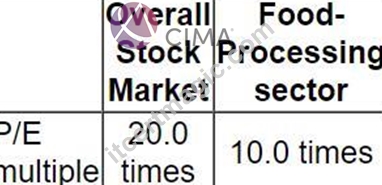
Which of the following is the best indication of the equity value of Company P?
- A. $48 million
- B. $40 million
- C. $24 million
- D. $80 million
Answer: C
NEW QUESTION # 229
Listed company R is in the process of making a cash offer for the equity of unlisted company S.
Company R has a market capitalisation of $200 million and a price/earnings ratio of 10.
Company S has a market capitalisation of $50 million and earnings of $7 million.
Company R intends to offer $60 million and expects to be able to realise synergistic benefits of $20 million by combining the two businesses. This estimate excludes the estimated $8 million cost of integrating the two businesses.
Which of the following figures need to be used when calculating the value of the combined entity in $ millions?
- A. 20, 50, 60, 200
- B. 8, 20, 50, 60, 200
- C. 8, 20, 50, 200
- D. 7, 10, 20, 50, 200
Answer: B
Explanation:
EBIT = 5
Interest @5% on 10m = 0.5 # PBT = 4.5
Tax 20% = 0.9 # Earnings = 3.6
EPS = 3.6 / 10m = 0.36
Price = 3.60 # P/E = 10
Next year:
Interest @6% = 0.6 # PBT = 4.4
Tax 20% = 0.88 # Earnings = 3.52
EPS = 3.52 / 10m = 0.352
Expected P/E = 9.5 # price = 0.352 × 9.5 = 3.344 (# 3.34).
Drop = 3.60 # 3.34 = 0.26 # % drop = 0.26 / 3.60 # 7.2%.
NEW QUESTION # 230
A company s about to announce a new project that has a positive NPV.
If the market is semi-strong form efficient, which of the following statements is most Likely to be true?
The value of the company will.
- A. already include the value of the project.
- B. Increase by the NPV of the project once the information has been announced
- C. increase only on completion of the project.
- D. only change to incorporate historical information.
Answer: B
Explanation:
In a semi-strong form efficient market, share prices instantly adjust to all publicly available information.
When the positive-NPV project is announced, its NPV is immediately reflected in the company's value.
Answer Q35: B. Increase by the NPV of the project once the information has been announced
NEW QUESTION # 231
Company Z has identified four potential acquisition targets: companies A, B. C and D.
Company Z has a current equity market value of S590 million.
The price it would have to pay for the equity of each company is as follows:
Only one of the target companies can be acquired and the consideration will be paid in cash.
The following estimations of the new combined value of Company Z have been prepared for each acquisition before deduction of the cash consideration:
Ignoring any premium paid on acquisition, which acquisition should the directors pursue?
- A. B - 655
- B. A - 620
- C. C - 666
- D. D - 652
Answer: C
Explanation:
Price to buy each target (equity market value):
A = 25
B = 62
C = 67
D = 60 (all $m)
Combined equity value before deducting cash consideration:
Z + A = 620
Z + B = 655
Z + C = 666
Z + D = 652 (all $m)
After paying cash, equity value = "combined value" # "price paid":
A: 620 # 25 = 595
B: 655 # 62 = 593
C: 666 # 67 = 599
D: 652 # 60 = 592
Best post-acquisition value is with C (599m).
NEW QUESTION # 232
A government is currently considering the privatisation of the national airline. The shares are to be offered to the public via a fixed price Initial Public Offering (IPO).
Which THREE of the following statements are correct?
- A. The government will receive significant financial resources from the sale of its shareholding in the national airline.
- B. An IPO is normally underwritten
- C. The rational airline employees will no longer be public sector employees following the completion of the privatisation
- D. The use of a fixed price offer will ensure that the government raises the maximum amount of finance.
- E. The rational airline will receive significant financial resources as a direct result of the shares company shares in the IPO.
Answer: A,B,C
Explanation:
A). An IPO is normally underwritten - Correct. For a fixed-price IPO, underwriters usually guarantee that the issue will be taken up, giving certainty of proceeds.
B). The government will receive significant financial resources from the sale - Correct. In a privatisation, the government is selling its ownership stake; the cash from selling these shares flows to the government.
C). The national airline employees will no longer be public sector employees - Correct. Once privatised, the airline becomes a private-sector company; its staff cease to be public-sector employees.
D is incorrect: a fixed-price offer does not guarantee maximum proceeds - the shares are often deliberately underpriced to ensure the issue is fully subscribed.
E is incorrect: in this scenario the proceeds go to the government as seller of existing shares, not directly to the airline itself.
NEW QUESTION # 233
The following information relates to Company A's current capital structure:
Company A is considering a change in the capital structure that will increase gearing to 30:70 (Debt:Equity).
The risk -free rate is 3% and the return on the market portfolio is expected to be 10%.
The rate of corporate tax is 25%
Using the Capital Asset Pricing Model, calculate the cost of equity resulting from the proposed change to the capital structure.
- A. 11.4%
- B. 12.3%
- C. 9.3%
- D. 10.1%
Answer: B
Explanation:
Given (current): Debt:Equity = 20:80, tax = 25%, equity beta = 1.20, asset beta = 1.01.
Check/ungear beta (matches table):
#a=#eEE+D(1#T)=1.20×8080+20×0.75=1.01\beta_a = \beta_e \frac{E}{E + D(1-T)} = 1.20 \times \frac{80}
{80 + 20×0.75} = 1.01#a=#eE+D(1#T)E=1.20×80+20×0.7580=1.01.
Re-gear for new structure D:E = 30:70:
#e#=#aE+D(1#T)E=1.01×70+30×0.7570=1.01×92.570#1.33\beta_e' = \beta_a \frac{E + D(1-T)}{E} = 1.01
\times \frac{70 + 30×0.75}{70} = 1.01 \times \frac{92.5}{70} \approx 1.33#e#=#aEE+D(1#T)=1.
01×7070+30×0.75=1.01×7092.5#1.33
CAPM with rf=3%r_f = 3\%rf=3%, rm=10%r_m = 10\%rm=10%:
Ke#=3%+1.33×(10%#3%)#3%+9.3%=12.3%K_e' = 3\% + 1.33 × (10\%-3\%) \approx 3\% + 9.3\% = 12.3\% Ke#=3%+1.33×(10%#3%)#3%+9.3%=12.3%
NEW QUESTION # 234
The directors of a financial services company need to calculate a valuation of their company's equity in preparation for an upcoming initial Public Offering (IPO) of shares. At a recent board meeting they discussed the various methods of business valuation.
The Chief Executive suggested using a Price-earing (P./E) method of valuation, but the finance Director argued that a valuation based on forecast cash flows to equity would be more appropriate.
Which THREE of the following are advantages of valuation based on forecast cash flows to equity, compared to a valuating using a price earnings methods?
- A. It give on estimate of the likely shareholder value that will be created.
- B. Using cash is theoretically superior to using profits in a valuation calculation.
- C. The calculations are much simpler.
- D. It avoids the problem of having to forecast a sustainable level of future growth.
- E. It incorporates the time value of money.
Answer: A,B,E
Explanation:
We're comparing valuation using forecast cash flows to equity (DCF / FCFE) vs P/E multiple:
A). Using cash is theoretically superior to using profits - True. Valuation theory (and CIMA F3) say value is based on cash flows, not accounting profits. Cash flow-based valuation is more theoretically robust than P/E- based (profit-based) methods.
B). It gives an estimate of the likely shareholder value that will be created - True. Discounting forecast cash flows to equity gives a direct estimate of the present value of future benefits to shareholders, i.e. shareholder value. A P/E multiple is more of a relative/comparative shortcut.
D). It incorporates the time value of money - True. DCF explicitly discounts future cash flows back to present value at the cost of equity. A simple P/E multiple does not explicitly model timing.
Not correct:
C - DCF is more complex, not simpler.
E - You still need long-term growth assumptions (terminal value), so it does not avoid growth forecasting problems.
NEW QUESTION # 235
An all-equity financed company currently generates total revenue of $50 million.
Its current profit before interest and taxation (PBIT) is $10 million.
Due to difficult trading conditions, the company expects its total revenue to be constant next year, although some margins will reduce.
It forecasts next year's PBIT will fall to 18% on 40% of its revenue, but that the PBIT on the other 60% of its revenue will be unaffected.
The rate of corporate tax is 20%.
What is the forecast percentage reduction in next year's Earnings?
- A. Reduction of 0%
- B. Reduction of 4.0%
- C. Reduction of 0.8%
- D. Reduction of 2.0%
Answer: B
NEW QUESTION # 236
On 31 October 20X3:
* A company expected to agree a foreign currency transaction in January 20X4 for settlement on 31 March 20X4.
* The company hedged the currency risk using a forward contract at nil cost for settlement on 31 March 20X4.
* The transaction was correctly treated as a cash flow hedge in accordance with IAS 39 Financial Instruments: Recognition and Measurement.
On 31 December 20X3, the financial year end, the fair value of the forward contract was $10,000 (asset).
How should the increase in the fair value of the forward contract be treated within the financial statements for the year ended 31 December 20X3?
- A. A $10,000 profit will be recognised within the Income Statement.
- B. A $10,000 profit will be recognised within other comprehensive income.
- C. Not recognised in 20X3 as the gain will be offset by a loss on the hedged transaction.
- D. Not recognised in 20X3 as the forward contract is not settled until after the year end.
Answer: B
NEW QUESTION # 237
DFG is a successful company and its shares are listed on a recognised stock exchange. The company's gearing ratio is currently in line with the industry average and the directors of DFG do not want to increase the company's financial risk. The company does not carry a large cash balance and its shareholders are not expected to be willing to support a rights issue at this time
LMB is a small services company owned and managed by a small board of directors who are going to retire within the next year
DFG wishes to purchase LMB and has approached LMB's owners, who are broadly open to the proposal, to discuss the bid and the consideration to be offered by DFG. LMB's owners explain to DFG that they are also keen to defer any tax liabilities they would be subject to on receipt of the consideration.
Based on the information provided, which of the following types of consideration would be most suitable to finance the acquisition?
- A. DFG shares for a percentage of the current value of LMB plus a three year earn-out arrangement
- B. Loan stock in DFG for the current value of LMB
- C. DFG shares for the current value of LMB
- D. Cash for the current value of LMB
Answer: C
NEW QUESTION # 238
Which THREE of the following statements are disadvantages of the net asset basis of valuation?
- A. The net realisable value is usually different from the net book value shown in the financial statements
- B. The net book value of assets is merely a record of past transactions which complies with accounting conventions
- C. The net book value of current assets is normally a reliable indicator of their realisable value
- D. Intangible assets are often not shown in the company's financial statements.
- E. The net book value of assets can be obtained from the financial statements
Answer: A,B,D
Explanation:
Disadvantages of net asset basis:
B - Net book value is historic cost based and reflects accounting conventions, not current value.
D - Net realisable value is usually different from NBV, so NBV may misstate value.
E - Many intangible assets (brands, goodwill, know-how) are missing from the balance sheet, so value is understated.
Answer (Q116): B, D, E
NEW QUESTION # 239
A company is undertaking a lease-or-buy evaluation, using the post-tax cost of bank borrowing as the discount rate.
Details of the two alternatives are as follows:
Buy option:
* To be financed by a bank loan
* Tax depreciation allowances are available on a reducing-balance basis
* Assets depreciated on a straight-line basis
Lease option:
* Finance lease
* Maintenance to be paid by the lessee
* Tax relief available on interest payments and book depreciation
Which THREE of the following are relevant cashflows in the lease-or-buy appraisal?
- A. Tax relief on tax depreciation allowances
- B. Tax relief on the book depreciation
- C. Bank loan payments
- D. Maintenance payments
- E. Lease payments
Answer: A,B,E
Explanation:
Relevant cash flows for a lease-or-buy decision (discounting at post-tax cost of borrowing) are:
A). Tax relief on tax depreciation allowances - relevant for the buy option.
B). Bank loan payments - not relevant; financing flows are excluded when using the borrowing rate as discount rate.
C). Maintenance payments - here, maintenance is paid by the lessee under the lease, and would also be paid if the asset is bought; since it is the same under both options, it is not a differential cash flow.
D). Lease payments - relevant cash outflows under the lease option.
E). Tax relief on the book depreciation - relevant where tax relief is given on book depreciation (here, under the finance lease).
Therefore, the three relevant cash flows from the list are:
Answer (200259):
A, D, E\boxed{A,\ D,\ E}A, D, E
NEW QUESTION # 240
H Company has a fixed rate load at 10.0%, but wishes to swap to variable. It can borrow at LIBOR 8%.
The bank is currently quoting swap rates of 3.1% (bid) and 3.5% (ask).
What net rate will HHH Company pay if it enters into the swap?
- A. Risk-free rate +8%
- B. Risk-free rate +6.9%
- C. Risk-free rate +3.1%
- D. Risk-free rate +6.5%
Answer: B
Explanation:
Company currently pays fixed 10% but wants variable.
Swap quotes: 3.1% (bid), 3.5% (ask).
To convert to variable, it receives fixed and pays LIBOR. So it receives the bid rate 3.1%.
Net outflow:
Pay 10% on loan
Receive 3.1% fixed from swap
Pay LIBOR on swap
Net cost = LIBOR + (10% # 3.1%) = LIBOR + 6.9%.
NEW QUESTION # 241
Integrated reporting is designed to make visible the capitals on which the organisation depends, and how the organisation uses those capitals to create value in the short, medium and long term Which THREE of the following capitals are specifically identified in the Integrated Reporting <IR> Framework?
- A. Manufactured
- B. Human
- C. Financial
- D. Research and Development
- E. Community
Answer: A,B
NEW QUESTION # 242
A large, listed company is planning a major project that should greatly improve its share price in the long term.
These plans require a significant capital cost that the company plans to finance by debt.
All of the debt options being considered are for the same duration of time.
Which of the following sources of debt finance is likely to be the most expensive for the company over the full term of the debt?
- A. Convertible bonds
- B. Bonds
- C. A finance lease
- D. Bank loan
Answer: A
Explanation:
All the options are debt with the same maturity, but convertible bonds include an equity conversion option for investors. Because of that option, the coupon rate at issue is usually lower than on straight bonds or bank loans. However, CIMA F3 emphasises that if the company's share price is expected to rise significantly (as in this question, where the project should greatly improve the share price), holders are very likely to convert.
When conversion happens, the company settles the debt by issuing shares that, at that point, are worth much more than the original debt value. The effective total cost of finance (interest paid plus the value of equity given up) can end up higher than for ordinary bonds, leases, or bank loans over the full term.
Therefore, given the expectation of a strong future share price, the source of debt finance likely to be most expensive over the full term is:
NEW QUESTION # 243
D has US$10 million to invest over 12 months in either USS or GBP Its options are to invest in USS at the present USS interest rate of 10 18%. or to convert the USS to GBP at the spot rate GBP1 =US$1 61 and invest in GBP at an interest rate of 6.4%.
According to the interest rate parity theory, what will the one year forward rate be?
Give your answer to three decimal places.
- A. 1.668
- B. 1.667
Answer: B
NEW QUESTION # 244
A company is considering whether to lease or buy an asset.
The following data applies:
* The bank will charge interest at 7.14% per annum
* The asset will cost $1 million
* Tax-allowable depreciation is available on a straight line basis over 5 years
* There is no residual value
* Corporate tax is paid at 30% in the year when the profit is earned
What is the NPV of the buy option?
Give your answer to the nearest $000.
$ ?
Answer:
Explanation:
740
NEW QUESTION # 245
A project requires an initial outlay of $2 million which can be financed with either a bank loan or finance lease.
The company will be responsible for annual maintenance under either option.
The tax regime is:
* Tax depreciation allowances can be claimed on purchased assets.
* If leased using a finance lease, tax relief can be claimed on the interest element of the lease payments and also on the accounting depreciation charge.
The trainee management accountant has begun evaluating the lease versus buy decision and has produced the following dat
a. He is not confident that all this information is relevant to this decision.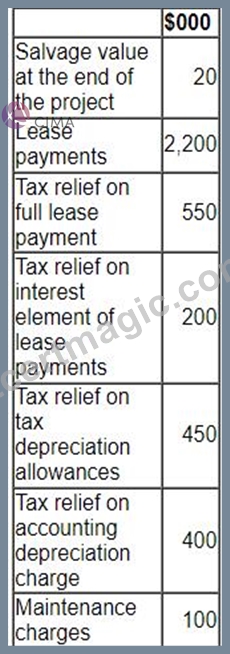
Using only the relevant data, which of the following is correct?
- A. The bank loan is $120,000 LESS expensive than the finance lease.
- B. The bank loan is $70,000 LESS expensive than the finance lease.
- C. The bank loan is $20,000 LESS expensive than the finance lease.
- D. The bank loan is $30,000 MORE expensive than the finance lease.
Answer: B
NEW QUESTION # 246
......
Get Special Discount Offer of CIMAPRA19-F03-1 Certification Exam Sample Questions and Answers: https://www.itcertmagic.com/CIMA/real-CIMAPRA19-F03-1-exam-prep-dumps.html
Enhance Your Career With Available Preparation Guide for CIMAPRA19-F03-1 Exam: https://drive.google.com/open?id=1yrZiM7ezwcsg9EdPL_8MHSc-9GFKgRql