

TAKE ISO 9001 ISO-9001-Lead-Auditor PRACTICE QUESTIONS FOR AMAZING RESULTS
PECB ISO-9001-Lead-Auditor Exam Dumps Are Essential To Get Good Marks
NEW QUESTION # 26
The following are stages of an audit, put them in the order they would be conducted.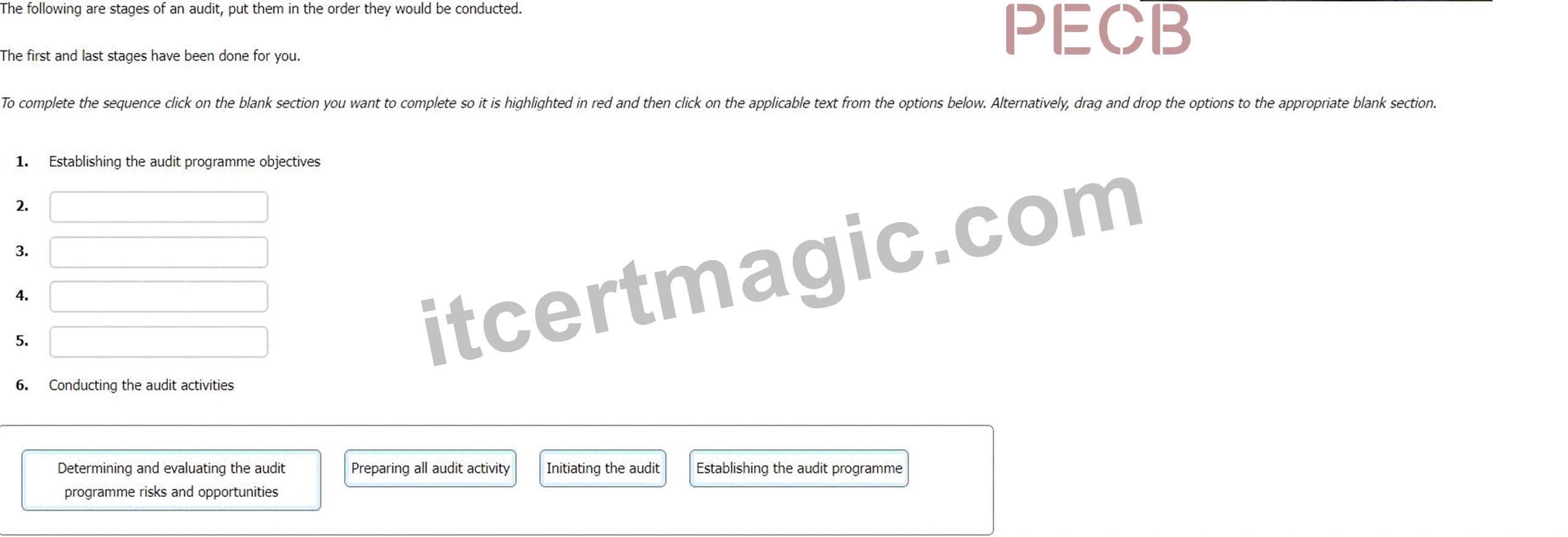
Answer:
Explanation: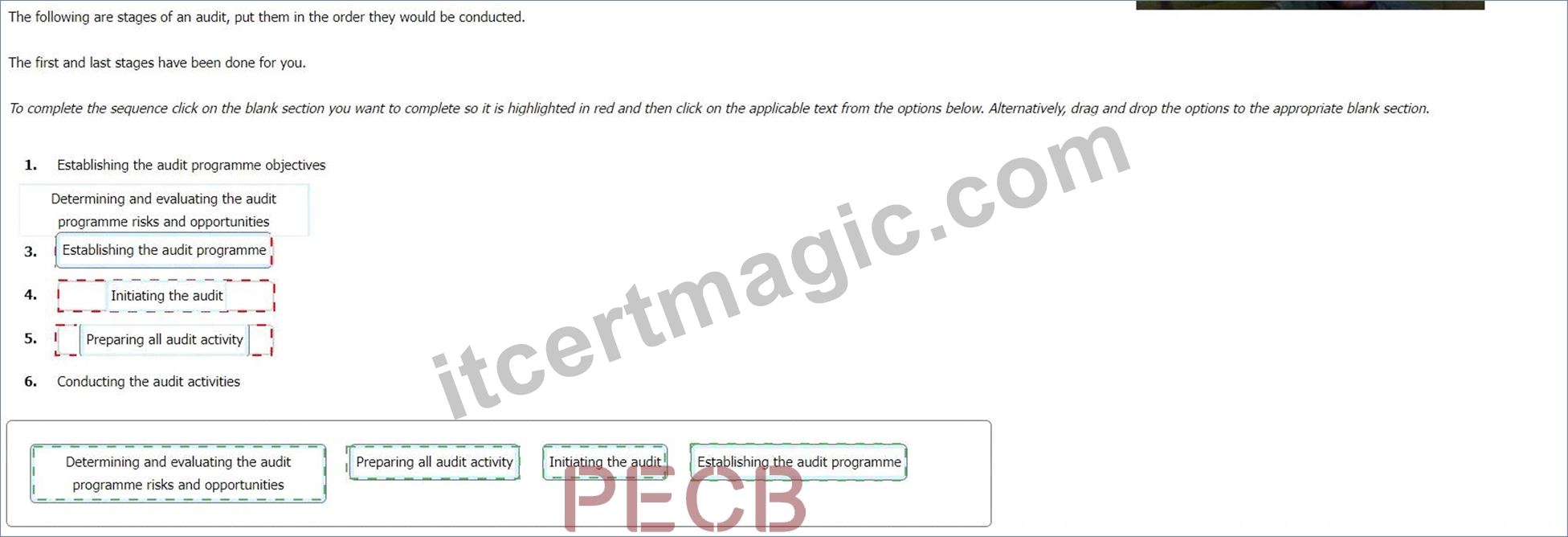
Explanation:
Establishing the audit programme objectives
Determining and evaluating the audit programme risks and opportunities
Establishing the audit programme
Initiating the audit
Preparing all audit activity
Conducting the audit activities
According to ISO 19011:2018, clause 5, the audit programme is a set of one or more audits planned for a specific time frame and directed towards a specific purpose. The audit programme includes all activities necessary to plan, organize, and conduct the audits. The audit programme management involves the following steps1:
Establishing the audit programme objectives: The audit programme objectives define the intended outcomes of the audit programme, such as verifying conformity, evaluating performance, identifying improvement opportunities, etc. The audit programme objectives should be aligned with the strategic direction and policies of the organization and the needs and expectations of the interested parties.
Determining and evaluating the audit programme risks and opportunities: The audit programme risks and opportunities are the factors that can affect the achievement of the audit programme objectives, such as changes in the internal or external context, availability of resources, competence of auditors, etc. The audit programme risks and opportunities should be identified, analyzed, and evaluated to determine the appropriate actions to address them.
Establishing the audit programme: The audit programme is established by defining the audit programme scope, criteria, methods, and resources. The audit programme scope defines the extent and boundaries of the audit programme, such as the processes, functions, sites, activities, etc. that will be audited. The audit programme criteria are the set of policies, procedures, or requirements used as a reference for the audits. The audit programme methods are the techniques used to conduct the audits, such as interviews, observations, document review, sampling, etc. The audit programme resources are the human, technical, and financial resources needed to implement the audit programme.
Initiating the audit: The audit initiation is the process of formally establishing the arrangements for an individual audit within the audit programme. The audit initiation involves contacting the auditee and the audit client, confirming the audit objectives, scope, and criteria, and obtaining the necessary information and access for the audit.
Preparing all audit activity: The audit preparation is the process of developing the audit plan and the audit work documents for an individual audit. The audit plan is a document that provides the basis for agreement regarding the conduct of the audit, such as the audit schedule, the audit team, the audit methods, the audit language, the audit report, etc. The audit work documents are the records that provide evidence of the audit activities, such as the audit checklist, the audit notes, the audit findings, etc.
Conducting the audit activities: The audit activities are the processes of collecting and verifying audit evidence and evaluating it against the audit criteria to make the audit conclusions. The audit activities include the opening meeting, the communication during the audit, the roles and responsibilities of the audit team and the auditee, the audit evidence collection and verification, the audit findings generation and recording, the closing meeting, and the audit report preparation and distribution.
References: ISO 19011:2018(en), Guidelines for auditing management systems
NEW QUESTION # 27
Match the process descriptions below to the process names: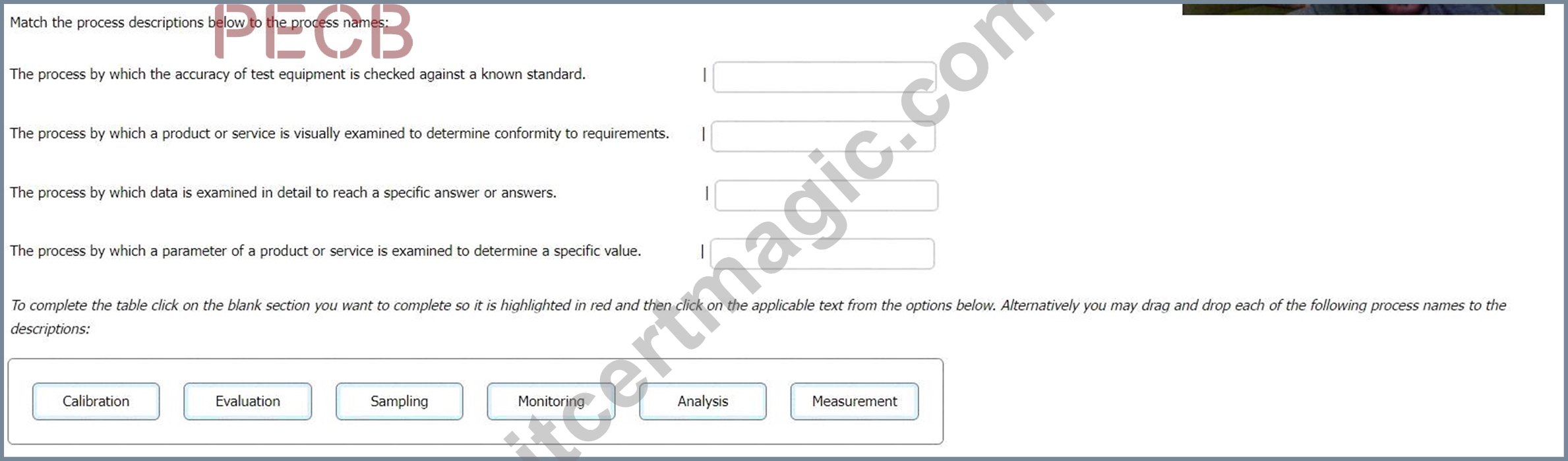
Answer:
Explanation: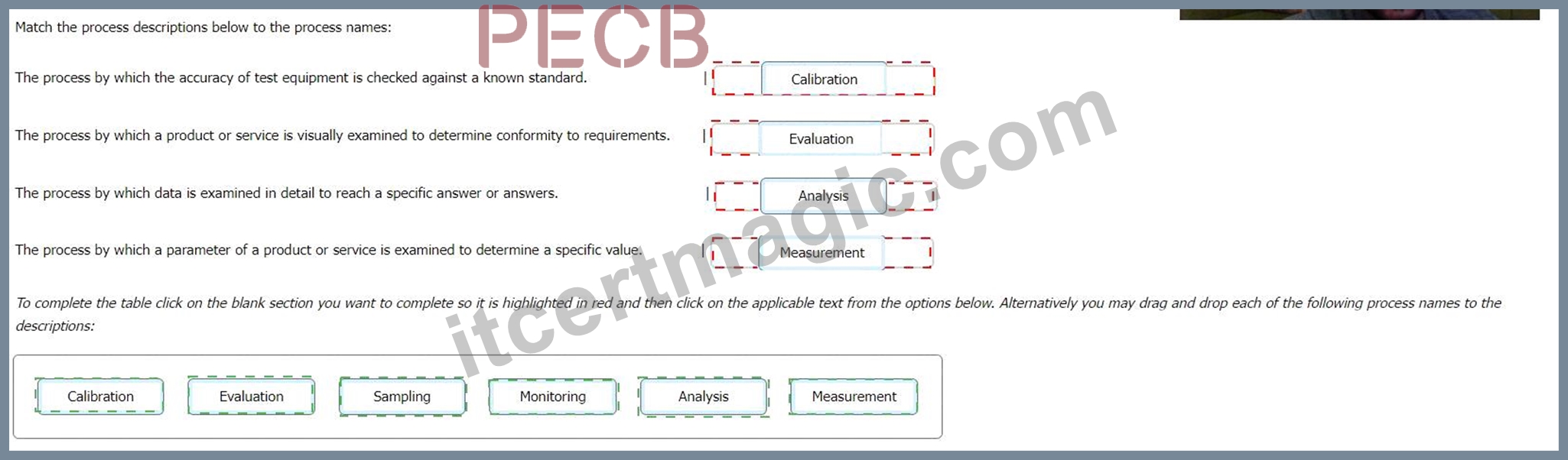
Explanation:
Match the process descriptions below to the process names:
The process by which the accuracy of test equipment is checked against a known standard. = Calibration The process by which a product or service is visually examined to determine conformity to requirements. = Evaluation The process by which data is examined in detail to reach a specific answer or answers. = Analysis The process by which a parameter of a product or service is examined to determine a specific value. = Measurement According to the ISO 9000:2015 - Quality management systems - Fundamentals and vocabulary, the definitions of the process names are as follows:
Calibration: operation that, under specified conditions, in a first step, establishes a relation between the quantity values with measurement uncertainties provided by measurement standards and corresponding indications with associated measurement uncertainties and, in a second step, uses this information to establish a relation for obtaining a measurement result from an indication.
Evaluation: determination of the suitability, adequacy or effectiveness of an object to achieve established objectives.
Analysis: detailed examination of the elements or structure of something.
Measurement: process to experimentally obtain one or more quantity values that can reasonably be attributed to a quantity.
Therefore, the process descriptions can be matched to the process names based on these definitions.
References:
ISO 9000:2015 - Quality management systems - Fundamentals and vocabulary
NEW QUESTION # 28
Put the following steps of a third-party audit into the correct sequence in which they happen.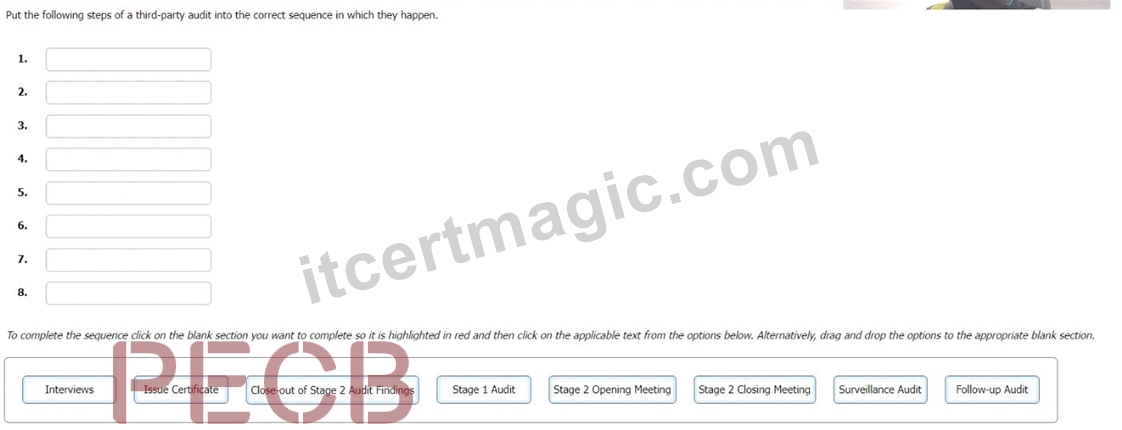
Answer:
Explanation: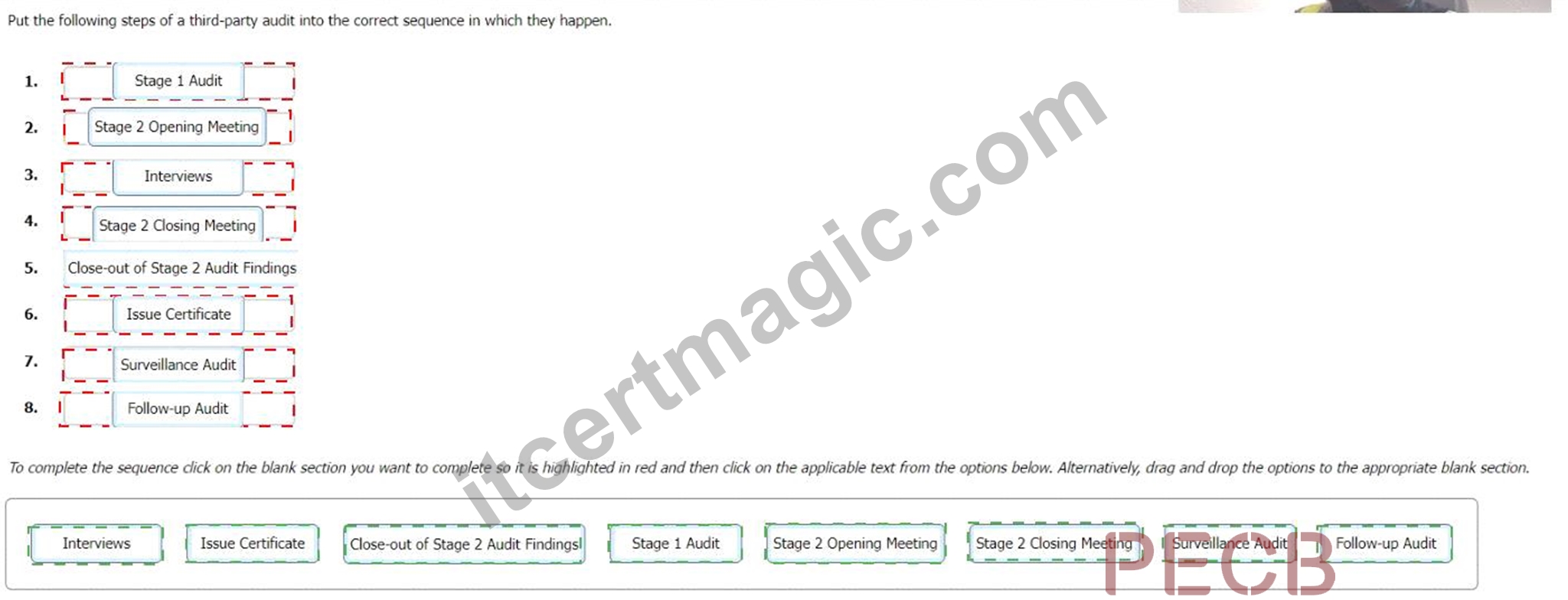
Explanation:
Sequence:
Stage 1 Audit
Stage 2 Opening Meeting
Interviews
Stage 2 Closing Meeting
Close-out of Stage 2 Audit Findings
Issue Certificate
Surveillance Audit
Follow-up Audit
To complete the sequence, you can drag and drop the options to the appropriate blank section.
Here is a brief explanation of each step:
Stage 1 Audit: This is the initial audit that aims to assess the readiness of the organization for the stage 2 audit. It involves reviewing the documentation of the quality management system, evaluating the scope and objectives of the audit, and identifying any major gaps or nonconformities34.
Stage 2 Opening Meeting: This is the meeting that marks the start of the stage 2 audit. It involves confirming the audit plan, the audit criteria, the audit scope, and the audit team. It also provides an opportunity for the auditee to ask any questions or raise any concerns34.
Interviews: This is the main activity of the stage 2 audit, where the audit team collects evidence by interviewing the personnel involved in the quality management system, observing the processes and activities, and examining the records and documents. The audit team uses various techniques, such as sampling, measurement, analysis, and evaluation, to verify the conformity and effectiveness of the quality management system345.
Stage 2 Closing Meeting: This is the meeting that marks the end of the stage 2 audit. It involves presenting the audit findings, the audit conclusions, and the audit report to the auditee. It also provides an opportunity for the auditee to provide feedback, ask questions, or dispute any findings34.
Close-out of Stage 2 Audit Findings: This is the process of verifying that the auditee has taken appropriate corrective actions to address any nonconformities or opportunities for improvement identified during the stage 2 audit. The audit team may request evidence or conduct a follow-up visit to confirm the effectiveness of the corrective actions34.
Issue Certificate: This is the process of issuing a certificate of conformity to the auditee, if the audit team is satisfied that the quality management system meets the requirements of the standard and that there are no major nonconformities or unresolved issues. The certificate is valid for a specified period, usually three years, and is subject to periodic surveillance audits34.
Surveillance Audit: This is the process of conducting periodic audits, usually once a year, to monitor the continued conformity and effectiveness of the quality management system. It involves reviewing the changes, improvements, and performance of the quality management system, and identifying any new nonconformities or opportunities for improvement34.
Follow-up Audit: This is the process of conducting an additional audit, usually in response to a significant change, a complaint, or a major nonconformity, to verify the impact and the corrective actions taken by the auditee. It may result in the suspension, withdrawal, or renewal of the certificate, depending on the outcome of the audit34.
NEW QUESTION # 29
You have been nominated audit team leader of a third-party audit. Which of the following could be the two most relevant objectives of this audit?
- A. Identify the need of resources
- B. Evaluate the effectiveness of the management system
- C. Evaluate the capability of the management system to establish and achieve objectives
- D. Evaluate the benefits obtained since the implementation of the management system
- E. Evaluate the satisfaction interested parties
- F. Identify opportunities for improvement
Answer: B,C
NEW QUESTION # 30
You are conducting a third-party audit to ISO 9001 and the next item on your audit plan is 'internal auditing'.
When reviewing a sample of audit records up to 5 years previously, you find that many contain non-conformance reports and no actions have been taken. You interview the Quality Manager.
You: "I have noted that many of the older files contain non-conformances that have not had any corrective action taken." Quality Manager: "Because the business is always changing, the departmental managers tell me that the non-conformances are no longer applicable. I made a decision that any non-conformance over 3 years old is automatically closed" You: "Do you obtain any confirmation beforehand from the appropriate departments that the non-conformances are no longer applicable." Quality Manager: " No, because they are so old I consider that they are no longer appropriate. Please remember that we take a risk-based approach which means we audit where and when it is considered important to do so.
Select one course of action you would now take from the options.
- A. Raise a non-conformance report against clause 9.2.2.e of ISO 9001
- B. Interview Top management to determine whether they were aware of and agreed the actions of the Quality Manager
- C. Interview relevant Departmental managers to assess whether the older non-conformances are still valid.
- D. Review all non-conformances reports related to clause 9.2 of ISO 9001
Answer: A
Explanation:
According to ISO 9001:2015, clause 9.2.2.e, the organization is required to retain documented information as evidence of the implementation of the audit programme and the audit results. This includes the records of the nonconformities identified during the internal audits and the corrective actions taken to address them. The organization is also required to verify the effectiveness of the corrective actions, as per clause 10.2.2.
Therefore, in the scenario given, the Quality Manager's decision to automatically close any nonconformance over 3 years old without obtaining any confirmation from the relevant departments or verifying the effectiveness of the corrective actions is a clear violation of the requirements of clause 9.2.2.e. This indicates a lack of control and follow-up of the internal audit process, as well as a potential risk of recurrence or occurrence of the nonconformities in other areas. This also undermines the credibility and value of the internal audit programme, as well as the risk-based approach claimed by the Quality Manager.
Hence, the best course of action to take is D, to raise a nonconformance report against clause 9.2.2.e of ISO
9001, and to communicate the audit findings to the relevant management. The other options are either insufficient or irrelevant to address the issue, as they do not directly relate to the noncompliance with clause
9.2.2.e.
References:
ISO 9001:2015(en), Quality management systems - Requirements, clause 9.2.2 and 10.2.2 ISO 19011:2018(en), Guidelines for auditing management systems, clause 6.4.4 and 6.7.2 ISO 9001 Lead Auditor Training Course | IRCA Certified | BSI, section "Learning objectives" ISO 9001 Lead Auditor Course Material | 3FOLD Education Centre, module 5 and 6
NEW QUESTION # 31
Below are four of the seven principles on which ISO 9000 series are based. Match a potential benefit to each of the quality management principles (QMP).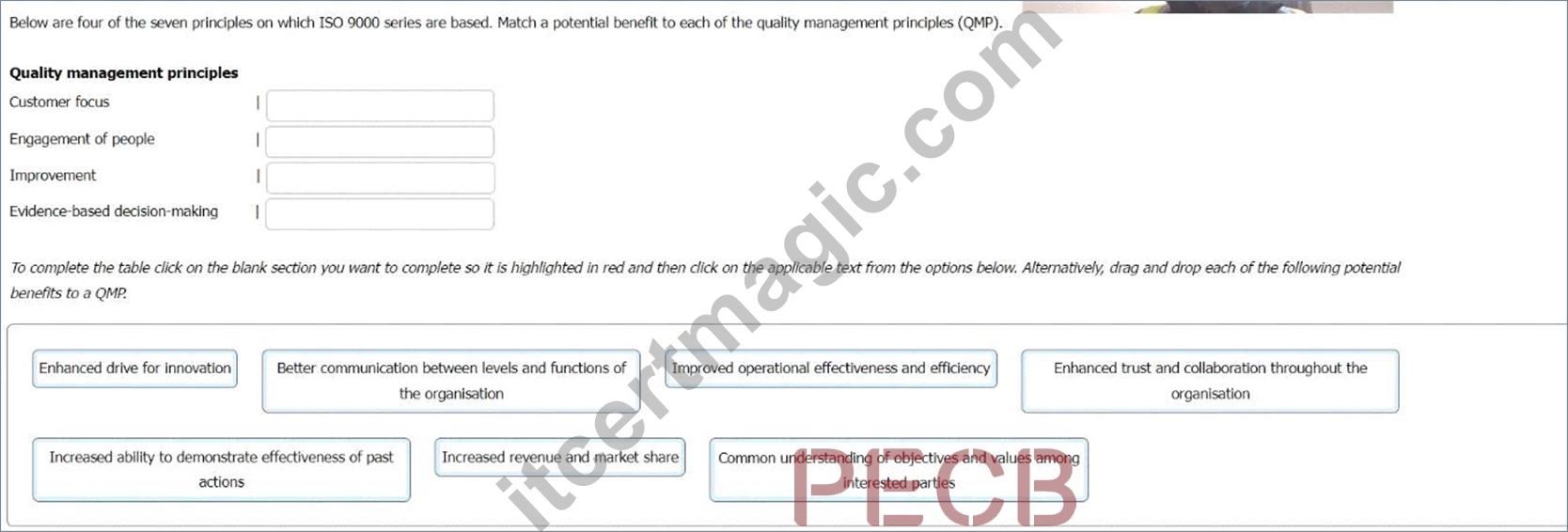
Answer:
Explanation: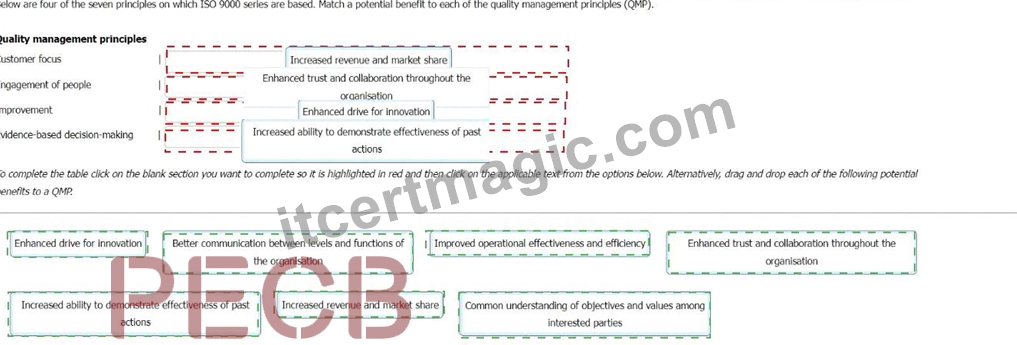
Explanation:
A screenshot of a chat Description automatically generated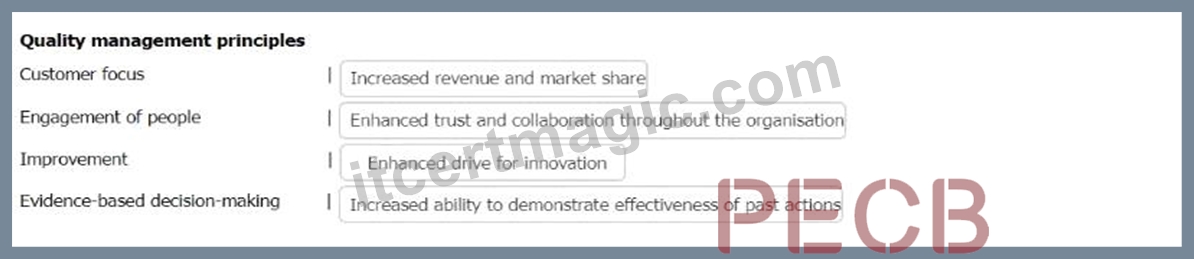
According to the ISO 9000:2015 document, the seven quality management principles are:
Customer focus
Leadership
Engagement of people
Process approach
Improvement
Evidence-based decision making
Relationship management
For each principle, the document provides a statement, a rationale, key benefits, and actions you can take to apply the principle in your organization.
Based on the document, here is a possible way to match a potential benefit to each of the four quality management principles you mentioned:
Table
Quality management principle
Potential benefit
Customer focus
Increased revenue and market share
Engagement of people
Enhanced trust and collaboration throughout the organization
Improvement
Enhanced drive for innovation
Evidence-based decision making
Increased ability to demonstrate effectiveness of past actions
NEW QUESTION # 32
During a second-party audit of a dairy farm (by a potential customer) complying with ISO 9001:2015, the auditor verifies that there is large variability in the daily production of the milking yard. The current agreement with their only customer is to provide 2,000 litres per day. However, in the last two years, they have noticed an increasing variability in daily production.
If they produce less than 2,000 litres, they are penalised with a fine of 1.5 pesos for every litre that they do not provide. If they produce more than 2,000 litres, they use the extra milk to feed the pigs.
This process has been in operation for decades. The dairy farm was founded by the grandfather of the current owners, who did not want to alter the established practices.
The auditor raises a nonconformity on the basis that the process is not under control (Clause 8.1).
If you had been the auditor, which one of the following actions would you have accepted?
- A. Retain the current contract and try to sell the occasional surplus milk to a second customer.
- B. Analyse the daily dispatch of milk for 7 days to determine its variability.
- C. Apply the existing process of addressing the risks and opportunities of milk production.
- D. Modify the contract with the current customer to provide them with only 1,500 litres of milk per day and make an agreement with a second customer.
Answer: C
Explanation:
The action that the auditor would have accepted is:
*Option B: Apply the existing process of addressing the risks and opportunities of milk production. This option is correct because ISO 9001:2015 clause 8.1 requires the organization to plan, implement and control the processes needed to meet the requirements for the provision of products and services, and to implement actions determined in clause 6.1, which refers to the actions to address risks and opportunities. The organization should apply the existing process of addressing the risks and opportunities of milk production, which may include identifying the sources of variability, assessing the potential impacts and consequences, determining and implementing appropriate actions to reduce or eliminate the variability, monitoring and measuring the effectiveness of the actions, and reviewing and updating the actions as necessary.
The following options are not correct:
*Option A: Modify the contract with the current customer to provide them with only 1,500 litres of milk per day and make an agreement with a second customer. This option is not correct because it does not address the root cause of the variability in the daily production of the milking yard, which may affect the quality and consistency of the products and services provided by the organization. It also does not demonstrate the organization's commitment to meet the customer and applicable statutory and regulatory requirements, as required by ISO 9001:2015 clause 8.2.2.
*Option C: Retain the current contract and try to sell the occasional surplus milk to a second customer. This option is not correct because it does not address the root cause of the variability in the daily production of the milking yard, which may affect the quality and consistency of the products and services provided by the organization. It also does not demonstrate the organization's commitment to meet the customer and applicable statutory and regulatory requirements, as required by ISO 9001:2015 clause 8.2.2.
*Option D: Analyse the daily dispatch of milk for 7 days to determine its variability. This option is not correct because it does not address the root cause of the variability in the daily production of the milking yard, which may affect the quality and consistency of the products and services provided by the organization. It also does not demonstrate the organization's commitment to implement actions to address risks and opportunities, as required by ISO 9001:2015 clause 8.1.
References:
*ISO 9001:2015 Quality management systems - Requirements, Clause 8: Operation, Subclause 8.1:
Operational planning and control, Subclause 8.2: Requirements for products and services
*ISO 9001 Lead Auditor Course Material, Module 4: ISO 9001:2015 Requirements, Slide 23: Clause 8 - Operation
*ISO 9001 Lead Auditor Training Course - IRCA Certified, Section 4.2: ISO 9001:2015 Requirements, Subsection 4.2.8: Clause 8 - Operation
*Lead Auditor Exam Preparation Guide (EPG) Template - PECB, Section 3.2: Exam Content Outline, Subsection 3.2.1: Section 1 - Audit Fundamentals, Subsection 3.2.2: Section 2 - Audit Principles, Subsection
3.2.3: Section 3 - Audit Process, Subsection 3.2.4: Section 4 - Audit Competencies
NEW QUESTION # 33
You have been nominated audit team leader of a third-party audit. Which of the following could be the two most relevant objectives of this audit?
- A. Identify the need of resources
- B. Evaluate the effectiveness of the management system
- C. Evaluate the capability of the management system to establish and achieve objectives
- D. Evaluate the benefits obtained since the implementation of the management system
- E. Evaluate the satisfaction interested parties
- F. Identify opportunities for improvement
Answer: B,C
Explanation:
Evaluate the effectiveness of the management system: This objective involves verifying that the quality management system meets the requirements of a specific standard, such as ISO 9001:2015, and that it achieves the intended results and outcomes. The audit team will collect and analyse audit evidence to determine the degree of conformity and performance of the quality management system23.
*Evaluate the capability of the management system to establish and achieve objectives: This objective involves verifying that the quality management system supports the strategic direction and policies of the organization, and that it addresses the needs and expectations of the interested parties. The audit team will assess the suitability, adequacy, and alignment of the quality management system objectives, and the effectiveness of the planning and implementation processes to achieve them23.
The other options are not the most relevant objectives of a third-party audit, according to the web search results from my internal tool. They may be related to other aspects or types of audits, but they are not the focus of a third-party audit.
Therefore, the correct answer is B and D.
References: 1: Safeguarding Your Business: The Power of Third-Party Security Audits 2: ISO 19011:2018 - Guidelines for auditing management systems 3: Third Party Audit - QMSGurus.com
NEW QUESTION # 34
Select the word that best completes the sentence:
Answer:
Explanation:
Explanation:
According to the ISO - Management system standards page, the key benefits of an effective management system include improved operational effectiveness and efficiency, improved risk management and protection of people and the environment, and enhanced drive for innovation. The Integrated Use of Management System Standards (IUMSS) handbook also states that the purpose and objectives of management system standards are to help organizations improve their performance by specifying repeatable steps that organizations consciously implement to achieve their goals and objectives.
Therefore, the complete sentence is:
"The purpose of a management system standard is to improve the performance of an organisation."
NEW QUESTION # 35
You are carrying out an audit to ISO 9001 at an organisation which offers regulatory consultancy services to manufacturers of cosmetics.
You are interviewing the Technical Director (TD), who manages a team of regulatory experts responsible for providing regulatory services to customers.
You: "How do you ensure your regulatory team's competence concerning regulatory requirements is maintained?" TD: "The two Regulatory Experts we employ full-time have years of experience of working in the cosmetics industry." You: "How is their regulatory competence maintained?" TD: "They are dedicated individuals with lots of contacts in the sector." You: "How does the business enable them to maintain their understanding of current regulatory requirements?" TD: "We leave that up to them."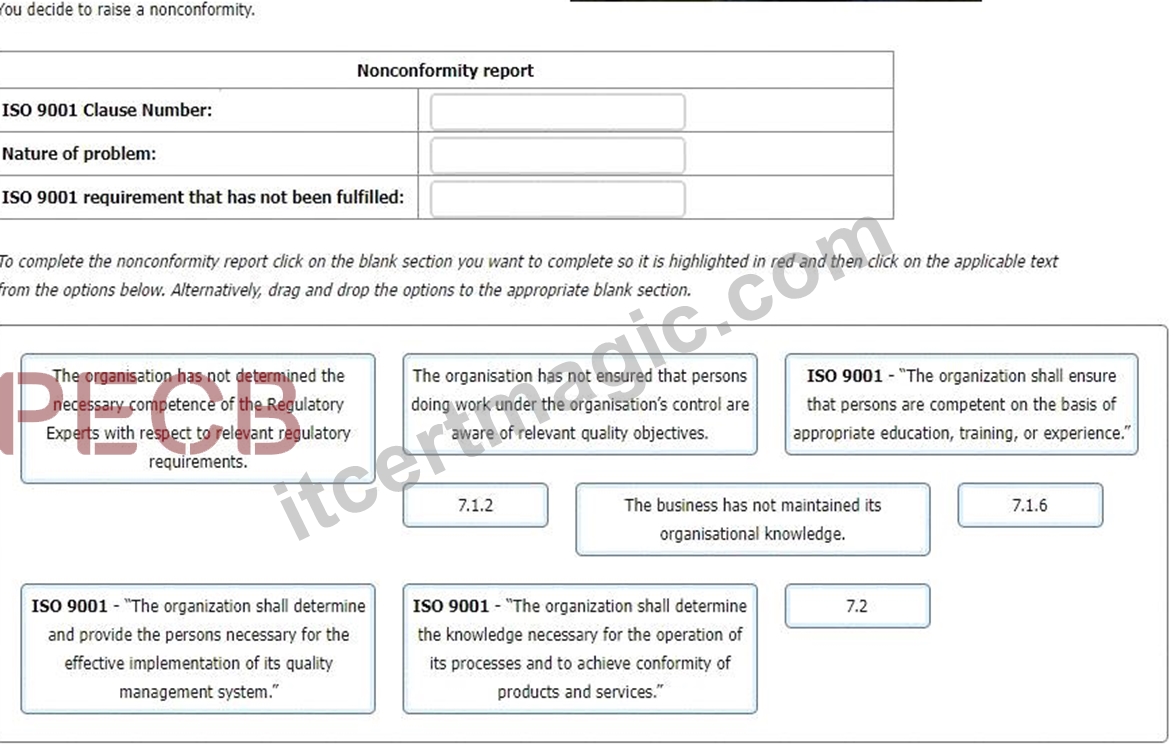
Answer:
Explanation: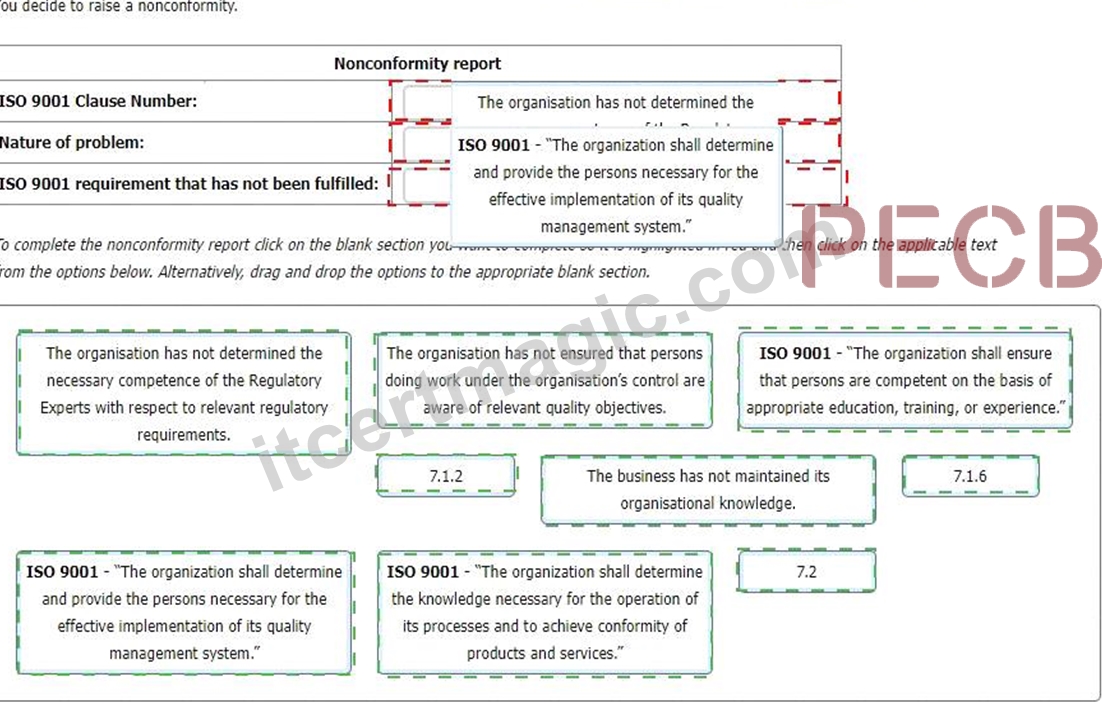
Explanation:
A screenshot of a computer Description automatically generated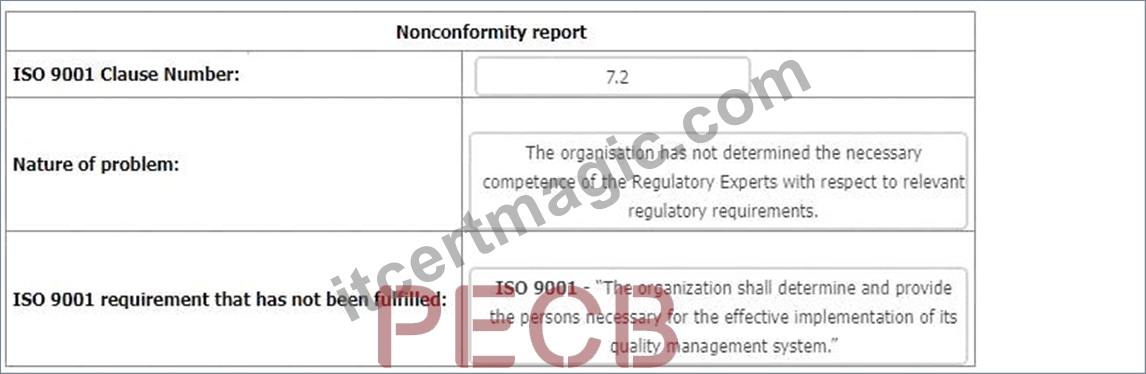
NEW QUESTION # 36
An internal auditor of a manufacturer of polystyrene packaging products for the electronics industry raised a nonconformity against section 10.3 of ISO 9001 in Report IA202. The nonconformity (NC 3) stated:
"The reject rate of the finished product of 9.7% needs improvement as it doesn't meet the stated objective of top management of 5%." As the third-party auditor reviewing the internal audit process, you come across the nonconformity. For corrective action, the Quality Manager conducted an investigation into the reject rates. He reported that the collection baskets for products ejecting from the moulding machines were not large enough. About 6% of products fell onto the wet and dirty factory floor. Management stated that replacing the baskets was too costly and ordered the Maintenance Manager to ensure that the floor was kept clean and dry to prevent rejects. The auditor later checked the factory floor, which was wet and dirty in places.
From the following nonconformities, select three that the auditor could raise to ISO 9001.
- A. 9.2.2 - Report IA202 contained a poorly worded nonconformity (NC 3).
- B. 7.3 - Staff were not aware that products were falling onto the factory floor.
- C. 7.1.4 - The factory environment is not suitably maintained to prevent dirty products.
- D. 8.5.1 - Production operations were not properly controlled to avoid reject products.
- E. 8.6 - Dirty products were released to the customer.
- F. 10.2.1 - Conduct of an investigation was not sufficient to understand the cause of the nonconformity.
- G. 7.1.1 - The organisation failed to provide the required resources to prevent nonconforming products.
- H. 10.3 - The organisation did not continuously improve. Reject rates were unchanged.
Answer: C,G,H
Explanation:
The auditor could raise the following nonconformities to ISO 9001 based on the scenario:
*Option A: 10.3 - The organisation did not continuously improve. Reject rates were unchanged. This option is correct because ISO 9001:2015 clause 10.3 requires the organization to improve the suitability, adequacy and effectiveness of the quality management system. The organization did not demonstrate any improvement in reducing the reject rate of the finished product, which was a stated objective of top management. The corrective action taken by the organization was not effective in addressing the root cause of the problem and preventing its recurrence.
*Option B: 7.1.4 - The factory environment is not suitably maintained to prevent dirty products. This option is correct because ISO 9001:2015 clause 7.1.4 requires the organization to determine, provide and maintain the environment necessary for the operation of its processes and to achieve conformity of products and services.
The organization did not ensure that the factory floor was clean and dry, which affected the quality of the products and increased the risk of nonconformity.
*Option C: 7.1.1 - The organization failed to provide the required resources to prevent nonconforming products. This option is correct because ISO 9001:2015 clause 7.1.1 requires the organization to determine and provide the resources needed for the establishment, implementation, maintenance and continual improvement of the quality management system. The organization did not provide adequate collection baskets for the products ejecting from the moulding machines, which resulted in products falling onto the factory floor and becoming nonconforming.
The following options are not correct:
*Option D: 9.2.2 - Report IA202 contained a poorly worded nonconformity (NC 3). This option is not correct because ISO 9001:2015 clause 9.2.2 does not specify the requirements for the wording of nonconformities in internal audit reports. The nonconformity (NC 3) stated by the internal auditor was clear and relevant to the audit criteria and audit evidence. The issue is not with the report, but with the corrective action taken by the organization.
*Option E: 8.6 - Dirty products were released to the customer. This option is not correct because ISO
9001:2015 clause 8.6 requires the organization to implement planned arrangements, at appropriate stages, to verify that the product and service requirements have been met. The scenario does not indicate that the dirty products were released to the customer, but that they were recalled and repaired then returned to the customers. The issue is not with the release, but with the production process and the environment.
*Option F: 7.3 - Staff were not aware that products were falling onto the factory floor. This option is not correct because ISO 9001:2015 clause 7.3 requires the organization to ensure that the persons doing work under its control are aware of the quality policy, relevant quality objectives, their contribution to the effectiveness of the quality management system, and the implications of not conforming with the quality management system requirements. The scenario does not indicate that the staff were not aware of these aspects, but that the management did not provide adequate resources and environment for the staff to perform their work. The issue is not with the awareness, but with the management responsibility and resource provision.
*Option G: 10.2.1 - Conduct of an investigation was not sufficient to understand the cause of the nonconformity. This option is not correct because ISO 9001:2015 clause 10.2.1 requires the organization to react to the nonconformity and, as applicable, take action to control and correct it and deal with the consequences. The scenario indicates that the Quality Manager conducted an investigation into the reject rates and identified the cause of the nonconformity. The issue is not with the investigation, but with the corrective action taken by the management.
*Option H: 8.5.1 - Production operations were not properly controlled to avoid reject products. This option is not correct because ISO 9001:2015 clause 8.5.1 requires the organization to implement production and service provision under controlled conditions. The scenario indicates that the production operations were controlled by the moulding machines, which ejected the products into the collection baskets. The issue is not with the production operations, but with the size of the collection baskets and the condition of the factory floor.
References:
*ISO 9001:2015 Quality management systems - Requirements
*ISO 9001 Lead Auditor Course Material, Module 6: Reporting Audit Findings, Slide 14: Writing Nonconformity Statements
*ISO 9001 Lead Auditor Training Course - IRCA Certified, Section 6.2: Reporting Audit Findings
*Lead Auditor Exam Preparation Guide (EPG) Template - PECB, Section 3.2: Exam Content Outline, Subsection 3.2.1: Section 1 - Audit Fundamentals, Subsection 3.2.2: Section 2 - Audit Principles, Subsection
3.2.3: Section 3 - Audit Process, Subsection 3.2.4: Section 4 - Audit Competencies
NEW QUESTION # 37
Takitup is a small fabrication organisation that manufactures steel fencing, stairs and platforms for the construction sector. It has been certified to ISO 9001 for some time and has appointed a new Quality Manager.
The audit plan during a surveillance audit covers the organisation's improvement actions and the auditor asks to see the most recent management review meeting minutes.
The auditor finds that the management review report records that none of the improvement actions set by the previous review has been realised for a second time. A new Quality Manager has been brought in at the middle management level to rectify the situation as the organisation is concerned that it might lose its certification.
Select three options that would provide evidence of conformance with clause 10.3 of ISO 9001.
- A. An enhanced customer satisfaction survey score than in the previous year.
- B. A quality objective to achieve lower reject rates by quality control.
- C. An increase in the number of quality staff.
- D. Outsource more processes to external providers
- E. The certification body auditor reporting fewer nonconformities.
- F. Automate the fabrication process to increase profitability.
- G. Removing expensive external providers from the database.
- H. Considering results from the analysis of the effectiveness of corrective actions to determine improvement opportunities.
Answer: A,B,H
NEW QUESTION # 38
Match each of the following statements into the table below to show whether they apply to first-party audits, second-party audits or third-party audits: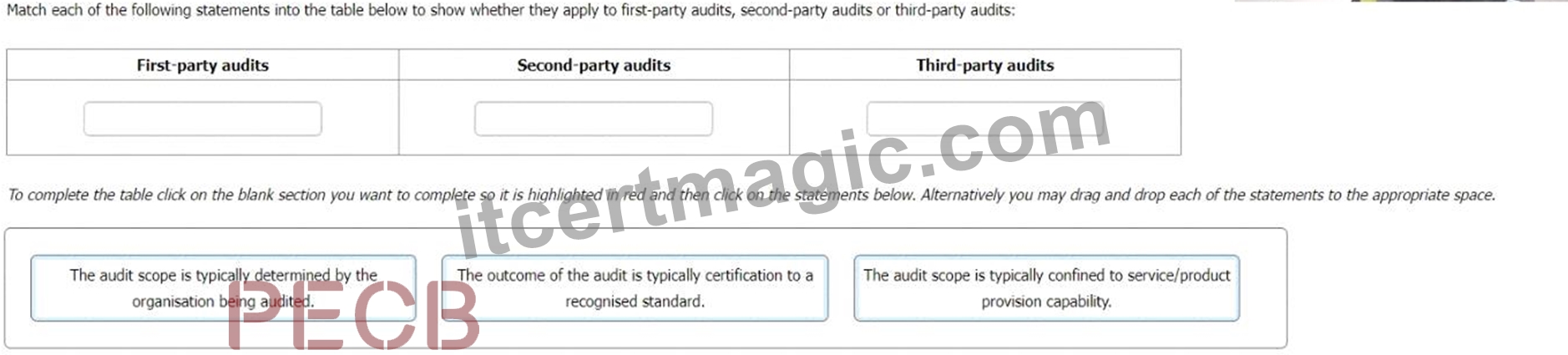
Answer:
Explanation: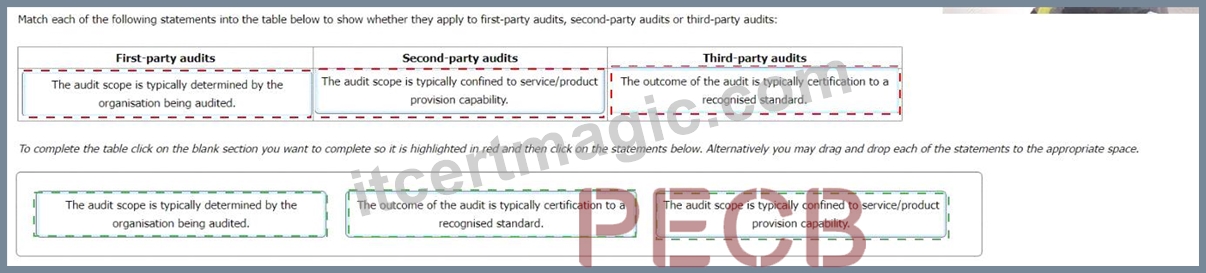
Explanation:
Table
Statement
First-party audits
Second-party audits
Third-party audits
The audit scope is typically determined by the organisation being audited.
Yes
No
No
The outcome of the audit is typically certification to a recognised standard.
No
No
Yes
The audit scope is typically confined to service/product provision capability.
No
Yes
No
Here is a brief explanation of each statement:
The audit scope is typically determined by the organisation being audited: This statement applies to first-party audits, also known as internal audits, where the organisation audits its own processes and activities to ensure conformity and improvement1. The organisation can decide the scope of the audit based on its own needs and objectives2. This statement does not apply to second-party audits, where the customer audits the supplier, or third-party audits, where an independent body audits the organisation. In these cases, the audit scope is determined by the customer or the certification body, respectively34.
The outcome of the audit is typically certification to a recognised standard: This statement applies to third-party audits, where an independent body audits the organisation to verify that it meets the requirements of a specific standard, such as ISO 9001, and issues a certificate of conformity if the audit is successful34. This statement does not apply to first-party audits or second-party audits, where the outcome of the audit is not certification, but rather self-improvement or supplier qualification13.
The audit scope is typically confined to service/product provision capability: This statement applies to second-party audits, where the customer audits the supplier to ensure that they are meeting the requirements specified in the contract, such as service or product quality, delivery, or performance34. The audit scope is usually focused on the specific aspects of the service or product that are of interest to the customer3. This statement does not apply to first-party audits or third-party audits, where the audit scope is broader and covers the entire quality management system or the relevant clauses of the standard14.
NEW QUESTION # 39
Which two of the following are included in the objectives of the 'Stage 1 initial certification audit'?
- A. To review the quality manual.
- B. To evaluate the preparedness of the organisation for a Stage 2 audit.
- C. To evaluate the internal audit and management review processes.
- D. To make a decision on certification to ISO 9001:2015.
- E. To evaluate the performance of monitoring and reviewing activities.
- F. To evaluate the operational processes of the organisation.
Answer: A,B
Explanation:
*To evaluate the preparedness of the organisation for a Stage 2 audit: This objective involves assessing the readiness of the organisation to undergo the Stage 2 audit, where the conformity and effectiveness of the quality management system will be verified123. The audit team will check the level of implementation and understanding of the quality management system, identify any major gaps or nonconformities, and confirm the audit scope, criteria, and plan123.
*To review the quality manual: This objective involves reviewing the documented information of the quality management system, such as the quality policy, the quality objectives, the scope, the processes, and the procedures, to ensure that they meet the requirements of ISO 9001:2015123. The audit team will also evaluate the organisation's understanding and application of the standard, and identify any areas of improvement or concern123.
The other options are not included in the objectives of the Stage 1 initial certification audit, according to the web search results from my internal tool. They may be related to other stages or types of audits, but they are not the focus of the Stage 1 audit.
Therefore, the correct answer is B and D.
References: 1: ISO 9001 Certification Audits | Stage 1 and Stage 2 - 9001. Simplified 2: Stage 1 of your Audit
| NQA Blog 3: Getting Certified to ISO 9001 - the Stage 1 Audit
NEW QUESTION # 40
XYZ Corporation is an organisation that employs 100 people. As the audit team leader, you conduct a certification audit at Stage 1. When reviewing the quality management system (QMS), you find that the objectives have been defined by an external consultant using those of a competitor, but nothing is documented.
The Quality Manager complains that this has created a lot of resistance to the QMS, and the Chief Executive is asking questions about how much it will cost.
Which two options describe the circumstances in which you could raise a nonconformity against clause 6.2 of ISO 9001?
- A. The consultant has not interpreted ISO 9001 correctly.
- B. Quality objectives are not being implemented by the organisations' personnel.
- C. Quality objectives were not established in alignment with the organisation's quality policy.
- D. Establishing quality objectives did not include top management.
- E. Quality objectives are not maintained as documented information.
- F. The organisation cannot afford to undertake quality objectives all at once.
Answer: C,E
Explanation:
According to ISO 9001:2015, clause 6.2.1, the organization is required to establish quality objectives at relevant functions, levels, and processes for the quality management system (QMS). The quality objectives must be consistent with the quality policy, measurable, monitored, communicated, and updated as appropriate.
The organization is also required to maintain documented information on the quality objectives, as per clause
7.5.1.
Therefore, in the scenario given, the quality objectives defined by the external consultant are not in alignment with the organization's quality policy, as they are based on those of a competitor, rather than the organization's own purpose, strategic direction, and customer requirements. This creates a mismatch between the organization's vision and goals, and the quality objectives that are supposed to guide and measure the QMS performance. Moreover, the quality objectives are not maintained as documented information, which makes it difficult to communicate, monitor, and update them, as well as to demonstrate evidence of their implementation and achievement.
Hence, the circumstances in which a nonconformity against clause 6.2 of ISO 9001 could be raised are B and C, as they indicate a failure to comply with the requirements of clause 6.2.1. The other options are either irrelevant or not directly related to clause 6.2, as they do not pertain to the establishment and documentation of quality objectives.
References:
ISO 9001:2015(en), Quality management systems - Requirements, clause 6.2.1 and 7.5.1 ISO 19011:2018(en), Guidelines for auditing management systems, clause 6.4.4 and 6.7.2 ISO 9001 Lead Auditor Training Course | IRCA Certified | BSI, section "Learning objectives" ISO 9001 Lead Auditor Course Material | 3FOLD Education Centre, module 5 and 6
NEW QUESTION # 41
You are an auditor from a construction organisation who is conducting a second party audit to ISO 9001 at a steel rolling mill producing structural steelwork. When auditing the rolling process, you find that the operator who is unloading the furnace does not use the adjacent infrared pyrometer to measure the appropriate product temperature in readiness for the next production stage.
You: "How do you tell when the billet is ready for the rolling stage?"
Operator: "I've done this job for 20 years. I can tell by the bright red colour." You: "What happens if the colour is wrong?" Operator: "The billet goes back into the furnace." You: "Is the pyrometer ever used?" Operator: "Only in borderline cases." You continue to interview the operator and find that around 25% of the billets are sent back to the furnace.
This includes 80% of the borderline cases.
Select three options that would provide evidence of conformance with clause 9.1.1 of ISO 9001.
- A. Periodic analysis of the results of temperature checks.
- B. Planning for monitoring and measuring the billet temperature.
- C. Certification of conformance to national standards from the manufacture of the pyrometer.
- D. Maintenance plan for the furnace.
- E. Annual review records for furnace operators.
- F. A procedure that provides instruction in taking billet temperature.
- G. A quality objective to achieve lower recycle rates for billets.
- H. An increase in the use of the pyrometer by operators.
Answer: A,B,F
Explanation:
According to ISO 9001:2015, clause 9.1.1, the organization is required to determine what needs to be monitored and measured, the methods for monitoring, measurement, analysis and evaluation, as applicable, to ensure valid results, and when the monitoring and measuring shall be performed. The organization is also required to retain appropriate documented information as evidence of the results.
Therefore, in the scenario given, the organization should have planned for monitoring and measuring the billet temperature, as it is a critical factor for the quality of the product and the process. The organization should also have established a procedure that provides instruction in taking billet temperature, using the pyrometer or other suitable methods, to ensure consistency and accuracy. The organization should also have performed periodic analysis of the results of temperature checks, to identify trends, problems, and opportunities for improvement.
Hence, the options that would provide evidence of conformance with clause 9.1.1 of ISO 9001 are A, E, and F, as they are aligned with the requirements of the clause. The other options are either irrelevant or not directly related to clause 9.1.1, as they do not pertain to the monitoring and measurement of the billet temperature.
References:
ISO 9001:2015(en), Quality management systems - Requirements, clause 9.1.1 ISO 19011:2018(en), Guidelines for auditing management systems, clause 6.4.4 and 6.7.2 ISO 9001 Lead Auditor Training Course | IRCA Certified | BSI, section "Learning objectives" ISO 9001 Lead Auditor Course Material | 3FOLD Education Centre, module 5 and 6
NEW QUESTION # 42
Match the process descriptions below to the process names: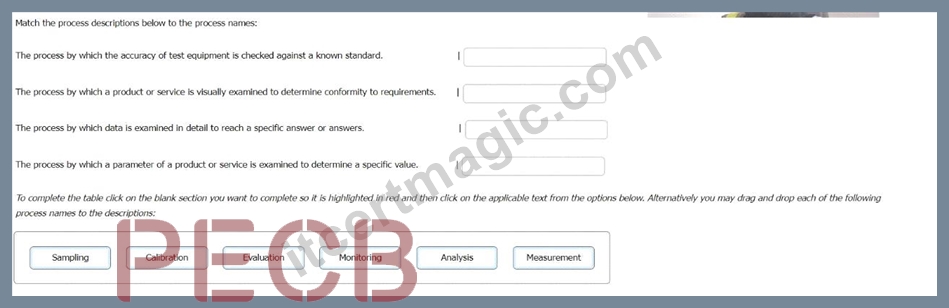
Answer:
Explanation: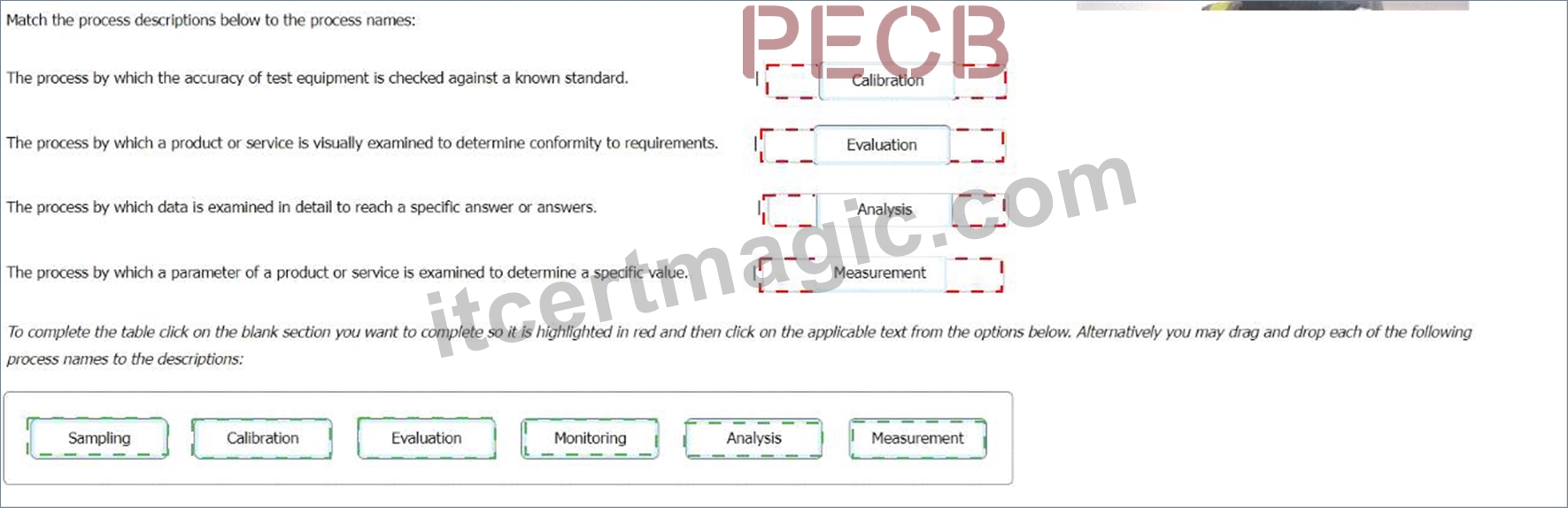
Explanation:
A white background with black text Description automatically generated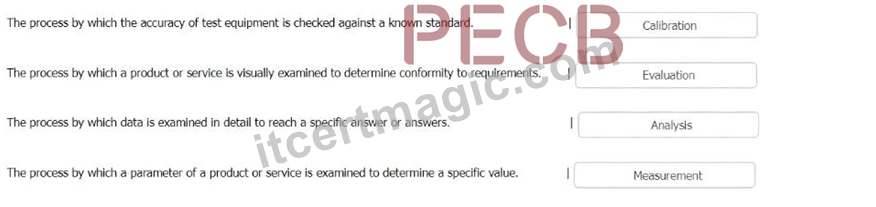
NEW QUESTION # 43
You work for an organisation, 'A', which provides packaged food to the public. You are asked to lead a team (you as the leader and two other auditors) to audit a supplier, 'B', which provides packaging materials to your organisation. It is 4 p.m. and the audit is close to an end; you are having an internal meeting with the team to decide what will be presented to the auditee during the Closing meeting.
The Closing meeting was scheduled
for 5 p.m.
You, as audit team leader, audited top management, the laboratory, and the storage of raw materials.
Auditor 1 audited the two manufacturing lines and dispatch areas.
You to Auditor 1: "What findings would you report?"
Auditor 1: "When reviewing the Dispatch records, I noticed that during the morning two different trucks (Number 011 and 025) delivered the same batch number of the product (Batch 33555). Truck 011 left the plant at 9.15 am and Truck 025 left the plant at
11.30 am. Procedure P-02 Rev.3 says
that trucks should carry a complete batch. The batch number, once on the truck, is captured using a QR device." You: "OK, what do you think?" Auditor 2: "I think that this is a nonconformity." You: "OK. How would you describe the evidence on which the nonconformity will be based"?
Identify which one of the following statements best describes the identified nonconformity.
- A. Dispatch personnel do not always carry out its activities in conformance with Procedure P-02 rev 3.
- B. The batch 33555 was delivered split in two different trucks (011 and 025).
- C. A product delivered to the client was not identified as required in P-02 Rev 3.
- D. Dispatch personnel are not fully aware of the need to conform to written procedures.
Answer: B
Explanation:
According to the definition in ISO 9000, a nonconformity is "non-fulfillment of a requirement". There are three parts to a well-documented nonconformity: the audit evidence to support auditor findings; a record of the requirement against which the nonconformity is detected; and the statement of nonconformity1. In this case, the audit evidence is the dispatch records that show the same batch number of the product being delivered by two different trucks at different times. The requirement is the procedure P-02 Rev.3 that says that trucks should carry a complete batch. The statement of nonconformity is that the batch 33555 was delivered split in two different trucks (011 and 025), which does not conform to the procedure. Therefore, option C best describes the identified nonconformity, as it includes all three parts of a well-documented nonconformity.
Option A is not correct, as it does not state the audit evidence or the requirement. Option B is not correct, as it does not specify the audit evidence or the statement of nonconformity. Option D is not correct, as it does not match the audit evidence or the requirement. References: 1: ISO 9001 Auditing Practices Group Guidance on Nonconformity - Documenting.
NEW QUESTION # 44
Which two of the following are the key expected results of a quality management system that conforms to the requirements of ISO 9001:2015?
- A. Decreased number of warranty claims
- B. Enhanced customer satisfaction
- C. Decreased number of management system nonconformities
- D. Increased profits
- E. Consistently provide products that meet customers' requirements
- F. Decreased number of nonconforming products in all stages of the manufacturing cycle
Answer: B,E
Explanation:
According to the ISO 9001:2015 document, the key expected results of a quality management system that conforms to the requirements of ISO 9001:2015 are:
*the ability to consistently provide products and services that meet customer and applicable statutory and regulatory requirements;
*the enhancement of customer satisfaction.
These results are derived from the quality management principles of customer focus and process approach, which are the basis of the ISO 9000 family of standards1. Customer focus means understanding and meeting customer needs and expectations, as well as exceeding them when possible1. Process approach means managing activities as interrelated processes that function as a coherent system, which leads to consistent and predictable results1.
Therefore, the correct answer is C and F.
References: 2: ISO 9001:2015 - Quality management systems - Requirements 1: ISO - Quality management principles
NEW QUESTION # 45
Which two of the following are the key expected results of a quality management system that conforms to the requirements of ISO 9001:2015?
- A. Decreased number of warranty claims
- B. Enhanced customer satisfaction
- C. Decreased number of management system nonconformities
- D. Increased profits
- E. Consistently provide products that meet customers' requirements
- F. Decreased number of nonconforming products in all stages of the manufacturing cycle
Answer: B,E
Explanation:
The key expected results of a quality management system that conforms to the requirements of ISO 9001:2015 are stated in clause 0.1 of the standard, which says: "The adoption of a quality management system is a strategic decision for an organization that can help to improve its overall performance and provide a sound basis for sustainable development initiatives. The potential benefits to an organization of implementing a quality management system based on this International Standard are: a) the ability to consistently provide products and services that meet customer and applicable statutory and regulatory requirements; b) facilitating opportunities to enhance customer satisfaction; c) addressing risks and opportunities associated with its context and objectives; d) the ability to demonstrate conformity to specified quality management system requirements." Therefore, the two options that best match these benefits are A and E, as they directly relate to providing products and services that meet customer requirements and enhancing customer satisfaction. The other options are not explicitly mentioned as key expected results, although they may be possible outcomes of implementing a quality management system. References: ISO 9001:2015 - Quality management systems - Requirements, Key Elements of an ISO 9001:2015 Quality Management System, What is ISO 9001 2015 as a Quality Management Systems?
NEW QUESTION # 46
Select six tasks you would expect to be completed at the audit team meeting of a third-party audit team leader and his audit team in preparation for a Closing meeting for a four-day initial certification audit.
- A. Audit team complete final version of their individual findings.
- B. Audit team leader informs the individual(s) managing the audit programme that the closing meeting is ready to be held.
- C. Audit team agree final audit outcome recommendation.
- D. Hold daily audit team meeting to review any timetable issues and potential findings and their impact on the audit for other team members.
- E. Write the audit finding report out when detected and obtain signature of the auditee.
- F. Audit team review any points raised by the auditee nominated representative.
- G. Agree the roles of each audit team member for the closing meeting.
- H. Final audit team meeting to agree findings and categories including clarification of any uncertainties.
- I. Audit team leader completes final report, including individual findings and certification recommendation.
- J. Re-audit corrective actions taken to correct findings found during the audit.
Answer: A,C,F,G,H,J
Explanation:
The tasks that are expected to be completed at the audit team meeting of a third-party audit team leader and his audit team in preparation for a Closing meeting for a four-day initial certification audit are:
*Option C: Final audit team meeting to agree findings and categories including clarification of any uncertainties. This option is correct because the audit team meeting is an opportunity for the audit team leader and the audit team members to review and consolidate the audit findings, to ensure that they are clear, accurate, objective, and supported by sufficient audit evidence. The audit team should also agree on the categories of the findings, such as nonconformity, observation, or opportunity for improvement, and resolve any uncertainties or disagreements among the audit team members.
*Option D: Agree the roles of each audit team member for the closing meeting. This option is correct because the audit team meeting is an opportunity for the audit team leader to assign the roles and responsibilities of each audit team member for the closing meeting, such as presenting the audit findings, answering questions, or taking notes. The audit team leader should also ensure that the audit team members are prepared and confident to perform their roles and to communicate effectively with the auditee.
*Option E: Audit team review any points raised by the auditee nominated representative. This option is correct because the audit team meeting is an opportunity for the audit team to review any points raised by the auditee nominated representative during the audit, such as requests for clarification, feedback, or complaints. The audit team should consider the validity and relevance of the points raised and decide how to address them in the closing meeting or in the audit report.
*Option F: Audit team agree final audit outcome recommendation. This option is correct because the audit team meeting is an opportunity for the audit team to agree on the final audit outcome recommendation, based on the audit findings and the audit criteria. The audit team should also consider the implications and consequences of the audit outcome recommendation for the auditee and the certification body, and ensure that the recommendation is consistent and justified.
*Option H: Audit team complete final version of their individual findings. This option is correct because the audit team meeting is an opportunity for the audit team to complete the final version of their individual findings, based on the agreement and feedback from the audit team meeting. The audit team should ensure that their individual findings are written in a clear, concise, and factual manner, and that they include the audit criteria, the audit evidence, and the audit conclusion. The audit team should also submit their individual findings to the audit team leader for review and approval.
*Option I: Re-audit corrective actions taken to correct findings found during the audit. This option is correct because the audit team meeting is an opportunity for the audit team to re-audit the corrective actions taken by the auditee to correct the findings found during the audit, if applicable and feasible. The audit team should verify the effectiveness and adequacy of the corrective actions and update the audit findings accordingly. The audit team should also document the results of the re-audit and communicate them to the auditee.
The following options are not correct:
*Option A: Audit team leader informs the individual(s) managing the audit programme that the closing meeting is ready to be held. This option is not correct because this task is not part of the audit team meeting, but part of the communication between the audit team leader and the individual(s) managing the audit programme. The audit team leader should inform the individual(s) managing the audit programme that the closing meeting is ready to be held after the audit team meeting, when the audit team has completed all the tasks and is ready to present the audit results to the auditee.
*Option B: Hold daily audit team meeting to review any timetable issues and potential findings and their impact on the audit for other team members. This option is not correct because this task is not part of the final audit team meeting, but part of the daily audit team meetings that are held during the audit. The daily audit team meetings are opportunities for the audit team to review the progress and performance of the audit, to identify and resolve any issues or problems, and to coordinate and adjust the audit plan and activities as needed.
*Option G: Audit team leader completes final report, including individual findings and certification recommendation. This option is not correct because this task is not part of the audit team meeting, but part of the audit reporting process. The audit team leader should complete the final report, including the individual findings and the certification recommendation, after the closing meeting, when the audit team has received and considered the feedback and comments from the auditee. The audit team leader should also ensure that the final report is reviewed and approved by the appropriate authorities before issuing it to the auditee and the certification body.
*Option J: Write the audit finding report out when detected and obtain signature of the auditee. This option is not correct because this task is not part of the audit team meeting, but part of the audit evidence collection and documentation process. The audit team should write the audit finding report out when detected and obtain the signature of the auditee during the audit, when the audit team has observed and verified the audit evidence and has communicated the audit finding to the auditee. The signature of the auditee does not indicate acceptance or agreement with the audit finding, but only acknowledgement of receipt.
References:
*ISO 19011:2018 Guidelines for auditing management systems, Clause 6.4.2: Conducting audit activities, Subclause i) and j)
*ISO 9001 Lead Auditor Course Material, Module 5: Conducting an Audit, Slide 19: Audit Team Meeting
*ISO 9001 Lead Auditor Training Course - IRCA Certified, Section 5.4: Audit Team Meeting
*Lead Auditor Exam Preparation Guide (EPG) Template - PECB, Section 3.2: Exam Content Outline, Subsection 3.2.1: Section 1 - Audit Fundamentals, Subsection 3.2.2: Section 2 - Audit Principles, Subsection
3.2.3: Section 3 - Audit Process, Subsection 3.2.4: Section 4 - Audit Competencies
NEW QUESTION # 47
Select the term that best describes the purpose of retaining documented information in a quality management system to ISO 9001.
- A. To support the operation of the processes of the quality management system.
- B. To facilitate auditing for proof of conformity to the standard.
- C. To safeguard the integrity of the quality management system.
- D. To provide confidence in the effectiveness of the quality management system.
Answer: A
Explanation:
Documented information is a means by which an organization demonstrates compliance. It communicates what we do and how we do things, it communicates what happened and what results were achieved. It is, essentially, a tool for communication. ISO 9001:2015 allows an organization flexibility in the way it chooses to document its quality management system (QMS). This enables each individual organization to determine the correct amount of documented information needed in order to demonstrate the effective planning, operation and control of its processes and the implementation and continual improvement of the effectiveness of its QMS. The standard states that the organization shall maintain documented information to the extent necessary to support the operation of processes and retain documented information to the extent necessary to have confidence that the processes are being carried out as planned. Therefore, the purpose of retaining documented information is to support the operation of the processes of the QMS, not to facilitate auditing, provide confidence or safeguard integrity, which are secondary benefits of documented information.
References: Guidance on the requirements for Documented Information of ISO 9001:2015, ISO 9001:2015 documented information | CQI | IRCA, Documented Information Required by ISO 9001:2015 - 9000 Store
NEW QUESTION # 48
The following are stages of an audit, put them in the order they would be conducted.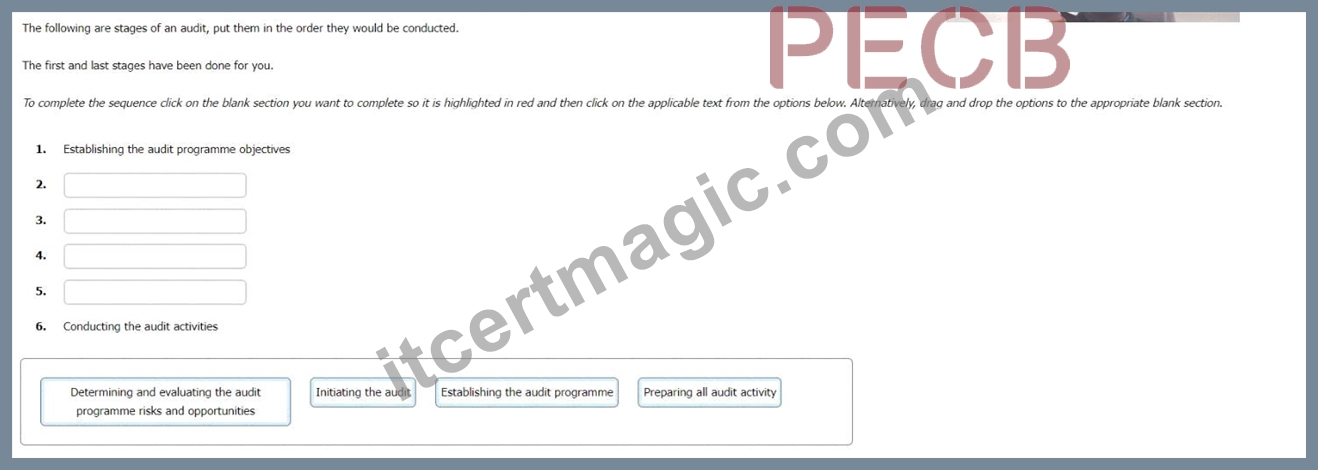
Answer:
Explanation: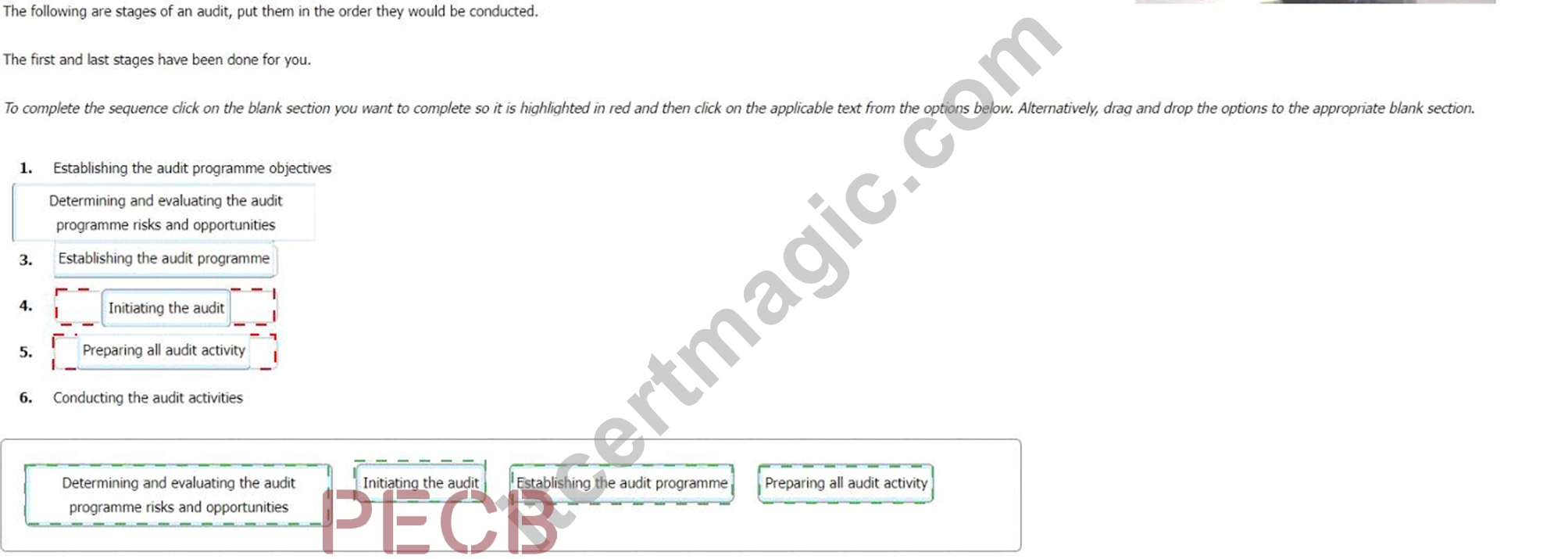
Explanation: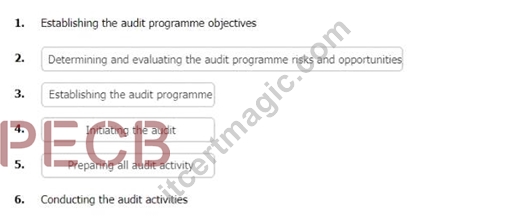
Establishing the audit programme objectives
Determining and evaluating the audit programme risks and opportunities
Establishing the audit programme
Initiating the audit
Preparing all audit activity
Conducting the audit activities
To complete the sequence, you can drag and drop the options to the appropriate blank section.
Here is a brief explanation of each stage:
Establishing the audit programme objectives: This is the first stage of the audit process, where the purpose, scope, and criteria of the audit programme are defined. The audit programme objectives should be aligned with the strategic direction and policies of the organization, and should address the needs and expectations of the interested parties12.
Determining and evaluating the audit programme risks and opportunities: This is the second stage of the audit process, where the factors that can affect the achievement of the audit programme objectives are identified and assessed. The audit programme risks and opportunities should consider the internal and external issues, the requirements and changes of the interested parties, and the results and feedback from previous audits12.
Establishing the audit programme: This is the third stage of the audit process, where the audit programme is designed and implemented. The audit programme should include the audit programme procedures, the audit programme resources, the audit methods and techniques, the audit frequency and schedule, and the audit programme performance indicators12.
Initiating the audit: This is the fourth stage of the audit process, where the audit is prepared and planned. The audit initiation involves selecting the audit team, establishing the contact with the auditee, defining the audit objectives, scope, and criteria, developing the audit plan, and conducting the document review123.
Preparing all audit activity: This is the fifth stage of the audit process, where the audit activities are organized and coordinated. The audit preparation involves assigning the audit tasks, communicating with the auditee and the audit team, arranging the logistics, preparing the working documents, and conducting the opening meeting123.
Conducting the audit activities: This is the sixth and final stage of the audit process, where the audit evidence is collected and evaluated. The audit conduct involves performing the audit activities, such as interviews, observations, document reviews, and tests, documenting the audit findings, preparing the audit conclusions, and conducting the closing meeting123.
I hope this helps you with your ISO 9001 Lead Auditor objectives and content. If you have any further questions, please feel free to ask.
References: 1: ISO 19011:2018 - Guidelines for auditing management systems 2: Audit Process | Flowchart | Summary - Accountinguide 3: What are the Stages of the Auditing Process & Why it is Important ...
NEW QUESTION # 49
......
Latest PECB ISO-9001-Lead-Auditor Dumps with Test Engine and PDF (New Questions): https://www.itcertmagic.com/PECB/real-ISO-9001-Lead-Auditor-exam-prep-dumps.html
Pass Your ISO-9001-Lead-Auditor Exam Easily - Real ISO-9001-Lead-Auditor Practice Dump Updated: https://drive.google.com/open?id=1jIVB9qX3fY0iPdn5KyrbWbWvYkyzr3yi