

Get instant access to DP-201 Practice Tests 2021 Free Updated Today!
Welcome to download the newest PassLeader DP-201 PDF dumps ( 207 Q&As)
NEW QUESTION 75
You have data on the 75,000 employees of your company. The data contains the properties shown in the following table.
You need to store the employee data in an Azure Cosmos DB container. Most queries on the data will filter by the Current Department and the Employee Surname properties.
Which partition key and item ID should you use for the container? To answer, select the appropriate options in the answer area.
NOTE: Each correct selection is worth one point.
Answer:
Explanation:
Explanation
Partition key: Current Department
Item ID: Employee ID
References:
https://docs.microsoft.com/en-us/rest/api/storageservices/designing-a-scalable-partitioning-strategy-for-azure-tab
NEW QUESTION 76
You are designing a real-time stream solution based on Azure Functions. The solution will process data uploaded to Azure Blob Storage.
The solution requirements are as follows:
* New blobs must be processed with a little delay as possible.
* Scaling must occur automatically.
* Costs must be minimized.
What should you recommend?
- A. Deploy the Azure Function in an App Service plan and use an Event Grid trigger.
- B. Deploy the Azure Function in a Consumption plan and use an Event Grid trigger.
- C. Deploy the Azure Function in a Consumption plan and use a Blob trigger.
- D. Deploy the Azure Function in an App Service plan and use a Blob trigger.
Answer: C
Explanation:
Explanation
Explanation:
Create a function, with the help of a blob trigger template, which is triggered when files are uploaded to or updated in Azure Blob storage.
You use a consumption plan, which is a hosting plan that defines how resources are allocated to your function app. In the default Consumption Plan, resources are added dynamically as required by your functions. In this serverless hosting, you only pay for the time your functions run. When you run in an App Service plan, you must manage the scaling of your function app.
Reference:
https://docs.microsoft.com/en-us/azure/azure-functions/functions-create-storage-blob-triggered-function
NEW QUESTION 77
You have an Azure subscription that contains an Azure virtual machine and an Azure Storage account. The virtual machine will access the storage account.
You are planning the security design for the storage account.
You need to ensure that only the virtual machine can access the storage account.
Which two actions should you include in the design? Each correct answer presents part of the solution.
NOTE: Each correct selection is worth one point.
- A. Select Allow trusted Microsoft services to access this storage account.
- B. Select Allow read access to storage logging from any network.
- C. Set the Allow access from setting to Selected networks.
- D. Enable a virtual network service endpoint.
Answer: A,D
Explanation:
C: Virtual Network (VNet) service endpoint provides secure and direct connectivity to Azure services over an optimized route over the Azure backbone network. Endpoints allow you to secure your critical Azure service resources to only your virtual networks. Service Endpoints enables private IP addresses in the VNet to reach the endpoint of an Azure service without needing a public IP address on the VNet.
A: You must have Allow trusted Microsoft services to access this storage account turned on under the Azure Storage account Firewalls and Virtual networks settings menu.
Reference:
https://docs.microsoft.com/en-us/azure/virtual-network/virtual-network-service-endpoints-overview
NEW QUESTION 78
You are designing a data storage solution for a database that is expected to grow to 50 TB. The usage pattern is singleton inserts, singleton updates, and reporting.
Which storage solution should you use?
- A. Azure Cosmos DB that uses the Gremlin API
- B. Azure SQL Database Hyperscale
- C. Azure SQL. Database elastic pools
- D. Azure SQL Data Warehouse
Answer: B
Explanation:
Explanation
A Hyperscale database is an Azure SQL database in the Hyperscale service tier that is backed by the Hyperscale scale-out storage technology. A Hyperscale database supports up to 100 TB of data and provides high throughput and performance, as well as rapid scaling to adapt to the workload requirements. Scaling is transparent to the application - connectivity, query processing, etc. work like any other Azure SQL database.
NEW QUESTION 79
You need to design the system for notifying law enforcement officers about speeding vehicles.
How should you design the pipeline? To answer, drag the appropriate services to the correct locations. Each service may be used once, more than once, or not at all. You may need to drag the split bar between panes or scroll to view content.
NOTE: Each correct selection is worth one point.
Answer:
Explanation:
Explanation

Scenario:
Information about vehicles that have been detected as going over the speed limit during the last 30 minutes must be available to law enforcement officers. Several law enforcement organizations may respond to speeding vehicles.
Telemetry Capture
The telemetry capture system records each time a vehicle passes in front of a sensor. The sensors run on a custom embedded operating system and record the following telemetry data:
* Time
* Location in latitude and longitude
* Speed in kilometers per hour (kmph)
* Length of vehicle in meters
Reference:
https://docs.microsoft.com/en-us/azure/azure-databricks/what-is-azure-databricks
NEW QUESTION 80
You are designing a new application that uses Azure Cosmos DB. The application will support a variety of data patterns including log records and social media mentions.
You need to recommend which Cosmos DB API to use for each data pattern. The solution must minimize resource utilization.
Which API should you recommend for each data pattern? To answer, select the appropriate options in the answer area.
NOTE: Each correct selection is worth one point.
Answer:
Explanation:
Explanation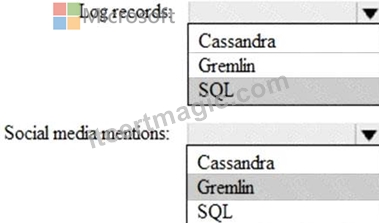
Log records: SQL
Social media mentions: Gremlin
You can store the actual graph of followers using Azure Cosmos DB Gremlin API to create vertexes for each user and edges that maintain the "A-follows-B" relationships. With the Gremlin API, you can get the followers of a certain user and create more complex queries to suggest people in common. If you add to the graph the Content Categories that people like or enjoy, you can start weaving experiences that include smart content discovery, suggesting content that those people you follow like, or finding people that you might have much in common with.
References:
https://docs.microsoft.com/en-us/azure/cosmos-db/social-media-apps
NEW QUESTION 81
You are designing a storage solution to store CSV files.
You need to grant a data scientist access to read all the files in a single container of an Azure Storage account.
The solution must use the principle of least privilege and provide the highest level of security.
What are two possible ways to achieve the goal? Each correct answer presents part of the solution.
NOTE: Each correct selection is worth one point.
- A. Assign the Reader role to the storage account.
- B. Provide a user delegation shared access signature (SAS).
- C. Provide an account shared access signature (SAS).
- D. Assign the Storage Blob Data Reader role at the container level.
- E. Provide an access key.
Answer: B,D
Explanation:
B: When an Azure role is assigned to an Azure AD security principal, Azure grants access to those resources for that security principal. Access can be scoped to the level of the subscription, the resource group, the storage account, or an individual container or queue.
The built-in Data Reader roles provide read permissions for the data in a container or queue.
Note: Permissions are scoped to the specified resource.
For example, if you assign the Storage Blob Data Reader role to user Mary at the level of a container named sample-container, then Mary is granted read access to all of the blobs in that container.
E: A user delegation SAS is secured with Azure Active Directory (Azure AD) credentials and also by the permissions specified for the SAS. A user delegation SAS applies to Blob storage only.
Reference:
https://docs.microsoft.com/en-us/azure/storage/common/storage-auth-aad-rbac-portal
https://docs.microsoft.com/en-us/azure/storage/common/storage-sas-overview
NEW QUESTION 82
You are designing a solution for a company. You plan to use Azure Databricks.
You need to recommend workloads and tiers to meet the following requirements:
* Provide managed clusters for running production jobs.
* Provide persistent clusters that support auto-scaling for analytics processes.
* Provide role-based access control (RBAC) support for Notebooks.
What should you recommend? To answer, select the appropriate options in the answer area.
NOTE: Each correct selection is worth one point.
Answer:
Explanation:
Box 1: Data Engineering Only
Box 2: Data Engineering and Data Analytics
Box 3: Standard
Box 4: Data Analytics only
Box 5: Premium
Premium required for RBAC. Data Analytics Premium Tier provide interactive workloads to analyze data collaboratively with notebooks References:
https://azure.microsoft.com/en-us/pricing/details/databricks/
NEW QUESTION 83
Note: This question is part of a series of questions that present the same scenario. Each question in the series contains a unique solution that might meet the stated goals. Some question sets might have more than one correct solution, while others might not have a correct solution.
After you answer a question in this section, you will NOT be able to return to it. As a result, these questions will not appear in the review screen.
You are designing an Azure SQL Database that will use elastic pools. You plan to store data about customers in a table. Each record uses a value for CustomerID.
You need to recommend a strategy to partition data based on values in CustomerID.
Proposed Solution: Separate data into customer regions by using horizontal partitioning.
Does the solution meet the goal?
- A. No
- B. Yes
Answer: A
Explanation:
Explanation/Reference:
Explanation:
We should use Horizontal Partitioning through Sharding, not divide through regions.
Note: Horizontal Partitioning - Sharding: Data is partitioned horizontally to distribute rows across a scaled out data tier. With this approach, the schema is identical on all participating databases. This approach is also called "sharding". Sharding can be performed and managed using (1) the elastic database tools libraries or (2) self-sharding. An elastic query is used to query or compile reports across many shards.
References:
https://docs.microsoft.com/en-us/azure/sql-database/sql-database-elastic-query-overview
NEW QUESTION 84
You are designing an anomaly detection solution for streaming data from an Azure IoT hub. The solution must meet the following requirements:
* Send the output to Azure Synapse.
* Identify spikes and dips in time series data.
* Minimize development and configuration effort
Which should you include in the solution?
- A. Azure Databricks
- B. Azure Stream Analytics
- C. Azure SQL Database
Answer: B
Explanation:
Explanation
You can identify anomalies by routing data via IoT Hub to a built-in ML model in Azure Stream Analytics.
Reference:
https://docs.microsoft.com/en-us/learn/modules/data-anomaly-detection-using-azure-iot-hub/
NEW QUESTION 85
You are designing an application. You plan to use Azure SQL Database to support the application.
The application will extract data from the Azure SQL Database and create text documents. The text documents will be placed into a cloud-based storage solution. The text storage solution must be accessible from an SMB network share.
You need to recommend a data storage solution for the text documents.
Which Azure data storage type should you recommend?
- A. Table
- B. Files
- C. Queue
- D. Blob
Answer: B
Explanation:
Explanation
Azure Files enables you to set up highly available network file shares that can be accessed by using the standard Server Message Block (SMB) protocol.
References:
https://docs.microsoft.com/en-us/azure/storage/common/storage-introduction
https://docs.microsoft.com/en-us/azure/storage/tables/table-storage-overview
NEW QUESTION 86
A company stores large datasets in Azure, including sales transactions and customer account information.
You must design a solution to analyze the data. You plan to create the following HDInsight clusters:
You need to ensure that the clusters support the query requirements.
Which cluster types should you recommend? To answer, select the appropriate configuration in the answer area.
NOTE: Each correct selection is worth one point.
Answer:
Explanation:
Explanation
Box 1: Interactive Query
Choose Interactive Query cluster type to optimize for ad hoc, interactive queries.
Box 2: Hadoop
Choose Apache Hadoop cluster type to optimize for Hive queries used as a batch process.
Note: In Azure HDInsight, there are several cluster types and technologies that can run Apache Hive queries.
When you create your HDInsight cluster, choose the appropriate cluster type to help optimize performance for your workload needs.
For example, choose Interactive Query cluster type to optimize for ad hoc, interactive queries. Choose Apache Hadoop cluster type to optimize for Hive queries used as a batch process. Spark and HBase cluster types can also run Hive queries.
References:
https://docs.microsoft.com/bs-latn-ba/azure/hdinsight/hdinsight-hadoop-optimize-hive-query?toc=%2Fko-kr%2F
NEW QUESTION 87
You need to design the SensorData collection.
What should you recommend? To answer, select the appropriate options in the answer area.
NOTE: Each correct selection is worth one point.
Answer:
Explanation:
Explanation
Box 1: Eventual
Traffic data insertion rate must be maximized.
Sensor data must be stored in a Cosmos DB named treydata in a collection named SensorData With Azure Cosmos DB, developers can choose from five well-defined consistency models on the consistency spectrum. From strongest to more relaxed, the models include strong, bounded staleness, session, consistent prefix, and eventual consistency.
Box 2: License plate
This solution reports on all data related to a specific vehicle license plate. The report must use data from the SensorData collection.
References:
https://docs.microsoft.com/en-us/azure/cosmos-db/consistency-levels
NEW QUESTION 88
You are designing a data storage solution for a database that is expected to grow to 50 TB. The usage pattern is singleton inserts, singleton updates, and reporting.
Which storage solution should you use?
- A. Azure Cosmos DB that uses the Gremlin API
- B. Azure SQL Database Hyperscale
- C. Azure Synapse Analytics
- D. Azure SQL Database elastic pools
Answer: B
Explanation:
Explanation/Reference:
Explanation:
A Hyperscale database is an Azure SQL database in the Hyperscale service tier that is backed by the Hyperscale scale-out storage technology. A Hyperscale database supports up to 100 TB of data and provides high throughput and performance, as well as rapid scaling to adapt to the workload requirements. Scaling is transparent to the application - connectivity, query processing, etc. work like any other Azure SQL database.
Incorrect Answers:
A: SQL Database elastic pools are a simple, cost-effective solution for managing and scaling multiple databases that have varying and unpredictable usage demands. The databases in an elastic pool are on a single Azure SQL Database server and share a set number of resources at a set price. Elastic pools in Azure SQL Database enable SaaS developers to optimize the price performance for a group of databases within a prescribed budget while delivering performance elasticity for each database.
B: Rather than SQL Data Warehouse, consider other options for operational (OLTP) workloads that have large numbers of singleton selects.
Reference:
https://docs.microsoft.com/en-us/azure/sql-database/sql-database-service-tier-hyperscale-faq
NEW QUESTION 89
You are planning a design pattern based on the Lambda architecture as shown in the exhibit.
Which Azure services should you use f2 or the cold path? To answer, drag the appropriate services to the correct layers. Each service may be used once, more than once, or not at all. You may need to drag the split bar between panes or scroll to view content.
NOTE: Each correct selection is worth one point.
Answer:
Explanation:
Explanation
Layer 2: Azure Data Lake Storage Gen2
Layer 3: Azure SQL Data Warehouse
Azure SQL Data Warehouse can be used for batch processing.
Note: Lambda architectures use batch-processing, stream-processing, and a serving layer to minimize the latency involved in querying big data.
References:
https://azure.microsoft.com/en-us/blog/lambda-architecture-using-azure-cosmosdb-faster-performance-low-tco-l
https://docs.microsoft.com/en-us/azure/architecture/data-guide/technology-choices/batch-processing
NEW QUESTION 90
You need to design the unauthorized data usage detection system.
What Azure service should you include in the design?
- A. Azure Analysis Services
- B. Azure Databricks
- C. Azure SQL Data Warehouse
- D. Azure Data Factory
Answer: C
Explanation:
SQL Database and SQL Data Warehouse
SQL threat detection identifies anomalous activities indicating unusual and potentially harmful attempts to access or exploit databases.
Advanced Threat Protection for Azure SQL Database and SQL Data Warehouse detects anomalous activities indicating unusual and potentially harmful attempts to access or exploit databases.
Scenario:
Requirements. Security
The solution must meet the following security requirements:
Unauthorized usage of data must be detected in real time. Unauthorized usage is determined by looking for unusual usage patterns.
Reference:
https://docs.microsoft.com/en-us/azure/sql-database/sql-database-threat-detection-overview Design for data security and compliance Question Set 7
NEW QUESTION 91
You need to design the vehicle images storage solution.
What should you recommend?
- A. Azure Redis Cache
- B. Azure Premium Storage account
- C. Azure Media Services
- D. Azure Cosmos DB
Answer: B
Explanation:
Explanation/Reference:
Explanation:
Premium Storage stores data on the latest technology Solid State Drives (SSDs) whereas Standard
Storage stores data on Hard Disk Drives (HDDs). Premium Storage is designed for Azure Virtual Machine
workloads which require consistent high IO performance and low latency in order to host IO intensive
workloads like OLTP, Big Data, and Data Warehousing on platforms like SQL Server, MongoDB,
Cassandra, and others. With Premium Storage, more customers will be able to lift-and-shift demanding
enterprise applications to the cloud.
Scenario: Traffic sensors will occasionally capture an image of a vehicle for debugging purposes.
You must optimize performance of saving/storing vehicle images.
The impact of vehicle images on sensor data throughout must be minimized.
References:
https://azure.microsoft.com/es-es/blog/introducing-premium-storage-high-performance-storage-for-azure-
virtual-machine-workloads/
NEW QUESTION 92
You store data in a data warehouse in Azure Synapse Analytics.
You need to design a solution to ensure that the data warehouse and the most current data is available within one hour of a datacenter failure.
Which three actions should you include in the design? Each correct answer presents part of the solution.
NOTE: Each correct selection is worth one point.
- A. If a failure occurs, modify the Azure Firewall rules of the data warehouse.
- B. If a failure occurs, update the connection strings to point to the recovered data warehouse.
- C. Each day, restore the data warehouse from a geo-redundant backup to an available Azure region.
- D. Each day, restore the data warehouse from a user-defined restore point to an available Azure region.
- E. Each day, create Azure Firewall rules that allow access to the restored data warehouse.
Answer: B,D,E
Explanation:
E: You can create a user-defined restore point and restore from the newly created restore point to a new data warehouse in a different region.
Note: A data warehouse snapshot creates a restore point you can leverage to recover or copy your data warehouse to a previous state.
A data warehouse restore is a new data warehouse that is created from a restore point of an existing or deleted data warehouse. On average within the same region, restore rates typically take around 20 minutes.
Incorrect Answers:
A: SQL Data Warehouse performs a geo-backup once per day to a paired data center. The RPO for a geo- restore is 24 hours. You can restore the geo-backup to a server in any other region where SQL Data Warehouse is supported. A geo-backup ensures you can restore data warehouse in case you cannot access the restore points in your primary region.
Reference:
https://docs.microsoft.com/en-us/azure/sql-data-warehouse/backup-and-restore
NEW QUESTION 93
Note: This question is part of a series of questions that present the same scenario. Each question in the series contains a unique solution that might meet the stated goals. Some question sets might have more than one correct solution, while others might not have a correct solution.
After you answer a question in this section, you will NOT be able to return to it. As a result, these questions will not appear in the review screen.
You plan to store delimited text files in an Azure Data Lake Storage account that will be organized into department folders.
You need to configure data access so that users see only the files in their respective department folder.
Solution: From the storage account, you disable a hierarchical namespace, and you use RBAC.
Does this meet the goal?
- A. No
- B. Yes
Answer: A
Explanation:
Explanation/Reference:
Explanation:
Instead of RBAC use access control lists (ACLs).
Note: Azure Data Lake Storage implements an access control model that derives from HDFS, which in turn derives from the POSIX access control model.
Blob container ACLs does not support the hierarchical namespace, so it must be disabled.
Reference:
https://docs.microsoft.com/en-us/azure/storage/blobs/data-lake-storage-known-issues
https://docs.microsoft.com/en-us/azure/data-lake-store/data-lake-store-access-control
NEW QUESTION 94
Note: This question is part of a series of questions that present the same scenario. Each question in the series contains a unique solution that might meet the stated goals. Some question sets might have more than one correct solution, while others might not have a correct solution.
After you answer a question in this section, you will NOT be able to return to it. As a result, these questions will not appear in the review screen.
You are designing an HDInsight/Hadoop cluster solution that uses Azure Data Lake Gen1 Storage.
The solution requires POSIX permissions and enables diagnostics logging for auditing.
You need to recommend solutions that optimize storage.
Proposed Solution: Ensure that files stored are larger than 250MB.
Does the solution meet the goal?
- A. No
- B. Yes
Answer: B
Explanation:
Explanation
Depending on what services and workloads are using the data, a good size to consider for files is 256 MB or greater. If the file sizes cannot be batched when landing in Data Lake Storage Gen1, you can have a separate compaction job that combines these files into larger ones.
Note: POSIX permissions and auditing in Data Lake Storage Gen1 comes with an overhead that becomes apparent when working with numerous small files. As a best practice, you must batch your data into larger files versus writing thousands or millions of small files to Data Lake Storage Gen1. Avoiding small file sizes can have multiple benefits, such as:
Lowering the authentication checks across multiple files
Reduced open file connections
Faster copying/replication
Fewer files to process when updating Data Lake Storage Gen1 POSIX permissions References:
https://docs.microsoft.com/en-us/azure/data-lake-store/data-lake-store-best-practices
NEW QUESTION 95
......
Aug-2021 Latest ITCertMagic DP-201 Exam Dumps with PDF and Exam Engine: https://www.itcertmagic.com/Microsoft/real-DP-201-exam-prep-dumps.html