

Get CAS-004 Products Practice Material for CAS-004 Exam Question Preparation
Most Reliable CompTIA CAS-004 Training Materials
CompTIA Advanced Security Practitioner (CASP+) certification exam, also known as CAS-004, is a globally recognized certification that validates advanced-level security skills and knowledge. The CASP+ certification is designed for IT professionals who have at least ten years of experience in IT administration, including five years of hands-on experience in technical security roles. CompTIA Advanced Security Practitioner (CASP+) Exam certification exam covers a broad range of advanced security topics such as risk management, enterprise security architecture, research and collaboration, and integration of security controls for heterogeneous systems. The CASP+ certification is highly valued by employers as it demonstrates that the individual has the necessary skills and knowledge to lead and manage complex security projects.
The CASP+ certification exam is designed for experienced IT professionals with a minimum of ten years of experience in IT administration, including at least five years of hands-on technical security experience. CAS-004 exam is intended to validate the critical thinking and judgment skills required to design, implement, and manage complex security solutions. Candidates for the certification exam should be familiar with the latest cybersecurity technologies and trends, as well as possess a deep understanding of the business and regulatory environment in which they operate.
NEW QUESTION # 80
A small bank is evaluating different methods to address and resolve the following requirements
" Must be able to store credit card data using the smallest amount of data possible
* Must be compliant with PCI DSS
* Must maintain confidentiality if one piece of the layer is compromised Which of the following is the best solution for the bank?
- A. Masking
- B. Tokenization
- C. Scrubbing
- D. Homomorphic encryption
Answer: B
Explanation:
Tokenization is the process of replacing sensitive data, like credit card numbers, with unique identification symbols (tokens) that retain all the essential information without compromising its security. This method is compliant with PCI DSS requirements as it ensures that actual credit card data is not stored or processed, thus minimizing the risk of data breaches. Tokenization also maintains confidentiality even if part of the data handling system is compromised, as the tokens do not hold any exploitable data.
NEW QUESTION # 81
A hospital has fallen behind with patching known vulnerabilities due to concerns that patches may cause disruptions in the availability of data and impact patient care. The hospital does not have a tracking solution in place to audit whether systems have been updated or to track the length of time between notification of the weakness and patch completion Since tracking is not in place the hospital lacks accountability with regard to who is responsible for these activities and the timeline of patching efforts. Which of the following should the hospital do first to mitigate this risk?
- A. Purchase a ticketing system for auditing efforts
- B. Obtain guidance from the health ISAC
- C. Complete a vulnerability analysis
- D. Train administrators on why patching is important
- E. Ensure CVEs are current
Answer: C
Explanation:
The first step in mitigating the risk associated with delayed patching is to conduct a vulnerability analysis. This process involves identifying, categorizing, and assessing the vulnerabilities within the hospital's IT infrastructure. By understanding the specific vulnerabilities and their potential impact on patient care and data availability, the hospital can prioritize patching efforts effectively and develop a strategy that minimizes disruptions while ensuring critical systems remain secure.
NEW QUESTION # 82
A local university that has a global footprint is undertaking a complete overhaul of its website and associated systems. Some of the requirements are:
* Handle an increase in customer demand of resources
* Provide quick and easy access to information
* Provide high-quality streaming media
* Create a user-friendly interface
Which of the following actions should be taken FIRST?
- A. Migrate to a virtualized environment.
- B. Enhance network access controls.
- C. Implement a content delivery network.
- D. Deploy high-availability web servers.
Answer: C
Explanation:
A content delivery network (CDN) is a geographically distributed network of servers that can cache content close to end users, allowing for faster and more efficient delivery of web content, such as images, videos, and streaming media. A CDN can also handle an increase in customer demand of resources, provide high-quality streaming media, and create a user-friendly interface by reducing latency and bandwidth consumption. A CDN can also improve the security and availability of the website by mitigating DDoS attacks and providing redundancy. Verified Reference:
https://www.cloudflare.com/learning/cdn/what-is-a-cdn/
https://learn.microsoft.com/en-us/azure/cdn/cdn-overview
https://en.wikipedia.org/wiki/Content_delivery_network
NEW QUESTION # 83
A customer reports being unable to connect to a website at www.test.com to consume services. The customer notices the web application has the following published cipher suite:
Which of the following is the MOST likely cause of the customer's inability to connect?
- A. The public key should be using ECDSA.
- B. The default should be on port 80.
- C. Weak ciphers are being used.
- D. The server name should be test.com.
Answer: C
Explanation:
Reference:
https://security.stackexchange.com/questions/23383/ssh-key-type-rsa-dsa-ecdsa-are-there-easy-answers-for-whic
NEW QUESTION # 84
Which of the following technologies allows CSPs to add encryption across multiple data storages?
- A. Symmetric encryption
- B. Bit splitting
- C. Data dispersion
- D. Homomorphic encryption
Answer: B
Explanation:
Reference: https://www.hhs.gov/sites/default/files/nist800111.pdf
NEW QUESTION # 85
A cyberanalyst for a government agency is concerned about how Pll is protected A supervisor indicates that a Privacy Impact Assessment must be done. Which of the following describes a function of a Privacy Impact Assessment?
- A. To validate the project participants
- B. To document residual risks
- C. To evaluate threat acceptance
- D. To identify the network ports
Answer: B
Explanation:
A Privacy Impact Assessment (PIA) is a process used to evaluate and manage privacy risks associated with the collection, use, and storage of personally identifiable information (PII). One of the key functions of a PIA is to document residual risks, which are the privacy risks that remain after controls have been applied. By identifying and documenting these risks, organizations can make informed decisions about whether additional measures are needed or whether certain risks are acceptable.
NEW QUESTION # 86
A security administrator configured the account policies per security implementation guidelines.
However, the accounts still appear to be susceptible to brute-force attacks. The following settings meet the existing compliance guidelines:
Must have a minimum of 15 characters
Must use one number
Must use one capital letter
Must not be one of the last 12 passwords used
Which of the following policies should be added to provide additional security?
- A. Time-based logins
- B. Shared accounts
- C. Account lockout
- D. Password complexity
- E. Password history
Answer: C
NEW QUESTION # 87
A security auditor needs to review the manner in which an entertainment device operates. The auditor is analyzing the output of a port scanning tool to determine the next steps in the security review. Given the following log output.
The best option for the auditor to use NEXT is:
- A. Network interception.
- B. A SCAP assessment.
- C. Reverse engineering
- D. Fuzzing
Answer: B
NEW QUESTION # 88
A security analyst is using data provided from a recent penetration test to calculate CVSS scores to prioritize remediation. Which of the following metric groups would the analyst need to determine to get the overall scores? (Select THREE).
- A. Temporal
- B. Attack vector
- C. Integrity
- D. Confidentiality
- E. Base
- F. Impact
- G. Environmental
- H. Availability
Answer: A,E,G
Explanation:
The three metric groups that are needed to calculate CVSS scores are Base, Temporal, and Environmental. The Base metrics represent the intrinsic characteristics of a vulnerability that are constant over time and across user environments. The Temporal metrics represent the characteristics of a vulnerability that may change over time but not across user environments. The Environmental metrics represent the characteristics of a vulnerability that are relevant and unique to a particular user's environment. Verified Reference:
https://nvd.nist.gov/vuln-metrics/cvss
https://www.first.org/cvss/specification-document
NEW QUESTION # 89
A new mandate by the corporate security team requires that all endpoints must meet a security baseline before accessing the corporate network. All servers and desktop computers are scanned by the dedicated internal scanner appliance installed in each subnet. However, remote worker laptops do not access the network regularly. Which of the following is the BEST option for the security team to ensure remote worker laptops are scanned before being granted access to the corporate network?
- A. Implement network access control to perform host validation of installed patches.
- B. Create a vulnerability scanning subnet for remote workers to connect to on the network at headquarters.
- C. Install a vulnerability scanning agent on each remote laptop to submit scan data.
- D. Create an 802.1X implementation with certificate-based device identification.
Answer: C
NEW QUESTION # 90
A security administrator adding a NAC requirement for all VPN users to ensure the connecting devices are compliant with company policy. Which of the following items provides the HIGHEST assurance to meet this requirement?
- A. Use an agentless implementation.
- B. Implement a permanent agent.
- C. Implement PKI.
- D. Install antivirus software.
Answer: C
NEW QUESTION # 91
A security analyst observes the following while looking through network traffic in a company's cloud log:
Which of the following steps should the security analyst take FIRST?
- A. Investigate web logs on 10.0.50.6 to determine if this is normal traffic.
- B. Isolate 10.0.50.6 via security groups.
- C. Quarantine 10.0.5.52 and run a malware scan against the host.
- D. Access 10.0.5.52 via EDR and identify processes that have network connections.
Answer: A
NEW QUESTION # 92
A cloud engineer is tasked with improving the responsiveness and security of a company's cloud- based web application. The company is concerned that international users will experience increased latency.
Which of the following is the BEST technology to mitigate this concern?
- A. Content delivery network
- B. Caching
- C. Clustering
- D. Containerization
Answer: A
NEW QUESTION # 93
A security engineer has been asked to close all non-secure connections from the corporate network. The engineer is attempting to understand why the corporate UTM will not allow users to download email via IMAPS. The engineer formulates a theory and begins testing by creating the firewall ID 58, and users are able to download emails correctly by using IMAP instead. The network comprises three VLANs:
The security engineer looks at the UTM firewall rules and finds the following: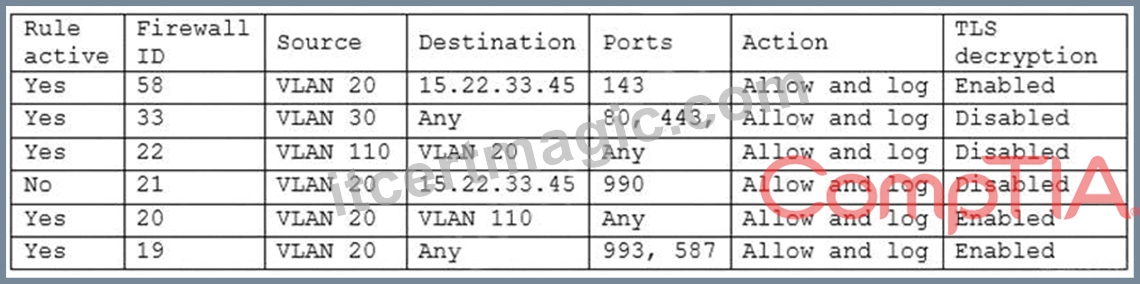
Which of the following should the security engineer do to ensure IMAPS functions properly on the corporate user network?
- A. Create an IMAPS firewall rule to ensure email is allowed.
- B. Contact the email service provider and ask if the company IP is blocked.
- C. Confirm the email server certificate is installed on the corporate computers.
- D. Make sure the UTM certificate is imported on the corporate computers.
Answer: A
Explanation:
Explanation
IMAPS (Internet Message Access Protocol Secure) is a protocol that allows users to access and manipulate email messages on a remote mail server over a secure connection. IMAPS uses SSL/TLS encryption to protect the communication between the client and the server. IMAPS uses port 993 by default. To ensure IMAPS functions properly on the corporate user network, the security engineer should create an IMAPS firewall rule on the UTM (Unified Threat Management) device that allows traffic from VLAN 10 (Corporate Users) to VLAN 20 (Email Server) over port 993. The existing firewall rules do not allow this traffic, as they only allow HTTP (port 80), HTTPS (port 443), and SMTP (port 25). References:
https://www.techopedia.com/definition/2460/internet-message-access-protocol-secure-imaps
https://www.sophos.com/en-us/support/knowledgebase/115145.aspx
NEW QUESTION # 94
During a review of events, a security analyst notes that several log entries from the FIM system identify changes to firewall rule sets. While coordinating a response to the FIM entries, the analyst receives alerts from the DLP system that indicate an employee is sending sensitive data to an external email address. Which of the following would be the most relevant to review in order to gain a better understanding of whether these events are associated with an attack?
- A. Firewall access control list
- B. NetFlow logs
- C. Intrusion prevention system
- D. Mobile device management platform
- E. Configuration management tool
Answer: B
Explanation:
NetFlow logs provide visibility into network traffic patterns and volume, which can be analyzed to detect anomalies, including potential security incidents. They can be invaluable in correlating the timing and nature of network events with security incidents to better understand if there is an association.
NEW QUESTION # 95
An attacker infiltrated the code base of a hardware manufacturer and inserted malware before the code was compiled. The malicious code is now running at the hardware level across a number of industries and sectors. Which of the following categories BEST describes this type of vendor risk?
- A. Remote code signing
- B. SDLC attack
- C. Side-load attack
- D. Supply chain attack
Answer: D
NEW QUESTION # 96
Which of the following risks does expanding business into a foreign country carry?
- A. Data sovereignty laws could result in unexpected liability
- B. Export controls might decrease software costs
- C. Some security tools might be monitored by legal authorities
- D. Data ownership might revert to the regulatory entities in the new country
Answer: A
NEW QUESTION # 97
A security engineer is creating a single CSR for the following web server hostnames:
* wwwint internal
* www company com
* home.internal
* www internal
Which of the following would meet the requirement?
- A. Issuer
- B. CRL
- C. SAN
- D. CN
- E. CA
Answer: C
Explanation:
Subject Alternative Name (SAN) is a part of the X.509 specification for SSL certificates that allows multiple domain names to be protected under a single SSL certificate. Using SAN is the most suitable option when a single Certificate Signing Request (CSR) needs to cover multiple hostnames. It enables the security engineer to list all the required hostnames in one certificate, ensuring secure communications for each listed entity without the need for separate certificates.
NEW QUESTION # 98
......
LATEST CAS-004 Exam Practice Material: https://www.itcertmagic.com/CompTIA/real-CAS-004-exam-prep-dumps.html
The Realest Study Materials CAS-004 Dumps: https://drive.google.com/open?id=11Clpja_wmjlOqR55GwDf9lR2XbK9IxnI