

CIPS Level 4 Diploma in Procurement and Supply L4M5 Dumps | Updated Jan 03, 2022 - ITCertMagic
Master 2022 Latest The Questions CIPS Level 4 Diploma in Procurement and Supply and Pass L4M5 Real Exam!
CIPS L4M5 Exam Syllabus Topics:
| Topic | Details |
|---|---|
| Topic 1 |
|
| Topic 2 |
|
| Topic 3 |
|
| Topic 4 |
|
| Topic 5 |
|
| Topic 6 |
|
| Topic 7 |
|
| Topic 8 |
|
| Topic 9 |
|
| Topic 10 |
|
| Topic 11 |
|
| Topic 12 |
|
| Topic 13 |
|
| Topic 14 |
|
NEW QUESTION 64
Which of the following will shift the supply curve to the right?
- A. Changes in customer taste
- B. New disruptive technology
- C. Increasedcustomers' disposable income
- D. Decreased market price of substitute products
Answer: B
Explanation:
Explanation
The following graph shows the factors that shift the supply curve to the left and to the right.
Diagram Description automatically generated with medium confidence
NEW QUESTION 65
In a commercial negotiation,a procurement professional believe that the larger the order quantity from buyer, the lower the supplier's average costs. Is this assumption true?
- A. No, because supplier's average costs will rise as the buyer's demand increases
- B. Yes, because larger order quantity will bring a considerable profit to supplier
- C. Yes, because larger order quantity will always enable the supplier to reach its economy of scale
- D. No, because the supplier may need to invest in new facility to meet buyer's demand
Answer: D
Explanation:
In some markets, suppliers experience peaks and troughs in demand and so buyers can increase their leverage through developing an understanding of how busy their vendor are at particular time during the year or business cycle and targetting atquieter period. Similarly, if a buyer can develop an understanding of supplier capacity and to what extent have they covered their fixed cost, they may be able to target suppliers when their average costs are likely to be lowest. Vendor's average costs will be higher at low and high capacity utilisation.
A picture containing graphical user interface Description automatically generated
NEW QUESTION 66
Which of the following are recognised techniques in contract negotiation? Select THREE that apply.
- A. Pacing and leading
- B. Validation
- C. Framing and reframing
- D. Role ethics
- E. Ratification
- F. Anchoring
Answer: A,C,F
Explanation:
Explanation
The question asks about negotiation techniques which are not present in the book. In this question, there are only 3 recognised techniques:
- Framing and reframing: A frame is an assumption, or set of assumptions, that guides our attention and behavior. Reframing is the ability to identify and significantly change assumptions or perspectives. Framing has a significant impact on the effectiveness of negotiation outcomes and negotiator working relationships.
You can read more on framing and reframing here.
- Anchoring: Anchoring bias is well-known cognitive bias in negotiation and in other contexts. The anchoring bias describes the common tendency to give too much weight to the first number put forth in a discussion and then inadequately adjust from that starting point, or the "anchor." We even fixate on anchors when we know they are irrelevant to the discussion at hand. You can read more on anchoring here.
- Pacing and leading: Pacing and leading is a two-step lever of persuasion. First - You "match your pace" to the person you want to influence in as many ways as possible. You can do this by mimicking the way the person talks, stands, their appearance, etc. You can also mimic less tangible aspects like the way they act, or their emotional state.Second - Once you've set your pace with someone, lead them to whatever decision or behavior you want them to take! You can read more on pacing and leading here.
NEW QUESTION 67
Which of the following should be done by the procurement team at the closing stage of a negotiation? Select TWO that apply.
- A. Accept ambiguity or uncertainty
- B. Tell TOP that they could have got a better deal
- C. Leave the meeting as soon as possible
- D. Gloat publicly about the deal
- E. Seek agreement in principle if TOP does not have the final authority
Answer: C,E
Explanation:
Explanation
The agreement and closingphase is the phase when it is either clear through explicit language, or strongly suggested through non-verbal signals, that TOP is ready to move to agreement. Judging when to close can be difficult and as with phases of the negotiation, experience, observation, practice and reflection will be the best ways to learn here.
In the closing phase, procurement should:
- Watch for closing/buying signals
- Check to ensure all issues have been resolved
- Consider using visual aids to summarise
- Use 'summary close'
- Make a decision to conclude/close
- Seek agreement in principle if TOP does not have the final authority
- Make your own private notes on the final agreement
- Shake hands on the agreement
- Leave the meeting as soon as possible thereafter.
LO 3, AC 3.1
NEW QUESTION 68
Which of the following is the best description of direct cost?
- A. Direct costs include raw materials, labour andoverheads
- B. Direct costs are only variable raw materials that constitute a product
- C. Direct costs include only raw materials and labour of making the final product
- D. Direct costs include raw materials, labour and other expenses attributable to the final product
Answer: D
Explanation:
Direct costs are those costs of a product/service directly attributable/traceable to its production, for example, the costs of labour and materials directly used to produce the goods/services which the organisation sells.
NEW QUESTION 69
Which of the following are examples of connected stakeholders in a private organisation? Select TWO that apply.
- A. Local community
- B. Government
- C. Media
- D. Shareholders
- E. Customers
Answer: D,E
Explanation:
Connected stakeholders are those who, by contractual or commercial relationships, have a significant stake in organisation activity. As a general rule, connectedstakeholder (with the exception of suppliers) have a low level of influence on procurement negotiations.
Examples of connected stakeholders are: suppliers, customers, bank where the organisation opens its account, shareholders.
NEW QUESTION 70
Professional buyer is planning for the next negotiation of a simple one-off contract. This negotiation is typified by which of the following? Select TWO that apply.
- A. Arm's-length approach
- B. Vendor ratings will be used
- C. Continuous dialogue with supplier
- D. Total cost of ownership is themost important criterion
- E. Pricing is the most important criterion
Answer: A,E
Explanation:
Professional buyers, when planning or engaging in negotiation with suppliers, should always be aware ofwhere the intended and actual relationship with this supplier is positioned on the 'spectrum' or 'continuum' of commercial relationships. The relationship spectrum describes the range of commercial relationships between a buyer and supplier based on richness of communication, longevity and mutual dependence.
Timeline Description automatically generated
In the question, the contract is simple one-off (or spot buy), which means the relationship will likely to be more transactional. In such relationship, price is the most important criteria and buyer may adopt arm's-length approach.
NEW QUESTION 71
How contribution is calculated in break-even analysis?
- A. Variable costs subtracted from price
- B. Fixed costs divided by variable costs
- C. Variable costs subtracted from fixed costs
- D. Price minus fixed costs
Answer: A
Explanation:
Contribution = Price - Variable cost
Break-evenpoint (volume) = Fixed cost/Contribution
NEW QUESTION 72
From the principled point of view about negotiation environment, which of the following is a true statement?
- A. There is no ideal negotiation environment in real life
- B. Advantage gained from uncomfortable negotiation environment is likely to last long after the negotiation
- C. Home advantage should not be exploited to win a temporary advantage
- D. The room layout can be seen as a source of tactical advantage
Answer: C
Explanation:
Explanation
From a principled point of view, the focus of negotiation is on resolving the issue and not on winning temporary advantage over TOPthrough exploiting home advantage. From the principled point of view, the location and room layout should not be viewed as a source of tactical advantage and should not be used to try to gain advantage over TOP or unfairly influence them in the meeting room.
From a pragmatic point of view, not all of these elements in the ideal negotiation environment may be feasible, so the host may have to make compromises and explain these to TOP.
From a distributive point of view, the host will seek to create an advantage for themselves either explicitly or more subtly. It is arguable that any advantage gained through intentionally creating an uncomfortable environment to put short-term pressure on TOP is likely to be short-lived as TOP will likely reflect on this laterand seek means to get even.
LO 2, AC 2.4
NEW QUESTION 73
Which of the following is the area where two or more negotiating parties may find common ground?
- A. Zone of proximal development
- B. Best alternative to a negotiated agreement
- C. Walk away area
- D. Zone of potential agreement
Answer: D
Explanation:
Explanation
The zone of possible agreement (ZOPA) orbargaining range is considered an area where two or more negotiating parties may find common ground. It is this area where parties will often compromise and strike a deal. In order for negotiating parties to find a settlement or reach an agreement, they must work towards a common goal and seek an area that incorporates at least some of each party's ideas.
The zone of proximal development refers to the difference between what a learner can do without help and what he or she can achieve with guidance and encouragement from a skilled partner.
There is no Walk away area. Walk away point is a position from which you cannot concede any more ground and must walk away/decline a deal.
Best alternative to a negotiated agreement is a fallback or backstop position if the negotiation fails to result in an agreement/no deal is agreed.
LO 1, AC 1.2
NEW QUESTION 74
Which of the following are most likely to be sources of conflict that can emerge from the process of commercial negotiations? Select TWO that apply.
- A. Line of the best fits
- B. Standard terms and conditions
- C. Differences in culture
- D. Types of purchase
- E. Differences in conflict management style
Answer: C,E
Explanation:
There are multiple sources of divergent positions that can arise in situations where money is exchange for goods and services. There are 2 different types of sources. Those that arise from the content or subject matter of the negotiation (what is being negotiated) and those that arise from the process of negotiation (how it is being negotiated).
Sources of divergent positions - the process of negotiation:
Table Description automatically generated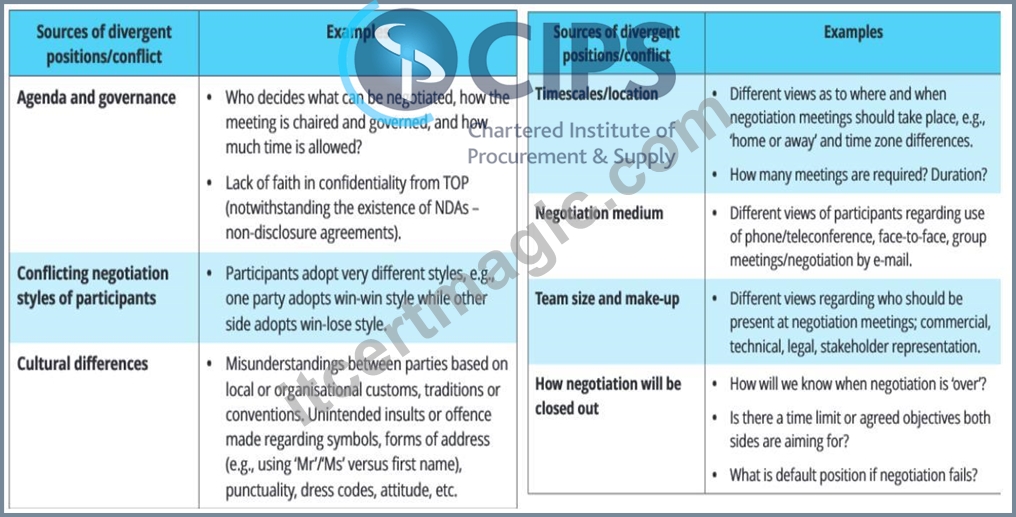
Line of best fits is the line that goes approximately through the middle of the data points with an equal number of data points above and below it. Line of best fits is a method of calculating medium value instatistics.
Standard terms and conditions are basic terms and conditions of business governing transactions that do not have a definitive contract, usually designed to be included in form documents such as orders. While there may be conflicts regarding standard terms and conditions, they are about the content of negotiation, not the process.
Type of purchase: when buying organisation makes an decision to purchase an item, a buyer is faced with three possible scenarios. The item to be bought could be a straight re-buy, a modified re-buy or a new purchase. Decision on type of purchase is purely an internal decision.
NEW QUESTION 75
A buying organisation with a low spend and the reputation for paying late might be viewed by a supplier as which of the following?
- A. Develop
- B. Exploit
- C. Nuisance
- D. Core
Answer: C
Explanation:
To answer this question, you should know The seller's perspective as in 'How to Negotiate Professionally':
Chart, treemap chart Description automatically generated
In the scenario, the buyer's spend is low, while they seem unattractive to seller (as they tend to pay late). So the buyer is classified as Nuisance in seller's perspective.
NEW QUESTION 76
In general, which of the following is the consequence of a flatter demand curve?
- A. Quantityelastic
- B. Price inelastic
- C. Unit price elastic
- D. Price elastic
Answer: D
Explanation:
Explanation
Elasticity refers to the responsiveness of quantity demanded or quantity supplied to a change in price or another factor.
In microeconomic graphs,elasticity and inelasticity can be shown by the slope of the demand curve. If a demand curve is almost horizontal, then the product pricing can be described as very elastic. If a demand curve is almost vertical, then the product pricing can be described asvery inelastic.
The formulae of elasticity:
Text Description automatically generated with low confidence
Table Description automatically generated with medium confidence
Table Description automatically generated with low confidence
LO 2, AC 2.2
NEW QUESTION 77
Whenimplementing value analysis or value engineering, which of the following acronyms reminds both buyer and supplier of ideas on removal, substitution and design-out of cost elements?
- A. SMART
- B. OWN-IT
- C. SAMOA
- D. STOPS WASTE
Answer: D
Explanation:
Ray Carter coined the mnemonic STOPS WASTE to remind buyers of 10 cost-reduction ideas they can ask for themselves and their suppliers in any situation when considering a key purchase input. Stop Waste by:
Standardisation - is there a standard specification?
Transportation - is the inbound transport classification appropriate
Over-engineered - is the specification too tight?
Packaging - can packaging be reduced or eliminated?
Substitutes - is there a cheaper substitute material
Weight - is there opportunity to reduce weight of the product?
Any unnecessary processing - is there any unnecessary design or feature?
Supplier's input - are suppliers able to assist with the cost reduction To make - is it more economical to make or buy?
Eliminate - if no one uses the feature, can it be eliminated?
SAMOA is a useful acronym for checking and testing the information gathered from the Internet:
Source
Audience
Methodology
Objectivity
Accuracy
OWN-IT is acronym for 5 steps in the process of collecting and analysing the data andinformation needed in any field:
Outline
Wide search
Narrow search
Increase your stockpile of information
Transform your stockpile into new knowledge
A SMART goal is used to help guide goal setting. SMART is an acronym that stands for Specific,Measurable, Achievable, Realistic, and Time-bound.
NEW QUESTION 78
When is the best time to adopt accommodating style according to Thomas-Kilmann conflict mode instrument?
- A. When both buyer and supplier want to find anintegrative solution as their concerns are too important to be compromised
- B. When buyer and supplier have equal power but are strongly committed to mutually exclusive goals
- C. When preserving harmony and avoiding disruption with supplier are especially important
- D. When buyer needs to gather more information to gain more advantages in later negotiations
Answer: C
Explanation:
Explanation
According to Thomas-Kilmann conflict model instrument, there are 5 conflict management styles:
Accommodating is an unassertive andcooperative approach to resolving the conflict. Accommodating means conceding to the other party with little debate or fight, not challenging or strongly putting forward your own point of view and generally giving and yielding to the other party's point of view. Accommodating is best used when:
1. When others can resolve the conflict more effectively
2. When the issue is much more important to the other person than to yourself - to satisfy the needs of others and to show you are reasonable
3. To build upsocial credit for later issues which are important to you
4. When continued competition would only damage your cause
5. When preserving harmony and avoiding disruption are especially important
6. To aid in the managerial development of subordinates by allowing them to experiment and learn from their own mistakes LO 1, AC 1.1
NEW QUESTION 79
Which of the following is most likely a consequence of falling interest rate?
- A. Decrease investment
- B. Increase savings
- C. Decreaseconsumption
- D. Increase aggregate demand
Answer: D
Explanation:
If interest rate are too low and credit is too, cheap rates can fund a spending boom with consumers and businesses buying (investment) more than they can afford to pay back.
NEW QUESTION 80
Which of the following are the most typical characteristics of integrative approach to negotiation? Select TWO that apply.
- A. Short-term wins
- B. Positional-based
- C. Interest-based
- D. Creating more value
- E. Claiming value
Answer: C,D
Explanation:
Integrative approach to negotiation used when the interested parties are attempting to create more of something of value to share, also known as collaborative approach or win-win. Integrative, interest-based negotiation can facilitate constructive, positive relationship and establishes contracts between parties on a foundation of goodwill. In integrative bargaining, both parties seek to 'expand the pie' by creating more value for both the buyer and the seller. Integrative negotiation 'shares thepie' and is interest rather than positional based.
In distributive bargaining, the focus is on claiming value and getting as much of the pie as parties can.
Table Description automatically generated
LO 1, AC 1.2
NEW QUESTION 81
A buying organisation with a low spend but the reputation for paying on-time. In order to increase buyer's leverage in negotiation with suppliers, which of the following should be a priority of this buyer?
- A. Volume separation
- B. Unavailable technical support
- C. Spend concentration
- D. Unclear tender award criteria
Answer: C
Explanation:
Explanation
According to Paul Steele's 'The Seller's Perspective', customer can be classified into 4 categories as below:
To increase theleverage in negotiation, buyer may increase its attractiveness and/or increase spend value. In this scenario, the buyer is already attractive to supplier as it always pays on-time, but the spend is still low. So to have greater leverage, the buyer has toincrease its spend volume by spend concentration. Spend concentration may take many forms as following:
- Vendor base reduction
- Volume pooling
- Volume redistribution
- Volume consolidation across categories
- Standardisation and harmonisation of specifications
- Forming purchasing consortia
Chart, treemap chart Description automatically generated
LO 1, AC 1.3
NEW QUESTION 82
Which of the following should be adopted to minimise the conflict between parties in commercial negotiation?
- A. Ground beam
- B. Ground zero
- C. Ground rules
- D. The rule of law
Answer: C
Explanation:
Ground rules are the basic rules for doing something (Cambridge Dictionary). A negotiation goes more smoothly if ground rules are adopted. Then if something goes awry at a later time, you can point out the ground rule that has been violated.Procurement professional should seek to minimise conflict over process through agreeing 'ground rules' and approach as far as possible with the other party in advance of any negotiation meetings.
There should be two sets of ground rules: 1) groundrules for the negotiations between the two parties and 2) ground rules for the negotiating team itself. This article is about the negotiating team ground rules.
The rule of law is the condition in which all members of society, including its political leaders, accept the authority of the law.
Ground zero describes the point on the Earth's surface closest to a nuclear detonation. In the case of an explosion above the ground, ground zero refers to the point on the ground directly below the nuclear detonation.
The Ground Beam is the beam which is provided usually at the foundation level to support building walls, joists, etc.
NEW QUESTION 83
In addition to organisational power, personal power of each negotiator can influence the outcomes of a negotiation. A good negotiator can leverage different sources of power. Is this statement true?
- A. Yes, because the good negotiator recognises his own power in a negotiation
- B. Yes, because allsources of power have similar effectiveness in every situation
- C. No, because each person has only one superior source of personal power
- D. No, because only organisational power can be leveraged during a negotiation
Answer: A
Explanation:
Explanation
Both organisational and personal power have the ability to influence the outcomes of negotiation. Good negotiators recognises the different sources of relative personal power they possess in a negotiation. There is no one superior source of personal power; they will vary in their effectiveness based on the situation. The more personal sources available the better, even if some not used, these can be used as a fallback.
LO 1, AC 1.3
NEW QUESTION 84
......
A fully updated 2022 L4M5 Exam Dumps exam guide from training expert ITCertMagic: https://www.itcertmagic.com/CIPS/real-L4M5-exam-prep-dumps.html
Practice To L4M5 - ITCertMagic Remarkable Practice On your Commercial Negotiation Exam: https://drive.google.com/open?id=1i2aEFDCFERKiMCQP1P-_fMVK1HhWi38f