

AZ-500 Questions - Truly Beneficial For Your Microsoft Exam (Updated 391 Questions)
View All AZ-500 Actual Exam Questions, Answers and Explanations for Free
The AZ-500 exam covers a range of topics related to Azure security, including securing Azure resources and services, implementing Azure security management, monitoring and responding to security incidents, and managing identity and access. Microsoft Azure Security Technologies certification can be earned by passing a single exam. AZ-500 exam consists of multiple-choice questions and requires a passing score of at least 700 out of a possible 1000 points. The AZ-500 certification is intended to demonstrate a candidate's expertise in Azure security and can be beneficial for career advancement in cloud security roles.
The Microsoft AZ-500 exam consists of multiple-choice questions and performance-based tasks that test your ability to apply your knowledge to real-world scenarios. Microsoft recommends that candidates have a good understanding of Azure services and experience with security technologies and practices before attempting the exam. AZ-500 exam is available in several languages and can be taken online or at a testing center.
NEW QUESTION # 228
Use the following login credentials as needed:
To enter your username, place your cursor in the Sign in box and click on the username below.
To enter your password, place your cursor in the Enter password box and click on the password below.
Azure Username: [email protected]
Azure Password: Ag1Bh9!#Bd
The following information is for technical support purposes only:
Lab Instance: 10598168

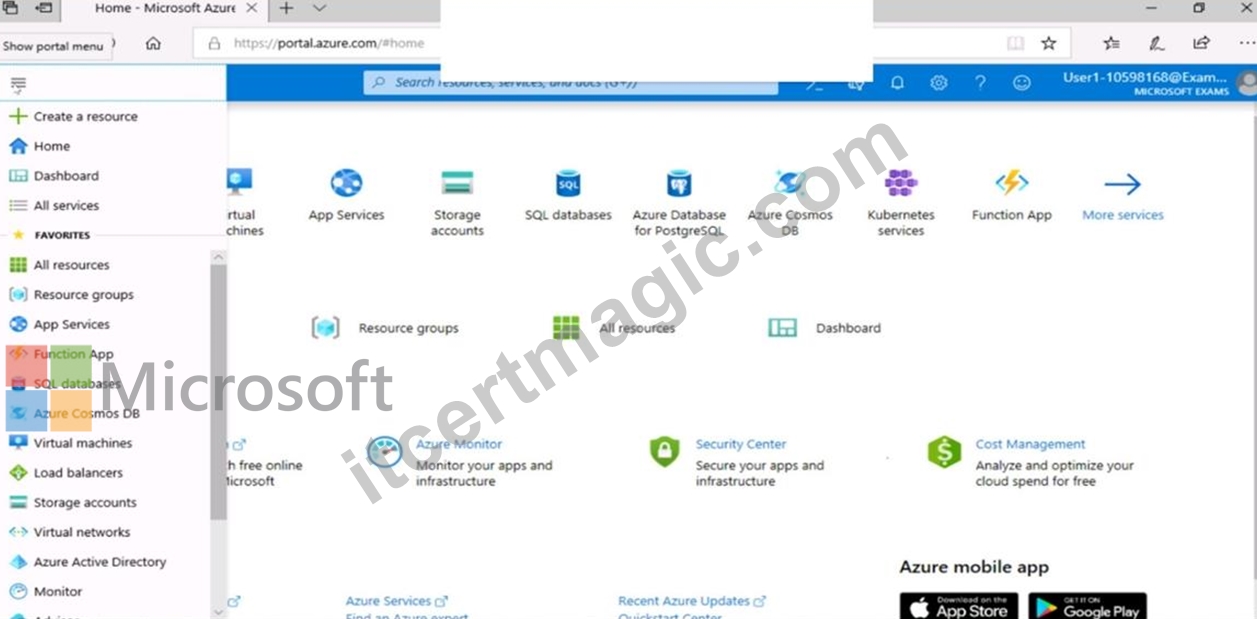

You need to prevent administrative users from accidentally deleting a virtual network named VNET1. The administrative users must be allowed to modify the settings of VNET1.
To complete this task, sign in to the Azure portal.
Answer:
Explanation:
See the explanation below.
Explanation
Locking prevents other users in your organization from accidentally deleting or modifying critical resources, such as Azure subscription, resource group, or resource.
Note: In Azure, the term resource refers to an entity managed by Azure. For example, virtual machines, virtual networks, and storage accounts are all referred to as Azure resources.
1. In the Settings blade for virtual network VNET, select Locks.
2. To add a lock, select Add.
3. For Lock type select Delete lock, and click OK
Reference:
https://docs.microsoft.com/en-us/azure/azure-resource-manager/resource-group-lock-resources
NEW QUESTION # 229
You have an Azure subscription that contains the virtual machines shown in the following table.
From Azure Security Center, you turn on Auto Provisioning.
You deploy the virtual machines shown in the following table.
On which virtual machines is the Log Analytics agent installed?
- A. VM3 and VM4 only
- B. VM1 and VM3 only
- C. VM3 only
- D. VM1, VM2, VM3, and VM4
Answer: D
Explanation:
Explanation
When automatic provisioning is On, Security Center provisions the Log Analytics Agent on all supported Azure VMs and any new ones that are created.
Supported Operating systems include: Ubuntu 14.04 LTS (x86/x64), 16.04 LTS (x86/x64), and 18.04 LTS (x64) and Windows Server 2008 R2, 2012, 2012 R2, 2016, version 1709 and 1803 Reference:
https://docs.microsoft.com/en-us/azure/security-center/security-center-enable-data-collection
NEW QUESTION # 230
You have an Azure Active Directory (Azure AD) tenant named contoso.com that contains the users shown in the following table.
Azure AD Privileged Identity Management (PIM) is enabled for the tenant.
In PIM, the Password Administrator role has the following settings:
* Maximum activation duration (hours): 2
* Send email notifying admins of activation: Disable
* Require incident/request ticket number during activation: Disable
* Require Azure Multi-Factor Authentication for activation: Enable
* Require approval to activate this role: Enable
* Selected approver: Group1
You assign users the Password Administrator role as shown in the following table.
For each of the following statements, select Yes if the statement is true. Otherwise, select No.
NOTE: Each correct selection is worth one point.
Answer:
Explanation:
Explanation
Box 1: Yes
Active assignments don't require the member to perform any action to use the role. Members assigned as active have the privileges assigned to the role at all times.
Box 2: No
MFA is disabled for User2 and the setting Require Azure Multi-Factor Authentication for activation is enabled.
Note: Eligible assignments require the member of the role to perform an action to use the role. Actions might include performing a multi-factor authentication (MFA) check, providing a business justification, or requesting approval from designated approvers.
Box 3: Yes
User3 is Group1, which is a Selected Approver Group
Reference:
https://docs.microsoft.com/bs-latn-ba/azure/active-directory/privileged-identity-management/pim-resource-roles-
NEW QUESTION # 231
You have an Azure subscription that contains an Azure key vault named Vault1.
On January 1, 2019, Vault1 stores the following secrets.
Which can each secret be used by an application? To answer, select the appropriate options in the answer area.
NOTE: Each correct selection is worth one point.
Answer:
Explanation:
Reference:
https://docs.microsoft.com/en-us/powershell/module/azurerm.keyvault/set-azurekeyvaultsecretattribute
NEW QUESTION # 232
You have an Azure subscription that contains a user named Admin1 and a resource group named RG1.
In Azure Monitor, you create the alert rules shown in the following table.
Admin1 performs the following actions on RG1:
Adds a virtual network named VNET1
Adds a Delete lock named Lock1
Which rules will trigger an alert as a result of the actions of Admin1? To answer, select the appropriate options in the answer area.
NOTE: Each correct selection is worth one point.
Answer:
Explanation:
NEW QUESTION # 233
You are evaluating the security of the network communication between the virtual machines in Sub2.
For each of the following statements, select Yes if the statement is true. Otherwise, select No.
NOTE: Each correct selection is worth one point.
Answer:
Explanation:
NEW QUESTION # 234
You have an Azure Active Directory (Azure AD) tenant named contoso.com that contains three security groups named Group1, Group2, and Group3 and the users shown in the following table.
Group3 is a member of Group2.
In contoso.com, you register an enterprise application named App1 that has the following settings:
Owners: User1
Users and groups: Group2
You configure the properties of App1 as shown in the following exhibit.
For each of the following statements, select Yes if the statement is true. Otherwise, select no.
NOTE: Each correct selection is worth one point.
Answer:
Explanation:
Reference:
https://docs.microsoft.com/en-us/azure/active-directory/manage-apps/assign-user-or-group-access-portal
NEW QUESTION # 235
You need to deploy AKS1 to meet the platform protection requirements.
Which four actions should you perform in sequence? To answer, move the appropriate actions from the list of actions to the answer area and arrange them in the correct order.
NOTE: More than one order of answer choices is correct. You will receive credit for any of the correct orders you select.
Answer:
Explanation:
Reference:
https://docs.microsoft.com/en-us/azure/aks/azure-ad-integration
NEW QUESTION # 236
You need to deploy an Azure firewall to a virtual network named VNET3.
To complete this task, sign in to the Azure portal and modify the Azure resources.
This task might take several minutes to complete. You can perform other tasks while the task completes.
Answer:
Explanation:
See the explanation below.
Explanation
To add an Azure firewall to a VNET, the VNET must first be configured with a subnet named AzureFirewallSubnet (if it doesn't already exist).
Configure VNET3.
* In the Azure portal, type Virtual Networks in the search box, select Virtual Networks from the search results then select VNET3. Alternatively, browse to Virtual Networks in the left navigation pane.
* In the Overview section, note the Location (region) and Resource Group of the virtual network. We'll need these when we add the firewall.
* Click on Subnets.
* Click on + Subnet to add a new subnet.
* Enter AzureFirewallSubnet in the Name box. The subnet must be named AzureFirewallSubnet.
* Enter an appropriate IP range for the subnet in the Address range box.
* Click the OK button to create the subnet.
Add the Azure Firewall.
* In the settings of VNET3 click on Firewall.
* Click the Click here to add a new firewall link.
* The Resource group will default to the VNET3 resource group. Leave this default.
* Enter a name for the firewall in the Name box.
* In the Region box, select the same region as VNET3.
* In the Public IP address box, select an available public IP address if one exists, or click Add new to add
* a new public IP address.
* Click the Review + create button.
* Review the settings and click the Create button to create the firewall.
Reference:
https://docs.microsoft.com/en-us/azure/firewall/tutorial-firewall-deploy-portal
NEW QUESTION # 237
Your company has an Azure subscription named Subscription1 that contains the users shown in the following table.
The company is sold to a new owner.
The company needs to transfer ownership of Subscription1.
Which user can transfer the ownership and which tool should the user use? To answer, select the appropriate options in the answer area.
NOTE: Each correct selection is worth one point.
Answer:
Explanation:
Reference:
https://docs.microsoft.com/en-us/azure/billing/billing-subscription-transfer#transfer-billing-ownership-of-an-azure-subscription
NEW QUESTION # 238
You need to create an Azure key vault. The solution must ensure that any object deleted from the key vault be retained for 90 days.
How should you complete the command? To answer, select the appropriate options in the answer area.
NOTE: Each correct selection is worth one point.
Answer:
Explanation:
Reference:
https://docs.microsoft.com/en-us/powershell/module/azurerm.keyvault/new-azurermkeyvault
NEW QUESTION # 239
You have an Azure AD tenant that contains the users shown in the following table.
You enable passwordless authentication for the tenant.
Which authentication method can each user use for passwordless authentication? To answer, drag the appropriate authentication methods to the correct users. Each authentication method may be used once, more than once, or not at all. You may need to drag the split bar between panes or scroll to view content.
NOTE: Each correct selection is worth one point.
Answer:
Explanation:
NEW QUESTION # 240
You need to configure WebApp1 to meet the data and application requirements.
Which two actions should you perform? Each correct answer presents part of the solution.
NOTE: Each correct selection is worth one point.
- A. Turn on the Incoming client certificates protocol setting.
- B. Upload a public certificate.
- C. Turn on the HTTPS Only protocol setting.
- D. Set the Minimum TLS Version protocol setting to 1.2.
- E. Change the pricing tier of the App Service plan.
Answer: B,D
Explanation:
Explanation/Reference:
Explanation:
A: To configure Certificates for use in Azure Websites Applications you need to upload a public Certificate.
C: Over time, multiple versions of TLS have been released to mitigate different vulnerabilities. TLS 1.2 is
the most current version available for apps running on Azure App Service.
Incorrect Answers:
B: We need support the http url as well.
Note:
References:
https://docs.microsoft.com/en-us/azure/app-service/app-service-web-configure-tls-mutual-auth
https://azure.microsoft.com/en-us/updates/app-service-and-functions-hosted-apps-can-now-update-tls-
versions/
Question Set 2
NEW QUESTION # 241
You have an Azure subscription that contains a virtual network. The virtual network contains the subnets shown in the following table.
The subscription contains the virtual machines shown in the following table.
You enable just in time (JIT) VM access for all the virtual machines.
You need to identify which virtual machines are protected by JIT.
Which virtual machines should you identify?
- A. VM4 only
- B. VM1, VM2, VM3, and VM4
- C. VM1 and VM3 only
- D. VM1, VM3 and VM4 only
Answer: D
Explanation:
An NSG needs to be enabled, either at the VM level or the subnet level.
Reference:
https://docs.microsoft.com/en-us/azure/security-center/security-center-just-in-time
NEW QUESTION # 242
You are configuring just in time (JIT) VM access to a set of Azure virtual machines.
You need to grant users PowerShell access to the virtual machine by using JIT VM access.
What should you configure? To answer, select the appropriate options in the answer area.
NOTE: Each correct selection is worth one point.
Answer:
Explanation:
Explanation
NEW QUESTION # 243
You have an Azure subscription that contains a storage account named storage1 and several virtual machines. The storage account and virtual machines are in the same Azure region. The network configurations of the virtual machines are shown in the following table.
The virtual network subnets have service endpoints defined as shown in the following table.
You configure the following Firewall and virtual networks settings for storage1:
Allow access from: Selected networks
Virtual networks: VNET3\Subnet3
Firewall - Address range: 52.233.129.0/24
For each of the following statements, select Yes if the statement is true. Otherwise, select No.
NOTE: Each correct selection is worth one point.
Answer:
Explanation:
NEW QUESTION # 244
You have two Azure virtual machines in the East US2 region as shown in the following table.
You deploy and configure an Azure Key vault.
You need to ensure that you can enable Azure Disk Encryption on VM1 and VM2.
What should you modify on each virtual machine? To answer, select the appropriate options in the answer area.
NOTE: Each correct selection is worth one point.
Answer:
Explanation:
Reference:
https://docs.microsoft.com/en-us/azure/virtual-machines/windows/generation-2#generation-1-vs-generation-2-capabilities
NEW QUESTION # 245
You have an Azure subscription that contains the custom roles shown in the following table.
In the Azure portal, you plan to create new custom roles by cloning existing roles. The new roles will be configured as shown in the following table.
Which roles can you clone to create each new role? To answer, select the appropriate options in the answer area.
NOTE: Each correct selection is worth one point.
Answer:
Explanation:
Reference:
https://docs.microsoft.com/en-us/azure/active-directory/roles/custom-create
https://docs.microsoft.com/en-us/azure/role-based-access-control/custom-roles-portal
NEW QUESTION # 246
You have an Azure Active Directory (Azure AD) tenant named contoso1812.onmicrosoft.com that contains the users shown in the following table.
You create an Azure Information Protection label named Label1. The Protection settings for Label1 are configured as shown in the exhibit. (Click the Exhibit tab.)
Label1 is applied to a file named File1.
For each of the following statements, select Yes if the statement is true, Otherwise, select No.
NOTE: Each correct selection is worth one point.
Answer:
Explanation:
NEW QUESTION # 247
You have the hierarchy of Azure resources shown in the following exhibit.
RG1, RG2, and RG3 are resource groups.
RG2 contains a virtual machine named VM1.
You assign role-based access control (RBAC) roles to the users shown in the following table.
For each of the following statements, select Yes if the statement is true. Otherwise, select No.
NOTE: Each correct selection is worth one point.
Answer:
Explanation:
NEW QUESTION # 248
Your network contains an Active Directory forest named contoso.com. The forest contains a single domain.
You have an Azure subscription named Sub1 that is associated to an Azure Active Directory (Azure AD)
tenant named contoso.com.
You plan to deploy Azure AD Connect and to integrate Active Directory and the Azure AD tenant.
You need to recommend an integration solution that meets the following requirements:
Ensures that password policies and user logon restrictions apply to user accounts that are synced to
the tenant
Minimizes the number of servers required for the solution.
Which authentication method should you include in the recommendation?
- A. federated identity with Active Directory Federation Services (AD FS)
- B. password hash synchronization with seamless single sign-on (SSO)
- C. pass-through authentication with seamless single sign-on (SSO)
Answer: B
Explanation:
Explanation/Reference:
Explanation:
Password hash synchronization requires the least effort regarding deployment, maintenance, and
infrastructure. This level of effort typically applies to organizations that only need their users to sign in to
Office 365, SaaS apps, and other Azure AD-based resources. When turned on, password hash
synchronization is part of the Azure AD Connect sync process and runs every two minutes.
Incorrect Answers:
A: A federated authentication system relies on an external trusted system to authenticate users. Some
companies want to reuse their existing federated system investment with their Azure AD hybrid identity
solution. The maintenance and management of the federated system falls outside the control of Azure AD.
It's up to the organization by using the federated system to make sure it's deployed securely and can
handle the authentication load.
C: For pass-through authentication, you need one or more (we recommend three) lightweight agents
installed on existing servers. These agents must have access to your on-premises Active Directory
Domain Services, including your on-premises AD domain controllers. They need outbound access to the
Internet and access to your domain controllers. For this reason, it's not supported to deploy the agents in a
perimeter network.
Pass-through Authentication requires unconstrained network access to domain controllers. All network
traffic is encrypted and limited to authentication requests.
References:
https://docs.microsoft.com/en-us/azure/active-directory/hybrid/how-to-connect-pta
NEW QUESTION # 249
You have an Azure subscription that contains a user named Adminl1 and a virtual machine named VM1. VM1 runs Windows Server 2019 and was deployed by using an Azure Resource Manager template. VM1 is the member of a backend pool of a public Azure Basic Load Balancer.
Admin1 reports that VM1 is listed as Unsupported on the Just in time VM access blade of Azure Security Center.
You need to ensure that Admin1 can enable just in time (JIT) VM access for VM1.
What should you do?
- A. Assign an Azure Active Directory Premium Plan 1 license to Admin1.
- B. Create and configure an additional public IP address for VM 1.
- C. Replace the Basic Load Balancer with an Azure Standard Load Balancer.
- D. Create and configure a network security group (NSG).
Answer: B
Explanation:
Reference:
https://docs.microsoft.com/en-us/azure/security-center/security-center-just-in-time?tabs=jit-config-asc%2Cjit-request-asc
NEW QUESTION # 250
You have a hybrid configuration of Azure Active Directory (Azure AD). You have an Azure SQL Database instance that is configured to support Azure AD authentication.
Database developers must connect to the database instance and authenticate by using their on-premises Active Directory account.
You need to ensure that developers can connect to the instance by using Microsoft SQL Server Management Studio. The solution must minimize authentication prompts.
Which authentication method should you recommend?
- A. Active Directory - Universal with MFA support
- B. SQL Server Authentication
- C. Active Directory - Integrated
- D. Active Directory - Password
Answer: C
Explanation:
Explanation
References:
https://docs.microsoft.com/en-us/azure/sql-database/sql-database-aad-authentication-configure
NEW QUESTION # 251
......
AZ-500 dumps Free Test Engine Verified By It Certified Experts: https://www.itcertmagic.com/Microsoft/real-AZ-500-exam-prep-dumps.html
AZ-500 Exam Free Practice Test with100% Accurate Answers: https://drive.google.com/open?id=14gNQJGccQyKK5mpF06GO_hRiIvpFJPVZ