

Positive Aspects of Valid Dumps SY0-701 Exam Dumps! [Apr-2026]
First Attempt Guaranteed Success in SY0-701 Exam 2026
NEW QUESTION # 438
Which of the following is a hardware-specific vulnerability?
- A. Firmware version
- B. Cross-site scripting
- C. Buffer overflow
- D. SQL injection
Answer: A
Explanation:
Explanation
Firmware is a type of software that is embedded in a hardware device, such as a router, a printer, or a BIOS chip. Firmware controls the basic functions and operations of the device, and it can be updated or modified by the manufacturer or the user. Firmware version is a hardware-specific vulnerability, as it can expose the device to security risks if it is outdated, corrupted, or tampered with. An attacker can exploit firmware vulnerabilities to gain unauthorized access, modify device settings, install malware, or cause damage to the device or the network. Therefore, it is important to keep firmware updated and verify its integrity and authenticity. References = CompTIA Security+ Study Guide with over 500 Practice Test Questions: Exam SY0-701, 9th Edition, Chapter 2, page 67. CompTIA Security+ SY0-701 Exam Objectives, Domain 2.1, page
10.
NEW QUESTION # 439
Which of the following would be best suited for constantly changing environments?
- A. Embedded systems
- B. RTOS
- C. Containers
- D. SCADA
Answer: C
Explanation:
Containers are a method of virtualization that allows applications to run in isolated environments with their own dependencies, libraries, and configurations. Containers are best suited for constantly changing environments because they are lightweight, portable, scalable, and easy to deploy and update. Containers can also support microservices architectures, which enable faster and more frequent delivery of software features.
NEW QUESTION # 440
A security administrator recently reset local passwords and the following values were recorded in the system: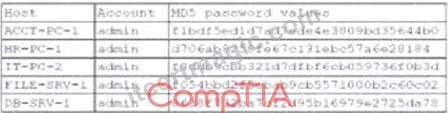
Which of the following in the security administrator most likely protecting against?
- A. Pass-the-hash attacks
- B. Password compromise
- C. Weak password complexity
- D. Account sharing
Answer: A
Explanation:
The scenario shows MD5 hashed password values. The most likely reason the security administrator is focusing on these values is to protect against pass-the-hash attacks. In this type of attack, an attacker can use a captured hash to authenticate without needing to know the actual plaintext password. By managing and monitoring these hashes, the administrator can implement strategies to mitigate this type of threat.
References =
CompTIA Security+ SY0-701 Course Content: Domain 04 Security Operations.
CompTIA Security+ SY0-601 Study Guide: Chapter on Identity and Access Management.
NEW QUESTION # 441
A security analyst receives an alert from a corporate endpoint used by employees to issue visitor badges. The alert contains the following details:
Which of the following best describes the indicator that triggered the alert?
- A. Brute-force attack
- B. Account lockout
- C. Blocked content
- D. Concurrent session usage
Answer: A
Explanation:
Detailed The activity described in the table, where multiple connection attempts are made on port 445 (used for SMB services), suggests a brute-force attack. The attacker likely used automated methods to guess credentials, causing multiple failures. Such attempts are a hallmark of brute-force attacks targeting shared resources. Reference: CompTIA Security+ SY0-701 Study Guide, Domain 4: Security Operations, Section: "Indicators of Malicious Activity".
NEW QUESTION # 442
An employee receives a text message from an unknown number claiming to be the company's Chief Executive Officer and asking the employee to purchase several gift cards. Which of the following types of attacks does this describe?
- A. Vishing
- B. Phishing
- C. Smishing
- D. Pretexting
Answer: C
Explanation:
Smishing is a type of phishing attack that uses text messages or common messaging apps to trick victims into clicking on malicious links or providing personal information. The scenario in the question describes a smishing attack that uses pretexting, which is a form of social engineering that involves impersonating someone else to gain trust or access. The unknown number claims to be the company's CEO and asks the employee to purchase gift cards, which is a common scam tactic. Vishing is a similar type of attack that uses phone calls or voicemails, while phishing is a broader term that covers any email-based attack. Reference: CompTIA Security+ Study Guide: Exam SY0-701, 9th Edition, page 771; Smishing vs. Phishing: Understanding the Differences2
NEW QUESTION # 443
A security administrator needs a method to secure data in an environment that includes some form of checks so that the administrator can track any changes. Which of the following should the administrator set up to achieve this goal?
- A. FIM
- B. NAC
- C. GPO
- D. SPF
Answer: A
Explanation:
FIM stands for File Integrity Monitoring, which is a method to secure data by detecting any changes or modifications to files, directories, or registry keys. FIM can help a security administrator track any unauthorized or malicious changes to the data, as well as verify the integrity and compliance of the data. FIM can also alert the administrator of any potential breaches or incidents involving the data.
NEW QUESTION # 444
Which of the following would be best suited for constantly changing environments?
- A. Embedded systems
- B. RTOS
- C. Containers
- D. SCADA
Answer: C
Explanation:
Containers are a method of virtualization that allows applications to run in isolated environments with their own dependencies, libraries, and configurations. Containers are best suited for constantly changing environments because they are lightweight, portable, scalable, and easy to deploy and update. Containers can also support microservices architectures, which enable faster and more frequent delivery of software features. Reference: CompTIA Security+ Study Guide: Exam SY0-701, 9th Edition, Chapter 10: Mobile Device Security, page 512 1
NEW QUESTION # 445
A company is developing a critical system for the government and storing project information on a fileshare.
Which of the following describes how this data will most likely be classified? (Select two).
- A. Restricted
- B. Urgent
- C. Public
- D. Confidential
- E. Private
- F. Operational
Answer: A,D
Explanation:
Data classification is the process of assigning labels to data based on its sensitivity and business impact. Different organizations and sectors may have different data classification schemes, but a common one is the following1:
Public: Data that can be freely disclosed to anyone without any harm or risk.
Private: Data that is intended for internal use only and may cause some harm or risk if disclosed.
Confidential: Data that is intended for authorized use only and may cause significant harm or risk if disclosed.
Restricted: Data that is intended for very limited use only and may cause severe harm or risk if disclosed.
In this scenario, the company is developing a critical system for the government and storing project information on a fileshare. This data is likely to be classified as confidential and restricted, because it is not meant for public or private use, and it may cause serious damage to national security or public safety if disclosed. The government may also have specific requirements or regulations for handling such data, such as encryption, access control, and auditing2. References: 1: CompTIA Security+ Study Guide: Exam SY0-701,
9th Edition, page 16-17 2: Data Classification Practices: Final Project Description Released
NEW QUESTION # 446
After reviewing the following vulnerability scanning report:
Server:192.168.14.6
Service: Telnet
Port: 23 Protocol: TCP
Status: Open Severity: High
Vulnerability: Use of an insecure network protocol
A security analyst performs the following test:
nmap -p 23 192.168.14.6 -script telnet-encryption
PORT STATE SERVICE REASON
23/tcp open telnet syn-ack
I telnet encryption:
| _ Telnet server supports encryption
Which of the following would the security analyst conclude for this reported vulnerability?
- A. A rescan is required.
- B. Compensating controls exist.
- C. It is a false positive.
- D. It is considered noise.
Answer: C
Explanation:
A false positive is a result that indicates a vulnerability or a problem when there is none. In this case, the vulnerability scanning report shows that the telnet service on port 23 is open and uses an insecure network protocol. However, the security analyst performs a test using nmap and a script that checks for telnet encryption support. The result shows that the telnet server supports encryption, which means that the data transmitted between the client and the server can be protected from eavesdropping. Therefore, the reported vulnerability is a false positive and does not reflect the actual security posture of the server. The security analyst should verify the encryption settings of the telnet server and client and ensure that they are configured properly3. References: 3: Telnet Protocol - Can You Encrypt Telnet?
NEW QUESTION # 447
A Chief Information Officer wants to ensure that network devices cannot connect to the public internet and the local network to directly perform firmware updates. The IT team must manually perform the update process by using a portable device. Which of the following architecture types best fits this description?
- A. Air-gapped
- B. Serverless
- C. Microservices
- D. Software-defined networking
Answer: A
Explanation:
The correct answer is Air-gapped because this architecture deliberately isolates systems from external and internal networks to prevent any direct electronic communication. In the Security+ SY0-701 domain of Security Architecture, air-gapped environments are used to achieve the highest level of protection against network-based threats by physically or logically separating critical systems from untrusted networks such as the internet or even the organization's internal network.
In this scenario, the CIO requires that network devices cannot connect to the public internet or the local network for firmware updates, and that updates must be performed manually using a portable device. This is a defining characteristic of an air-gapped architecture. Air-gapped systems rely on controlled, manual transfer methods-such as USB drives or other removable media-to introduce updates, ensuring that malware, remote exploits, and supply-chain-based network attacks cannot reach the isolated systems through traditional network paths.
Option A, Microservices, refers to an application design model where software is built as loosely coupled services and does not address physical or logical network isolation. Option C, Software-defined networking, focuses on centralized and programmable network control, not network disconnection. Option D, Serverless, is a cloud computing model where infrastructure management is abstracted away from developers and is incompatible with isolated, offline environments.
The SY0-701 study guide highlights air-gapped architectures as common in high-security environments such as industrial control systems, military systems, financial infrastructure, and environments requiring maximum protection against zero-day exploits and remote compromise. While air-gapping introduces operational overhead and update delays, it significantly reduces attack surface and exposure to external threats.
In summary, an architecture that requires manual updates via portable media and prevents any direct network connectivity is best described as air-gapped, making option B the correct answer.
NEW QUESTION # 448
Employees in the research and development business unit receive extensive training to ensure they understand how to best protect company data. Which of the following is the type of data these employees aremostlikely to use in day-to-day work activities?
- A. Intellectual property
- B. Data in transit
- C. Critical
- D. Encrypted
Answer: A
Explanation:
Intellectual property is a type of data that consists of ideas, inventions, designs, or other creative works that have commercial value and are protected by law. Employees in the research and development business unit are most likely to use intellectual property data in their day-to-day work activities, as they are involved in creating new products or services for the company. Intellectual property data needs to be protected from unauthorized use, disclosure, or theft, as it can give the company a competitive advantage in the market. Therefore, these employees receive extensive training to ensure they understand how to best protect this type of data. References = CompTIA Security+ SY0-701 Certification Study Guide, page 90; Professor Messer's CompTIA SY0-701 Security+ Training Course, video 1.2 - Security Concepts, 7:57 - 9:03.
NEW QUESTION # 449
An internet company has created a new collaboration application. To expand the user base, the company wants to implement an option that allows users to log in to the application with the credentials of other popular websites. Which of the following should the company implement?
- A. OpenID
- B. 802.1x
- C. CHAP
- D. SSO
Answer: A
Explanation:
It's using sign-in credentials from OTHER popular websites. An example of this would be logging into CompTIA using a google/gmail account. OpenID uses SSO. However, SSO is more broad and I feel OpenID perfectly fits this scenario.
NEW QUESTION # 450
An employee receives a text message that appears to have been sent by the payroll department and is asking for credential verification. Which of the following social engineering techniques are being attempted? (Choose two.)
- A. Phishing
- B. Vishing
- C. Impersonation
- D. Typosquatting
- E. Smishing
- F. Misinformation
Answer: A,E
Explanation:
Smishing is a type of social engineering technique that uses text messages (SMS) to trick victims into revealing sensitive information, clicking malicious links, or downloading malware. Smishing messages often appear to come from legitimate sources, such as banks, government agencies, or service providers, and use urgent or threatening language to persuade the recipients to take action12. In this scenario, the text message that claims to be from the payroll department is an example of smishing.
Impersonation is a type of social engineering technique that involves pretending to be someone else, such as an authority figure, a trusted person, or a colleague, to gain the trust or cooperation of the target. Impersonation can be done through various channels, such as phone calls, emails, text messages, or in-person visits, and can be used to obtain information, access, or money from the victim34. In this scenario, the text message that pretends to be from the payroll department is an example of impersonation.
A: Typosquatting is a type of cyberattack that involves registering domain names that are similar to popular or well-known websites, but with intentional spelling errors or different extensions. Typosquatting aims to exploit the common mistakes that users make when typing web addresses, and redirect them to malicious or fraudulent sites that may steal their information, install malware, or display ads56. Typosquatting is not related to text messages or credential verification.
B: Phishing is a type of social engineering technique that uses fraudulent emails to trick recipients into revealing sensitive information, clicking malicious links, or downloading malware. Phishing emails often mimic the appearance and tone of legitimate organizations, such as banks, retailers, or service providers, and use deceptive or urgent language to persuade the recipients to take action78. Phishing is not related to text messages or credential verification.
D: Vishing is a type of social engineering technique that uses voice calls to trick victims into revealing sensitive information, such as passwords, credit card numbers, or bank account details. Vishing calls often appear to come from legitimate sources, such as law enforcement, government agencies, or technical support, and use scare tactics or false promises to persuade the recipients to comply9 . Vishing is not related to text messages or credential verification.
F: Misinformation is a type of social engineering technique that involves spreading false or misleading information to influence the beliefs, opinions, or actions of the target. Misinformation can be used to manipulate public perception, create confusion, damage reputation, or promote an agenda . Misinformation is not related to text messages or credential verification.
References = 1: What is Smishing? | Definition and Examples | Kaspersky 2: Smishing - Wikipedia 3:
Impersonation Attacks: What Are They and How Do You Protect Against Them? 4: Impersonation - Wikipedia 5: What is Typosquatting? | Definition and Examples | Kaspersky 6: Typosquatting - Wikipedia 7: What is Phishing? | Definition and Examples | Kaspersky 8: Phishing - Wikipedia 9: What isVishing? | Definition and Examples | Kaspersky : Vishing - Wikipedia : What is Misinformation? | Definition and Examples | Britannica : Misinformation - Wikipedia
NEW QUESTION # 451
A company is implementing a vendor's security tool in the cloud. The security director does not want to manage users and passwords specific to this tool but would rather utilize the company's standard user directory. Which of the following should the company implement?
- A. 802.1X
- B. RADIUS
- C. CHAP
- D. SAML
Answer: D
NEW QUESTION # 452
A company's marketing department collects, modifies, and stores sensitive customer dat a. The infrastructure team is responsible for securing the data while in transit and at rest. Which of the following data roles describes the customer?
- A. Subject
- B. Owner
- C. Processor
- D. Custodian
Answer: A
Explanation:
According to the CompTIA Security+ SY0-701 Certification Study Guide, data subjects are the individuals whose personal data is collected, processed, or stored by an organization. Data subjects have certain rights and expectations regarding how their data is handled, such as the right to access, correct, delete, or restrict their data. Data subjects are different from data owners, who are the individuals or entities that have the authority and responsibility to determine how data is classified, protected, and used. Data subjects are also different from data processors, who are the individuals or entities that perform operations on data on behalf of the data owner, such as collecting, modifying, storing, or transmitting data. Data subjects are also different from data custodians, who are the individuals or entities that implement the security controls and procedures specified by the data owner to protect data while in transit and at rest.
Reference
CompTIA Security+ SY0-701 Certification Study Guide, Chapter 2: Data Security, page 511
NEW QUESTION # 453
An organization needs to monitor its users' activities to prevent insider threats. Which of the following solutions would help the organization achieve this goal?
- A. Behavioral analytics
- B. Identity and access management
- C. Network intrusion detection system
- D. Access control lists
Answer: A
Explanation:
Detailed Explanation:Behavioral analytics tools monitor user actions and detect anomalies that may indicate insider threats, such as unauthorized access or unusual data exfiltration activities. These tools establish baselines for normal behavior and flag deviations. Reference: CompTIA Security+ SY0-701 Study Guide, Domain 4: Security Operations, Section: "Behavioral Analytics and Monitoring".
NEW QUESTION # 454
An enterprise security team is researching a new security architecture to better protect the company's networks and applications against the latest cyberthreats. The company has a fully remote workforce. The solution should be highly redundant and enable users to connect to a VPN with an integrated, software-based firewall. Which of the following solutions meets these requirements?
- A. SIEM
- B. IPS
- C. SASE
- D. CASB
Answer: C
Explanation:
The requirements point to a cloud-delivered, remote-user-first architecture that provides secure connectivity and security controls as an integrated service. Secure Access Service Edge (SASE) matches this because it combines remote connectivity capabilities (often replacing or modernizing traditional VPN approaches) with cloud-based security services, including firewalling, in a way that supports distributed users and resilient global access. The Study Guide explicitly states: "Secure Access Service Edge (SASE... ) combines virtual private networks, SD-WAN, and cloud-based security tools like firewalls, cloud access security brokers (CASBs), and zero-trust networks to provide secure access for devices regardless of their location." This directly aligns with a fully remote workforce ("regardless of their location"), VPN capability, and an integrated firewall ("cloud-based security tools like firewalls").
Why the other options don't fit as well: IPS is a specific protective control, not an end-to-end remote access architecture; SIEM is for log aggregation/correlation and monitoring, not VPN + firewall delivery; and CASB is a component used to enforce cloud policy, but the guide distinguishes it as a policy enforcement point rather than a full connectivity + firewall architecture: "A CASB is a policy enforcement point..." . Therefore, SASE is the best match.
References: Sybex CompTIA Security+ Study Guide (SY0-701) - SASE definition and included capabilities (also duplicated in ).
NEW QUESTION # 455
......
Practice LATEST SY0-701 Exam Updated 765 Questions: https://www.itcertmagic.com/CompTIA/real-SY0-701-exam-prep-dumps.html
Real SY0-701 Exam Questions are the Best Preparation Material: https://drive.google.com/open?id=1bjAFE4xE605CXvoLLdjd0J89KNJPI1Vb