

Feb-2026 Latest ITCertMagic AZ-305 Exam Dumps with PDF and Exam Engine Free Updated Today!
Following are some new AZ-305 Real Exam Questions!
NEW QUESTION # 236
How should the migrated databases DB1 and DB2 be implemented in Azure?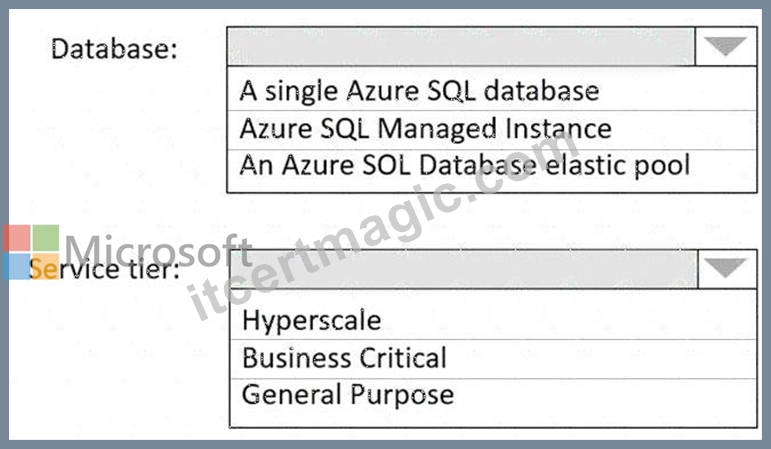
Answer:
Explanation: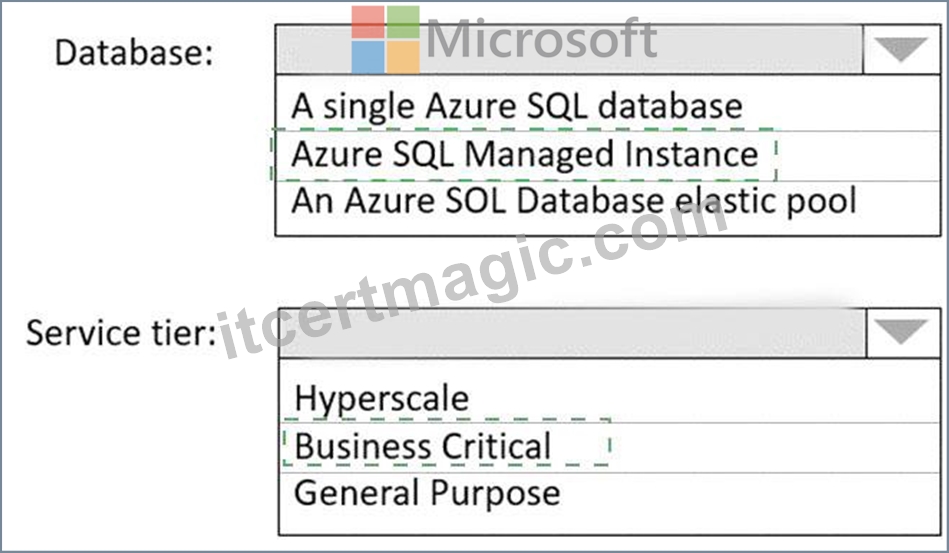
Explanation
Table Description automatically generated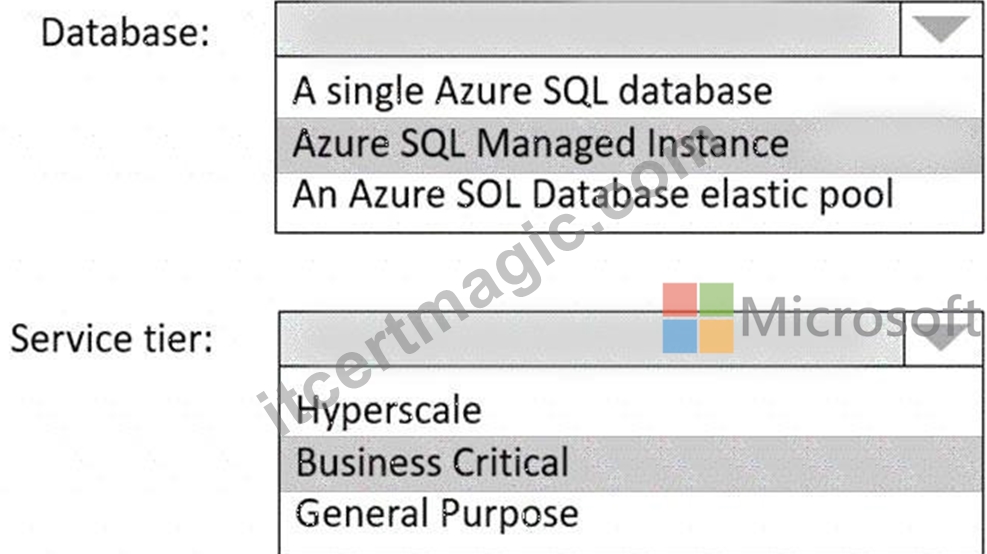
Box 1: SQL Managed Instance
Scenario: Once migrated to Azure, DB1 and DB2 must meet the following requirements:
Maintain availability if two availability zones in the local Azure region fail.
Fail over automatically.
Minimize I/O latency.
The auto-failover groups feature allows you to manage the replication and failover of a group of databases on a server or all databases in a managed instance to another region. It is a declarative abstraction on top of the existing active geo-replication feature, designed to simplify deployment and management of geo-replicated databases at scale. You can initiate a geo-failover manually or you can delegate it to the Azure service based on a user-defined policy. The latter option allows you to automatically recover multiple related databases in a secondary region after a catastrophic failure or other unplanned event that results in full or partial loss of the SQL Database or SQL Managed Instance availability in the primary region.
Box 2: Business critical
SQL Managed Instance is available in two service tiers:
General purpose: Designed for applications with typical performance and I/O latency requirements.
Business critical: Designed for applications with low I/O latency requirements and minimal impact of underlying maintenance operations on the workload.
Reference:
https://docs.microsoft.com/en-us/azure/azure-sql/database/auto-failover-group-overview
https://docs.microsoft.com/en-us/azure/azure-sql/managed-instance/sql-managed-instance-paas-overview
NEW QUESTION # 237
You have a Microsoft Entra tenant that uses Microsoft Entra Connect Sync to sync with an on-premises Active Directory Domain Services {AD DS) domain. The domain contains several member servers.
You have a custom human resources (HR) application named App1 that stores employee records.
You are designing a solution to automate the management of user accounts. The solution must meet the following requirements:
* When employees are added to App1, the user accounts of the employees must be provisioned to the AD DS domain and the Microsoft Entra tenant automatically.
* New employee records must be read from a CSV file that is exported from App1 daily.
You need to recommend a Microsoft Entra Identity Governance provisioning method and a target endpoint for creating new user accounts.
What should you recommend? To answer, select the appropriate options in the answer area.
NOTE: Each connect selection is worth one point.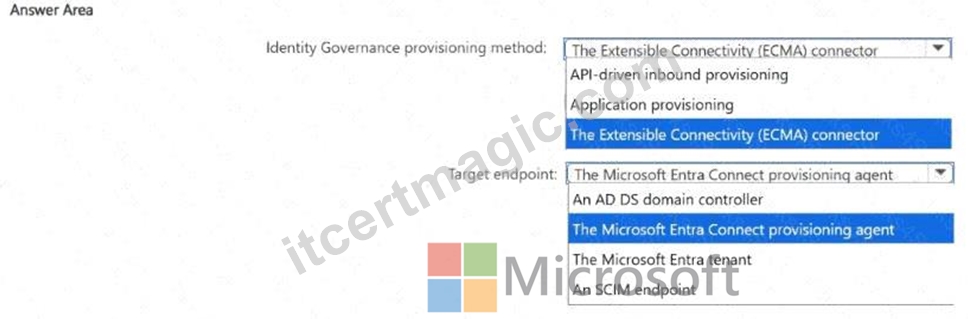
Answer:
Explanation: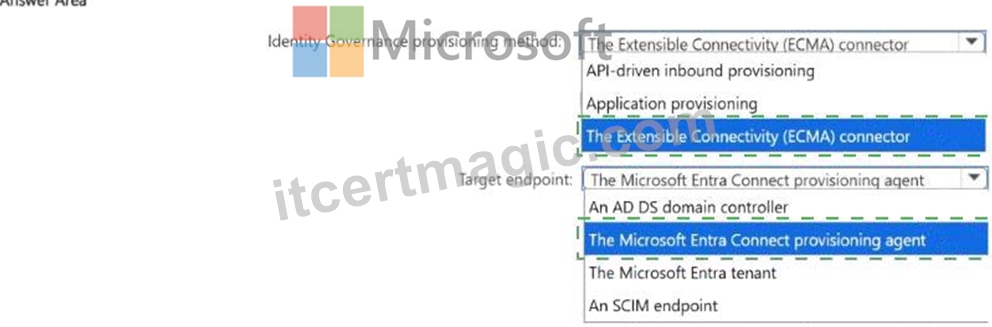
Explanation:
NEW QUESTION # 238
You plan to deploy an Azure web app named Appl that will use Azure Active Directory (Azure AD) authentication.
App1 will be accessed from the internet by the users at your company. All the users have computers that run Windows 10 and are joined to Azure AD.
You need to recommend a solution to ensure that the users can connect to App1 without being prompted for authentication and can access App1 only from company-owned computers.
What should you recommend for each requirement? To answer, select the appropriate options in the answer area.
NOTE: Each correct selection is worth one point.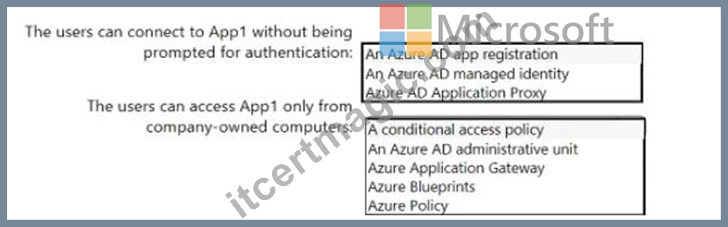
Answer:
Explanation: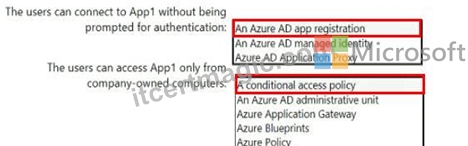
Reference:
https://codingcanvas.com/using-azure-active-directory-authentication-in-your-web-application/
https://docs.microsoft.com/en-us/azure/active-directory/conditional-access/overview
https://docs.microsoft.com/en-us/powerapps/developer/data-platform/walkthrough-register-app-azure-active-directory#:~:text=Create%20an%20application%20registration%201%20Create%20an%20application,the%20options%20and%20click%20on%20Add%20permissions.%20
"After consenting to use their Dataverse account with the ISV's application, end users can connect to Dataverse environment from external application. The consent form is not displayed again to other users after the first user who has already consented to use the ISV's app. Apps registered in Azure Active Directory are multi-tenant, which implies that other Dataverse users from other tenant can connect to their environment using the ISV's app."
NEW QUESTION # 239
You have 100 servers that run Windows Server 2012 R2 and host Microsoft SQL Server 2012 R2 instances.
The instances host databases that have the following characteristics:
* The largest database is currently 3 TB. None of the databases will ever exceed 4 TB.
* Stored procedures are implemented by using CLR.
You plan to move all the data from SQL Server to Azure.
You need to recommend an Azure service to host the databases. The solution must meet the following requirements:
* Whenever possible, minimize management overhead for the migrated databases.
* Minimize the number of database changes required to facilitate the migration.
* Ensure that users can authenticate by using their Active Directory credentials.
What should you include in the recommendation?
- A. Azure SQL Database single databases
- B. Azure SQL Database elastic pools
- C. SQL Server 2016 on Azure virtual machines
- D. Azure SQL Database Managed Instance
Answer: D
Explanation:
Explanation
References:
https://docs.microsoft.com/en-us/azure/sql-database/sql-database-managed-instance SQL Managed Instance allows existing SQL Server customers to lift and shift their on-premises applications to the cloud with minimal application and database changes. At the same time, SQL Managed Instance preserves all PaaS capabilities (automatic patching and version updates, automated backups, high availability) that drastically reduce management overhead and TCO.
https://docs.microsoft.com/en-us/azure/azure-sql/managed-instance/transact-sql-tsql-differences-sql-server#clr
https://docs.microsoft.com/en-gb/azure/azure-sql/database/transact-sql-tsql-differences-sql-server#transact-sql-sy
NEW QUESTION # 240
You need to recommend a solution that meets the file storage requirements for App2.
What should you deploy to the Azure subscription and the on-premises network? To answer, drag the appropriate services to the correct locations. Each service may be used once, more than once, or not at all. You may need to drag the split bar between panes or scroll to view content.
NOTE: Each correct selection is worth one point.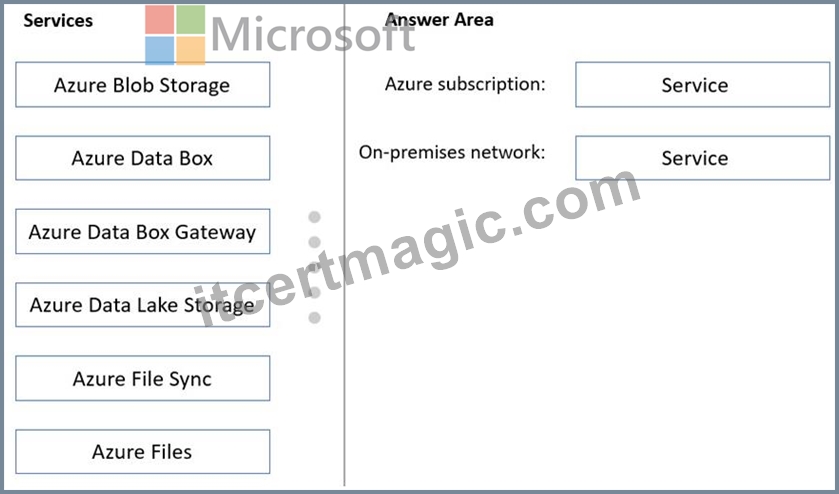
Answer:
Explanation: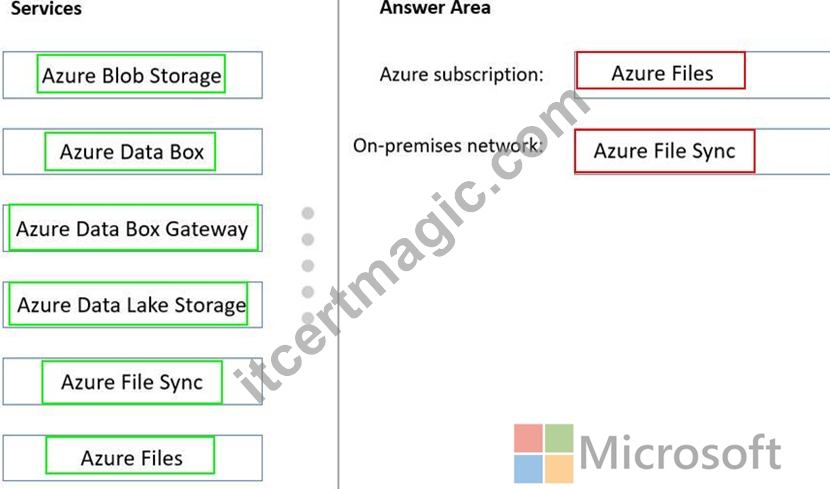
Reference:
https://docs.microsoft.com/en-us/azure/storage/file-sync/file-sync-deployment-guide
NEW QUESTION # 241
To meet the authentication requirements of Fabrikam, what should you include in the solution? To answer, select the appropriate options in the answer area.
NOTE:Each correct selection is worth one point.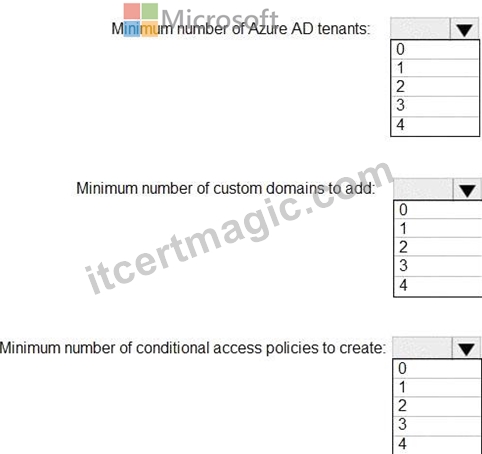
Answer:
Explanation: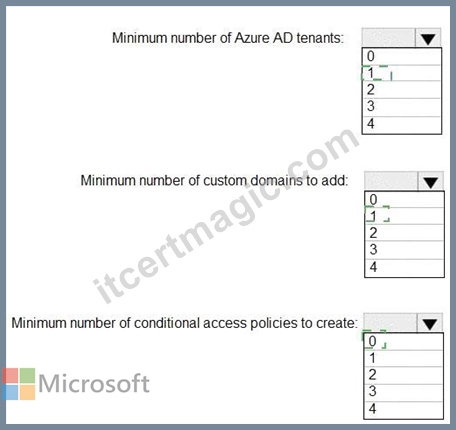
Explanation
1
1
0
Topic 1, Fabrikam, inc Case Study A
Overview:
Existing Environment
Fabrikam, Inc. is an engineering company that has offices throughout Europe. The company has a main office in London and three branch offices in Amsterdam Berlin, and Rome.
Active Directory Environment:
The network contains two Active Directory forests named corp.fabnkam.com and rd.fabrikam.com. There are no trust relationships between the forests.Corp.fabrikam.com is a production forest that contains identities used for internal user and computer authentication. Rd.fabrikam.com is used by the research and development (R&D) department only. The R&D department is restricted to using on-premises resources only.
Network Infrastructure:
Each office contains at least one domain controller from the corp.fabrikam.com domain. The main office contains all the domain controllers for the rd.fabrikam.com forest.
All the offices have a high-speed connection to the Internet.
An existing application named WebApp1 is hosted in the data center of the London office. WebApp1 is used by customers to place and track orders. WebApp1 has a web tier that uses Microsoft Internet Information Services (IIS) and a database tier that runs Microsoft SQL Server 2016. The web tier and the database tier are deployed to virtual machines that run on Hyper-V.
The IT department currently uses a separate Hyper-V environment to test updates to WebApp1.
Fabrikam purchases all Microsoft licenses through a Microsoft Enterprise Agreement that includes Software Assurance.
Problem Statement:
The use of Web App1 is unpredictable. At peak times, users often report delays. At other times, many resources for WebApp1 are underutilized.
Requirements:
Planned Changes:
Fabrikam plans to move most of its production workloads to Azure during the next few years.
As one of its first projects, the company plans to establish a hybrid identity model, facilitating an upcoming Microsoft Office 365 deployment All R&D operations will remain on-premises.
Fabrikam plans to migrate the production and test instances of WebApp1 to Azure.
Technical Requirements:
Fabrikam identifies the following technical requirements:
* Web site content must be easily updated from a single point.
* User input must be minimized when provisioning new app instances.
* Whenever possible, existing on premises licenses must be used to reduce cost.
* Users must always authenticate by using their corp.fabrikam.com UPN identity.
* Any new deployments to Azure must be redundant in case an Azure region fails.
* Whenever possible, solutions must be deployed to Azure by using platform as a service (PaaS).
* An email distribution group named IT Support must be notified of any issues relating to the directory synchronization services.
* Directory synchronization between Azure Active Directory (Azure AD) and corp.fabhkam.com must not be affected by a link failure between Azure and the on premises network.
Database Requirements:
Fabrikam identifies the following database requirements:
* Database metrics for the production instance of WebApp1 must be available for analysis so that database administrators can optimize the performance settings.
* To avoid disrupting customer access, database downtime must be minimized when databases are migrated.
* Database backups must be retained for a minimum of seven years to meet compliance requirement Security Requirements:
Fabrikam identifies the following security requirements:
*Company information including policies, templates, and data must be inaccessible to anyone outside the company
*Users on the on-premises network must be able to authenticate to corp.fabrikam.com if an Internet link fails.
*Administrators must be able authenticate to the Azure portal by using their corp.fabrikam.com credentials.
*All administrative access to the Azure portal must be secured by using multi-factor authentication.
*The testing of WebApp1 updates must not be visible to anyone outside the company.
NEW QUESTION # 242
You have an Azure subscription that is linked to an Azure Active Directory Premium Plan 2 tenant The tenant has multi-factor authentication (MFA) enabled for all users.
You have the named locations shown in the following table.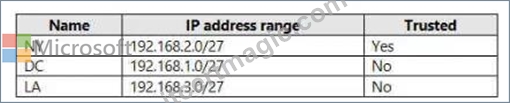
You have the users shown in the following table.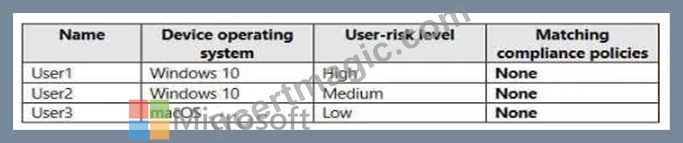
You plan to deploy the Conditional Access policies shown in the following table.
For each of the following statements, select Yes if the statement is true. Otherwise, select No.
NOTE: Each correct selection is worth one point.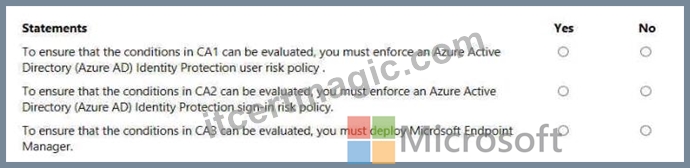
Answer:
Explanation: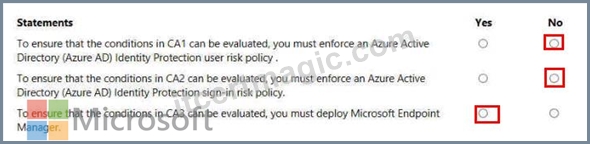
NEW QUESTION # 243
You need to configure an Azure policy to ensure that the Azure SQL databases have TDE enabled. The solution must meet the security and compliance requirements.
Which three actions should you perform in sequence? To answer, move the appropriate actions from the list of actions to the answer area and arrange them in the correct order.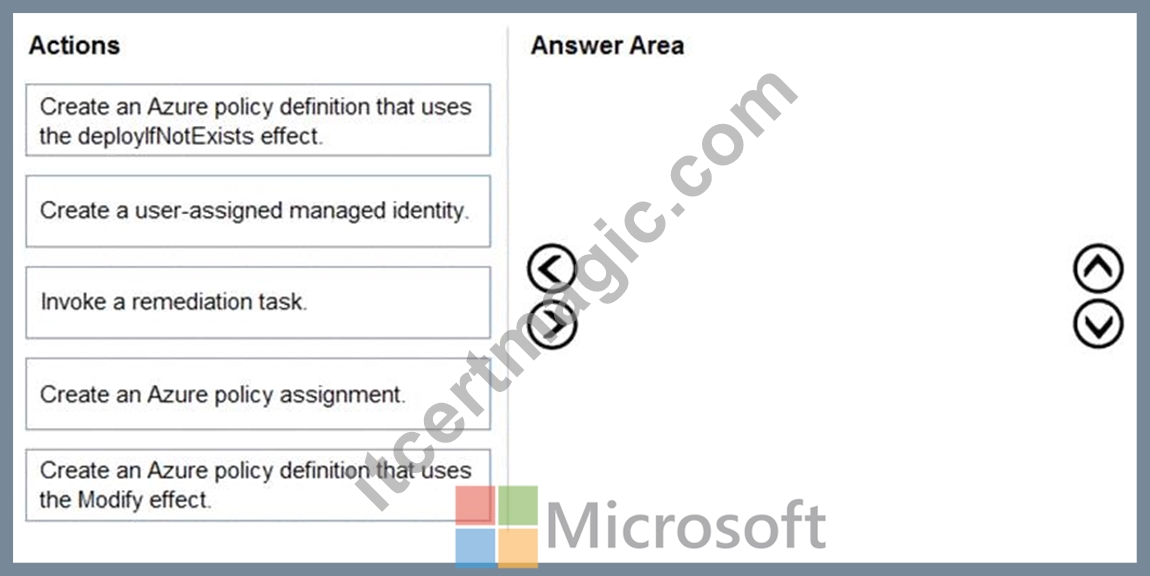
Answer:
Explanation: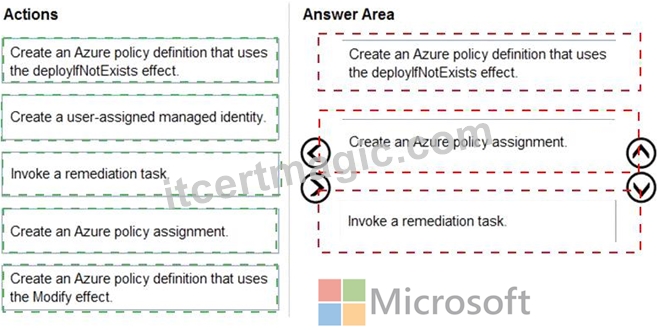
Explanation:
A picture containing text Description automatically generated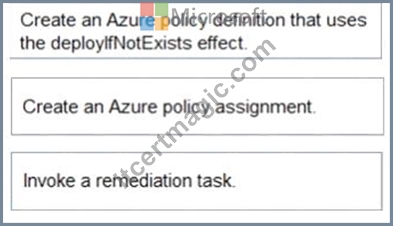
Scenario: All Azure SQL databases in the production environment must have Transparent Data Encryption (TDE) enabled.
Step 1: Create an Azure policy definition that uses the deployIfNotExists identity.
The first step is to define the roles that deployIfNotExists and modify needs in the policy definition to successfully deploy the content of your included template.
Step 2: Create an Azure policy assignment
When creating an assignment using the portal, Azure Policy both generates the managed identity and grants it the roles defined in roleDefinitionIds.
Step 3: Invoke a remediation task
Resources that are non-compliant to a deployIfNotExists or modify policy can be put into a compliant state through Remediation. Remediation is accomplished by instructing Azure Policy to run the deployIfNotExists effect or the modify operations of the assigned policy on your existing resources and subscriptions, whether that assignment is to a management group, a subscription, a resource group, or an individual resource.
During evaluation, the policy assignment with deployIfNotExists or modify effects determines if there are non-compliant resources or subscriptions. When non-compliant resources or subscriptions are found, the details are provided on the Remediation page.
Reference:
https://docs.microsoft.com/en-us/azure/governance/policy/how-to/remediate-resources
NEW QUESTION # 244
You design a solution for the web tier of WebApp1 as shown in the exhibit.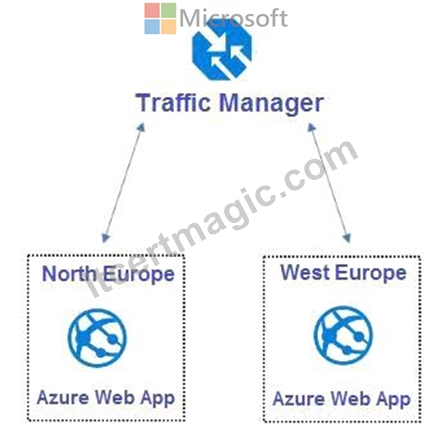
For each of the following statements, select Yes if the statement is true. Otherwise, select No.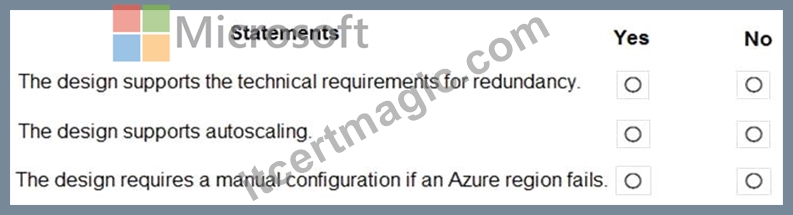
Answer:
Explanation: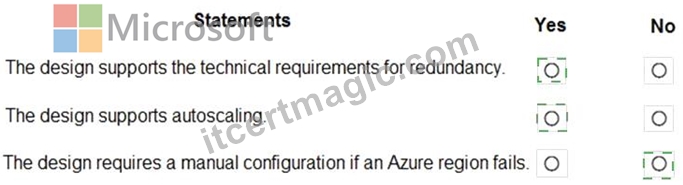
Explanation: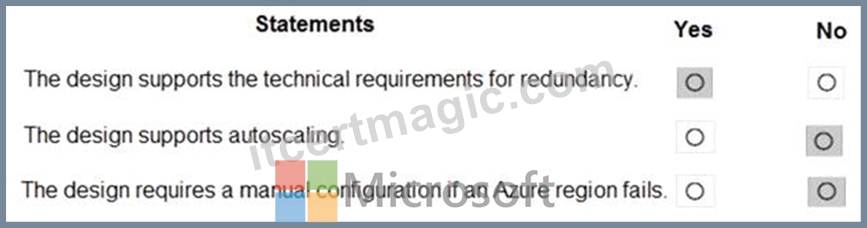
Box 1: Yes
Any new deployments to Azure must be redundant in case an Azure region fails.
Traffic Manager uses DNS to direct client requests to the most appropriate service endpoint based on a traffic-routing method and the health of the endpoints. An endpoint is any Internet-facing service hosted inside or outside of Azure. Traffic Manager provides a range of traffic-routing methods and endpoint monitoring options to suit different application needs and automatic failover models. Traffic Manager is resilient to failure, including the failure of an entire Azure region.
Box 2: Yes
Recent changes in Azure brought some significant changes in autoscaling options for Azure Web Apps (i.e.
Azure App Service to be precise as scaling happens on App Service plan level and has effect on all Web Apps running in that App Service plan).
Box 3: No
Traffic Manager provides a range of traffic-routing methods and endpoint monitoring options to suit different application needs and automatic failover models. Traffic Manager is resilient to failure, including the failure of an entire Azure region.
Reference:
https://docs.microsoft.com/en-us/azure/traffic-manager/traffic-manager-overview
https://blogs.msdn.microsoft.com/hsirtl/2017/07/03/autoscaling-azure-web-apps/
NEW QUESTION # 245
Your on-premises network contains a file server named Server1 that stores 500 GB of data.
You need to use Azure Data Factory to copy the data from Server1 to Azure Storage.
You add a new data factory.
What should you do next? To answer, select the appropriate options in the answer area.
NOTE: Each correct selection is worth one point.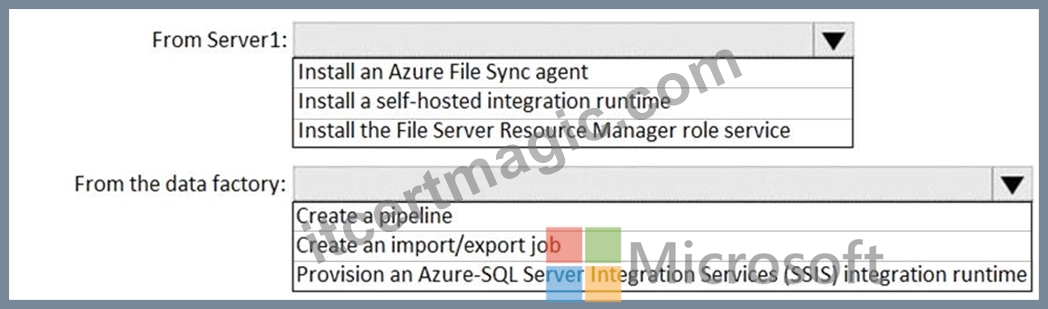
Answer:
Explanation: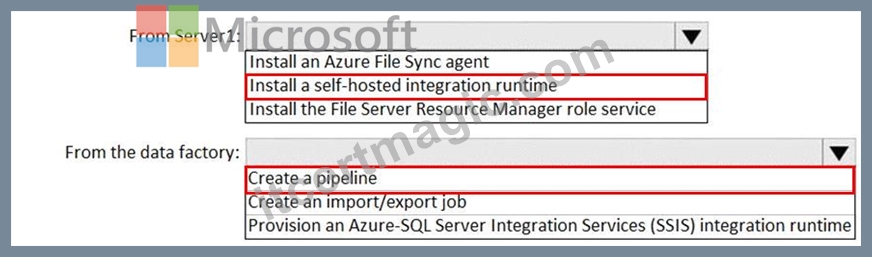
Reference:
https://docs.microsoft.com/en-us/azure/machine-learning/team-data-science-process/move-sql-azure-adf
NEW QUESTION # 246
You have an Azure web app named App1 and an Azure key vault named KV1.
App1 stores database connection strings in KV1.
App1 performs the following types of requests to KV1:
* Get
* List
* Wrap
* Delete
* Unwrap
* Backup
* Decrypt
* Encrypt
You are evaluating the continuity of service for App1.
You need to identify the following if the Azure region that hosts KV1 becomes unavailable:
* To where will KV1 fail over?
* During the failover, which request type will be unavailable?
What should you identify? To answer, select the appropriate options in the answer area.
NOTE: Each correct selection is worth one point.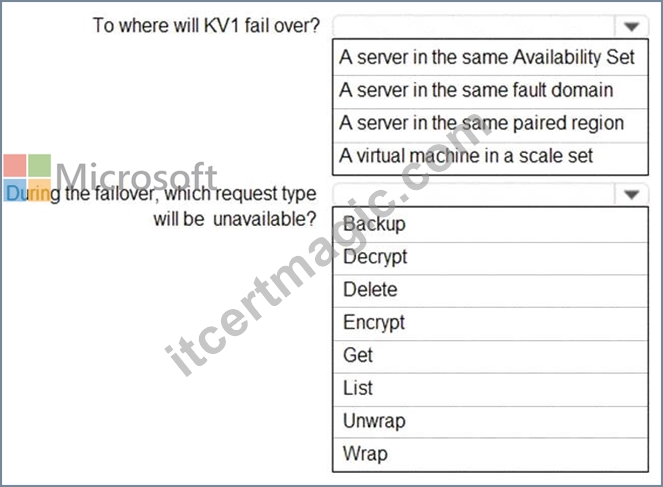
Answer:
Explanation: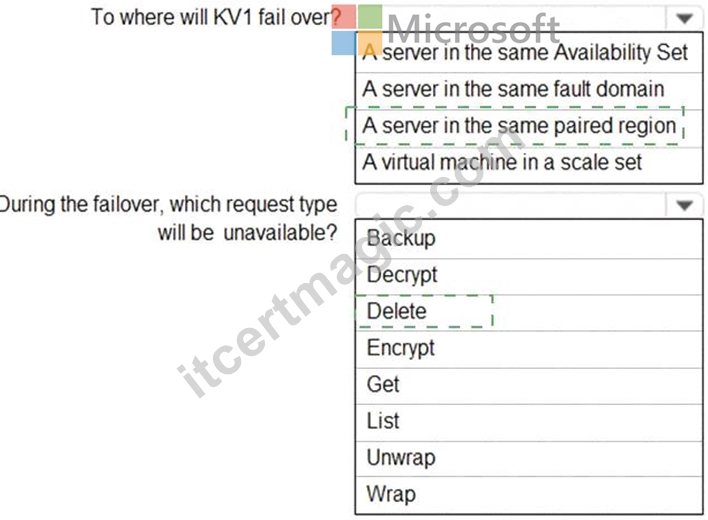
Explanation: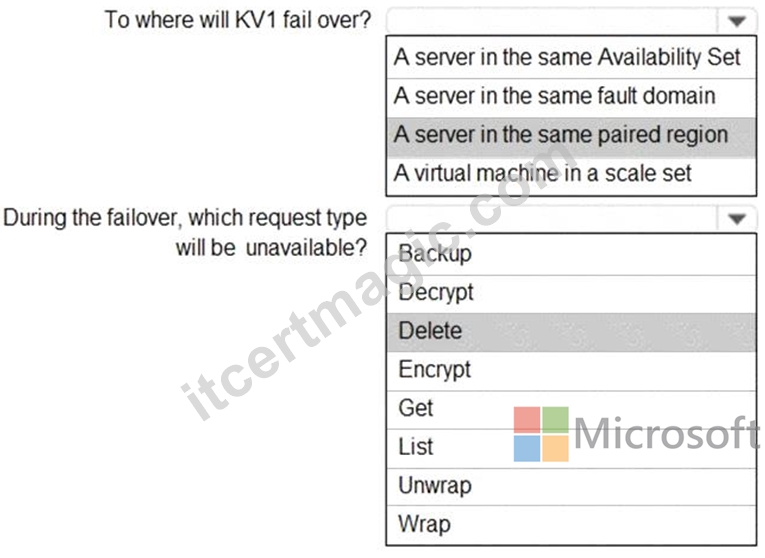
Box 1: A server in the same paired region
The contents of your key vault are replicated within the region and to a secondary region at least 150 miles away, but within the same geography to maintain high durability of your keys and secrets.
Box 2: Delete
During failover, your key vault is in read-only mode. Requests that are supported in this mode are:
* List certificates
* Get certificates
* List secrets
* Get secrets
* List keys
* Get (properties of) keys
* Encrypt
* Decrypt
* Wrap
* Unwrap
* Verify
* Sign
* Backup
Reference:
https://docs.microsoft.com/en-us/azure/key-vault/general/disaster-recovery-guidance
NEW QUESTION # 247
You plan provision to a High Performance Computing (HPC) cluster in Azure that will use a third-party scheduler.
You need to recommend a solution to provision and manage the HPC cluster node.
What should you include in the recommendation?
- A. Azure Automation
- B. Azure Lighthouse
- C. Azure CycleCloud
- D. Azure Purview
Answer: C
NEW QUESTION # 248
You have an Azure subscription.
You need to recommend a solution to provide developers with the ability to provision Azure virtual machines.
The solution must meet the following requirements:
* Only allow the creation of the virtual machines in specific regions.
* Only allow the creation of specific sizes of virtual machines.
What should you include in the recommendation?
- A. Azure Policy
- B. role-based access control (RBAC)
- C. Conditional Access policies
- D. Azure Resource Manager (ARM) templates
Answer: B
Explanation:
https://docs.microsoft.com/en-us/azure/governance/policy/tutorials/create-and-manage
https://docs.microsoft.com/en-us/azure/cloud-adoption-framework/manage/azure-server-management
/common-policies#restrict-vm-size
NEW QUESTION # 249
Case Study 1 - Litware
Existing Environment
Azure Environment
Litware has 10 Azure subscriptions that are linked to the Litware.com tenant and five Azure subscriptions that are linked to the dev.litware.com tenant. All the subscriptions are in an Enterprise Agreement (EA).
The litware.com tenant contains a custom Azure role-based access control (Azure RBAC) role named Role1 that grants the DataActions read permission to the blobs and files in Azure Storage.
On-Premises Environment
The on-premises network of Litware contains the resources shown in the following table.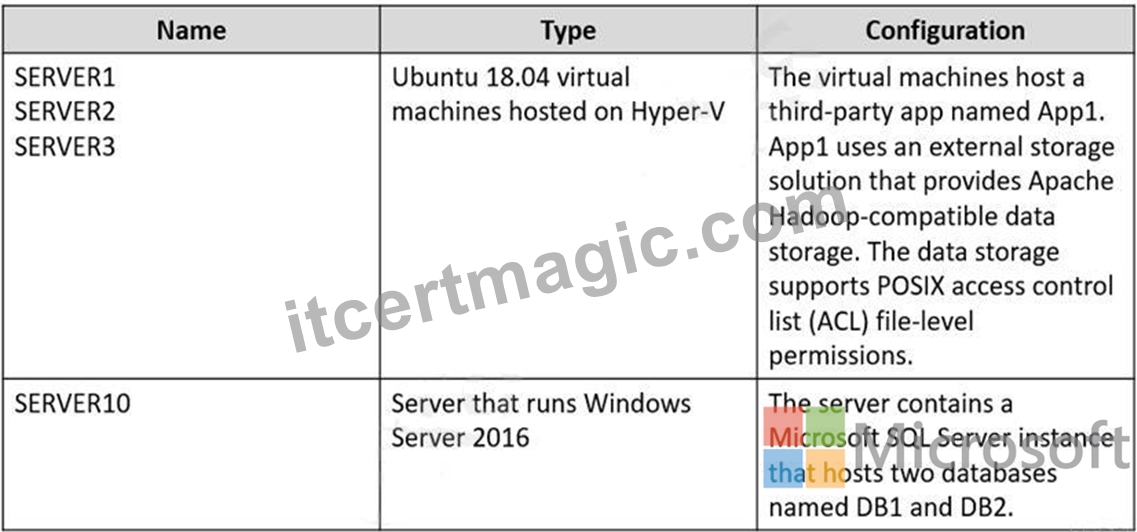
Network Environment
Litware has ExpressRoute connectivity to Azure.
Planned Changes and Requirements
Litware plans to implement the following changes:
* Migrate DB1 and DB2 to Azure.
* Migrate App1 to Azure virtual machines.
* Migrate the external storage used by App1 to Azure Storage.
* Deploy the Azure virtual machines that will host App1 to Azure dedicated hosts.
Authentication and Authorization Requirements
Litware identifies the following authentication and authorization requirements:
* Only users that manage the production environment by using the Azure portal must connect from a hybrid Azure AD-joined device and authenticate by using Azure Multi-Factor Authentication (MFA).
* The Network Contributor built-in RBAC role must be used to grant permissions to the network administrators for all the virtual networks in all the Azure subscriptions.
* To access the resources in Azure, App1 must use the managed identity of the virtual machines that will host the app.
* RBAC roles must be applied at the highest level possible.
Resiliency Requirements
Litware identifies the following resiliency requirements:
* Once migrated to Azure, DB1 and DB2 must meet the following requirements:
- Maintain availability if two availability zones in the local Azure region fail.
- Fail over automatically.
- Minimize I/O latency.
* App1 must meet the following requirements:
- Be hosted in an Azure region that supports availability zones.
- Be hosted on Azure virtual machines that support automatic scaling.
- Maintain availability if two availability zones in the local Azure region fail.
Security and Compliance Requirements
Litware identifies the following security and compliance requirements:
* Once App1 is migrated to Azure, you must ensure that new data can be written to the app, and the modification of new and existing data is prevented for a period of three years.
* On-premises users and services must be able to access the Azure Storage account that will host the data in App1.
* Access to the public endpoint of the Azure Storage account that will host the App1 data must be prevented.
* All Azure SQL databases in the production environment must have Transparent Data Encryption (TDE) enabled.
* App1 must NOT share physical hardware with other workloads.
Business Requirements
Litware identifies the following business requirements:
* Minimize administrative effort.
* Minimize costs.
After you migrate App1 to Azure, you need to enforce the data modification requirements to meet the security and compliance requirements.
What should you do?
- A. Implement Azure resource locks.
- B. Create Azure RBAC assignments.
- C. Create an access policy for the blob service.
- D. Modify the access level of the blob service.
Answer: C
Explanation:
Scenario: Once App1 is migrated to Azure, you must ensure that new data can be written to the app, and the modification of new and existing data is prevented for a period of three years.
Immutable storage for Azure Blob Storage enables users to store business-critical data in a WORM (Write Once, Read Many) state. While in a WORM state, data cannot be modified or deleted for a user-specified interval. By configuring immutability policies for blob data, you can protect your data from overwrites and deletes.
Reference:
https://docs.microsoft.com/en-us/azure/storage/blobs/immutable-storage-overview
NEW QUESTION # 250
You are evaluating whether to use Azure Traffic Manager and Azure Application Gateway to meet the connection requirements for App1.
What is the minimum numbers of instances required for each service? To answer, select the appropriate options in the answer area.
NOTE: Each correct selection is worth one point.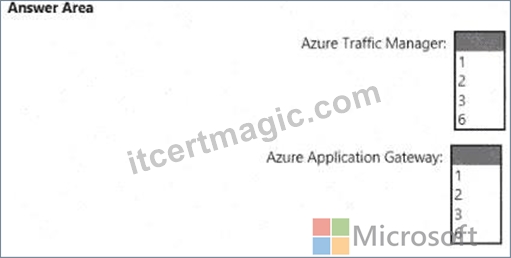
Answer:
Explanation: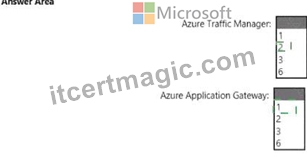
Explanation: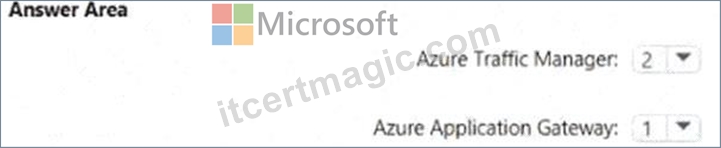
NEW QUESTION # 251
You plan to migrate on-premises Microsoft SQL Server databases to Azure.
You need to recommend a deployment and resiliency solution that meets the following requirements:
Supports user-initiated backups
Supports multiple automatically replicated instances across Azure regions Minimizes administrative effort to implement and maintain business continuity What should you recommendation? To answer, select the appropriate options in the answer area.
NOTE: Each correct selection is worth one point.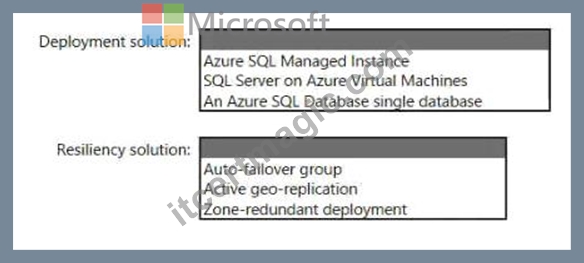
Answer:
Explanation: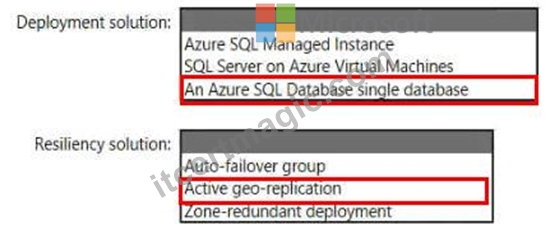
Reference:
https://docs.microsoft.com/en-us/azure/azure-sql/database/active-geo-replication-overview
NEW QUESTION # 252
Your on-premises network contains a file server named Server1 that stores 500 GB of data.
You need to use Azure Data Factory to copy the data from Server1 to Azure Storage.
You add a new data factory.
What should you do next? To answer, select the appropriate options in the answer area.
NOTE: Each correct selection is worth one point.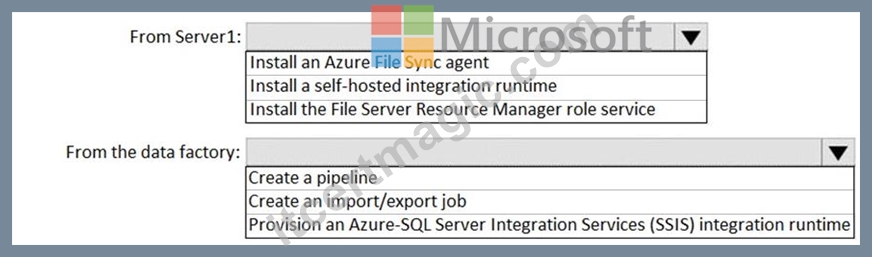
Answer:
Explanation: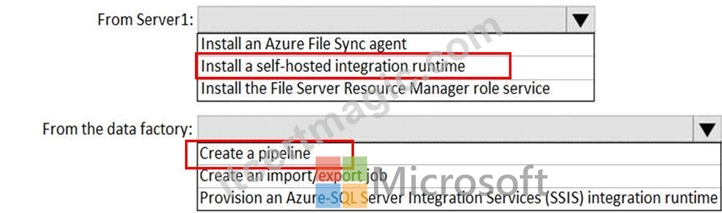
Reference:
https://docs.microsoft.com/en-us/azure/machine-learning/team-data-science-process/move-sql-azure-adf
NEW QUESTION # 253
You have a .NET web service named Service! that performs the following tasks:
* Reads and writes temporary files to the local file system.
* Writes to the Application event log.
You need to recommend a solution to host Service1 in Azure. The solution must meet the following requirements:
* Minimize maintenance overhead.
* Minimize costs.
What should you include in the recommendation?
- A. an Azure Functions app
- B. an Azure App Service web app
- C. an Azure virtual machine scale set
- D. an App Service Environment (ASE)
Answer: A
NEW QUESTION # 254
......
Resources From:
- 2026 Latest ITCertMagic AZ-305 Exam Dumps (PDF & Exam Engine) Free Share: https://www.itcertmagic.com/Microsoft/real-AZ-305-exam-prep-dumps.html
- 2026 Latest ITCertMagic AZ-305 PDF and AZ-305 Exam Dumps Free Share: https://drive.google.com/open?id=1Gyobp7AU1v3Bx9gsk9prNQg2oQiQwKzT
Free Resources from ITCertMagic, We Devoted to Helping You 100% Pass All Exams!